
Lake Worth’s “Our Town” Shows Your Town is My Town Too

Lake Worth Playhouse’s production of Thornton Wilder’s Our Town leans into the melancholy that makes the play endure. It is not sad in a showy or theatrical way. Instead, it captures the quiet desperation of the masses, the accumulation of moments that Frankenstein a life. This staging understands that Wilder meant the play to be honest. What emerges here is a gently depressing but deeply humane portrait of love, time, and loss. It succeeds because it lets the world of Grover’s Corners be as bare or full as a memory.

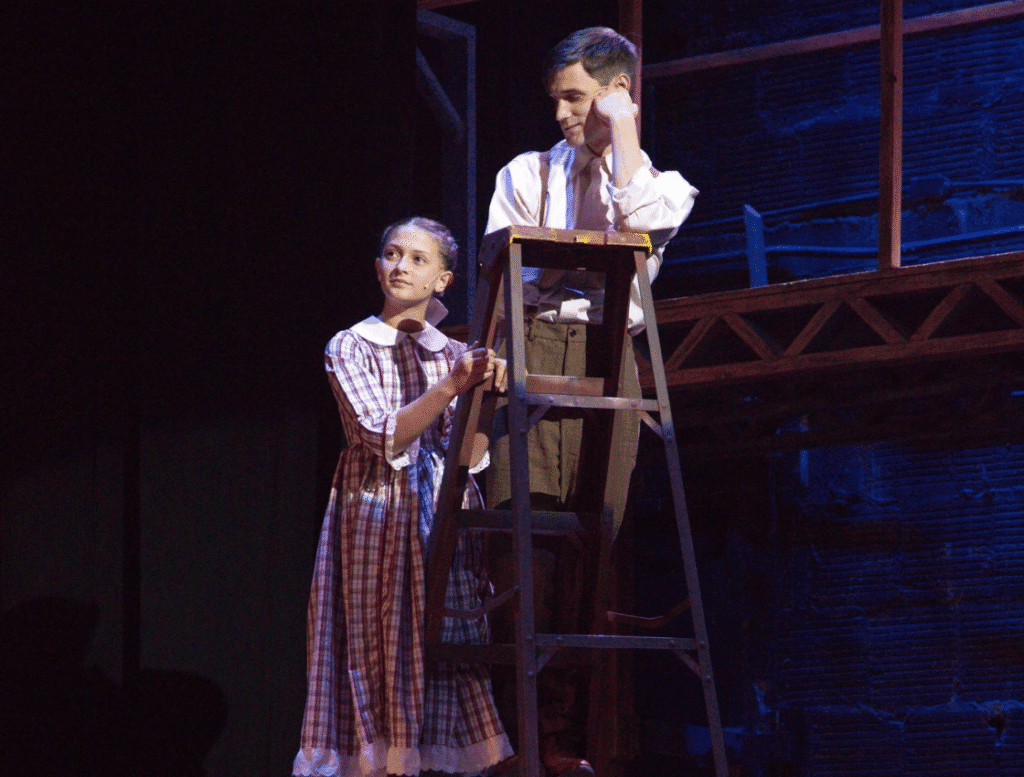
The production hinges on the Stage Manager, and Lake Worth Playhouse was fortunate to have a narrator who carried the entire experience. Played by Mike Schmidt, the Stage Manager becomes the gravitational center of the performance. Wilder’s script already places immense responsibility on this character, but this production heightens that effect. Every pause, every pacing choice, every shift in breath becomes part of the texture of the play. His moments of visible perspiration and the minor stumbles in delivery only strengthen the realism. Instead of breaking the theatrical illusion, they emphasize it. He is part guide, part observer, and part reminder that even when telling a story, humans reveal themselves. Schmidt’s interruptions in the first two acts are particularly sharp. He controls the flow of time. He stops scenes mid-gesture, redirects conversations, or propels the narrative forward with a simple sentence. These transitions are handled with a light touch, never rushed, and never indulgent. You feel him steering the audience, ushering them through the town’s schoolyard crushes and everyday chatter. In this production, he does not simply narrate time, he becomes time’s voice.

Credit to Olga Kark

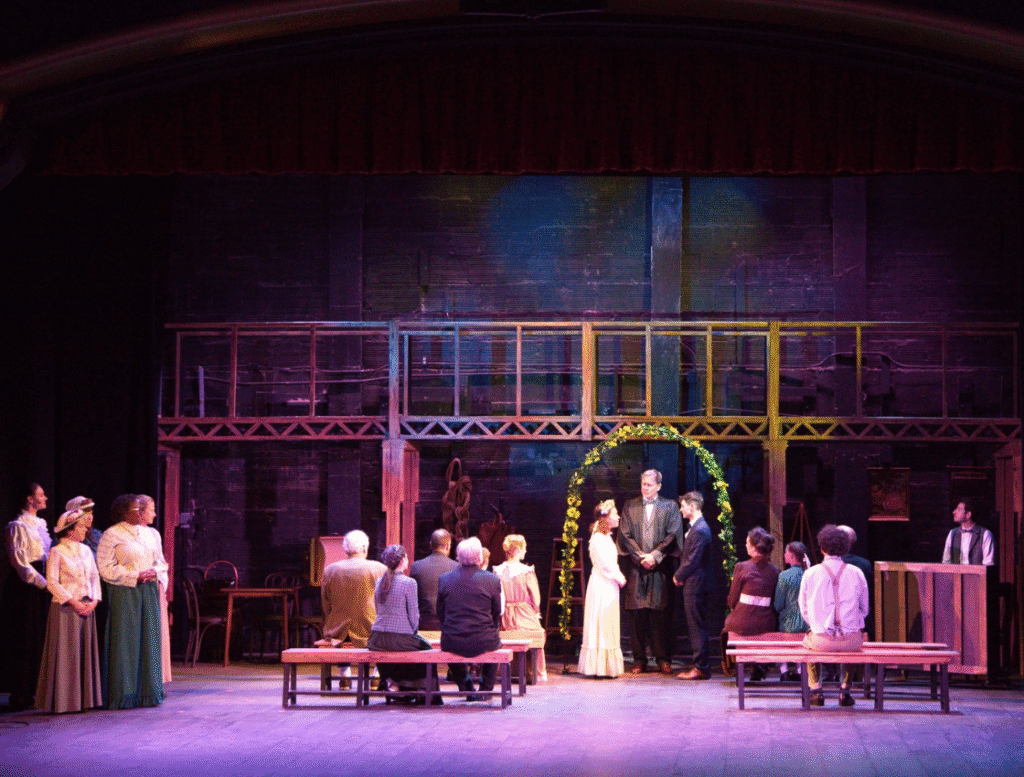
The supporting cast provides a strong backbone, even when the script demands restraint. Emily Webb, played by Clare Bawarski, resonates wholly and pays off most fully in the third act. George Gibbs, portrayed by Jonathan White, offers sincerity and humor that carries the second act’s courtship scenes. The Gibbs and Webb parents, played by Tom Hallett & Kathleen Shelton and Russell Kerr & Meg Westand, round out the domestic of Grover’s Corners. Director Daniel Eilola, who also serves as the nonprofit’s Artistic Director, keeps the cast moving. The choices are simple and effective. The most powerful section of this production is its third and final act, which contains such quiet force. The staging choice to arrange the dead in chairs is resonant in a waking way, imagining the dead to have their eyes locked on one place, as if only the future unironically lies ahead. I thought, what unusual thoughtfulness. Each chair becomes a marker of time and distance from the living world.

The production captures a central truth: the living rarely appreciate life while they have it, and the dead understand too late how precious everything was. What gives the third act its weight here is the balance between linear and circular time. The production leans into that duality. Schmidt guides the audience along a straight path, yet the repetition of daily rituals and the sameness of ordinary life hint at cycles we all inhabit. The dead sit still, but the living continue their routines. The past cannot be retrieved, yet it folds into the present, into memory, and into the future. 

Lake Worth Playhouse’s Our Town shows us that life can be small, but it still matters. Time moves, and we move with it. Their next production, Kiss Me Kate, premieres on Friday, January 16.

You may also like

Leave a Reply

Your email address will not be published. Required fields are marked *