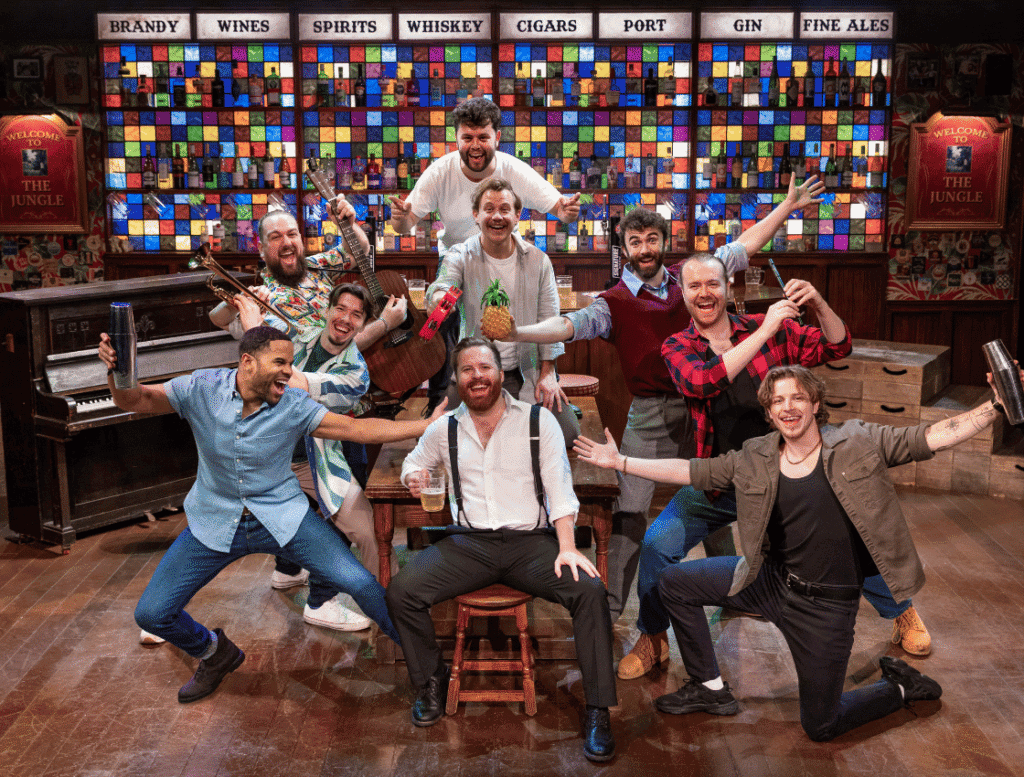
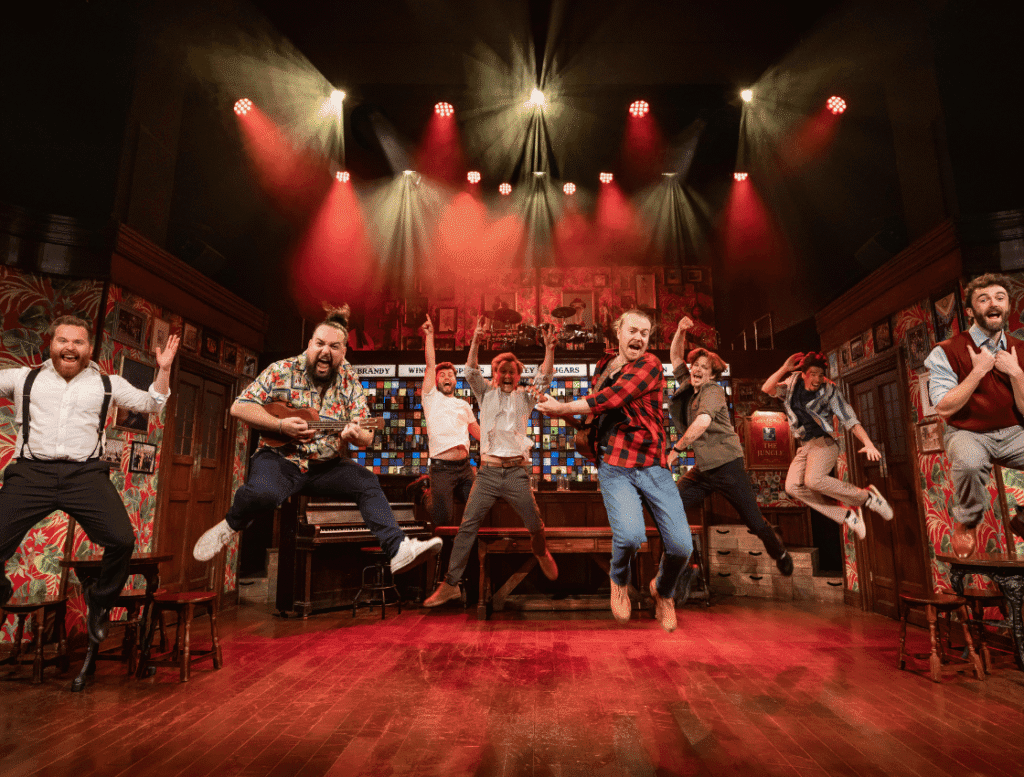
On December 23, The Choir of Man arrived at the Kravis Center as part of its official U.S. tour, transforming the Dreyfoos Hall stage into a working pub, inviting the audience to order a pint. Nine men gather in a bar, they drink, they sing, they tell stories, and they invite the audience into the ritual. Over the course of ninety-some minutes, the show presents a sequence of musical numbers drawn from rock, folk, and pop, each loosely anchored to one of the men, the Joker (Conor Mellor), the Hard Man (RJ Griffith), the Poet (Conor Hanley), the Bore (Lewis Bennett), the Romantic (Tristan Whincup), the Beast (Rob Godfrey), the Handyman (Adam Hilton), the Barman (Mark Loveday), and the Maestro (Lee O’Reily). There is no narrative arc in the traditional sense. Instead, the evening unfolds as a night at the pub would, with songs, banter, toasts, moments of vulnerability, and a collective closing number and last call.
That lack of plot is both the show’s defining feature and its most significant limitation. “The Choir of Man” does not pretend to be a book musical, nor does it aspire to psychological depth. What it offers instead is atmosphere. As a young Irishman who enjoys drinking and socializing, I found myself disarmed by how precisely the production seemed calibrated to my sensibilities. The watering hole as a sacred space, the blending of music (live or over-speakers) with personal confession, the way humor and sentimentality coexist, all of it felt familiar. It is easy to enjoy oneself in this environment, especially when the cast’s musical prowess is as formidable as it is here.
The show’s stated message centers on the idea of the “third place,” that social space beyond home and work where community is forged and sustained. This theme, articulated explicitly and implicitly throughout the evening, is larger and more generous than the drinking culture that frames it. Alcohol is present, sometimes excessively so, but it functions more as shorthand for communion than as an endorsement of excess. The bar becomes a modern hearth, a place where people who might otherwise remain isolated come together to sing, argue, joke, and grieve. When the production leans into this idea, it finds its most resonant moments.
Still, the allure of a bar with a choir only goes so far. Once the novelty settles, the structure reveals its limits. Each number is introduced as a kind of character showcase, yet the characters themselves remain archetypes rather than individuals. We meet the sad one, the funny one, the angry one, the romantic one, but we never see them change. There is no dramatic tension to propel the evening forward, only the accumulation of songs. For audience members who crave narrative progression, this can feel static. If you are not a fan of karaoke culture, the kind that thrives on enthusiastic participation and recognizable hits, this show may test your patience.
That impatience was visible in the house. With no intermission, the ninety-minute runtime is designed to feel brisk, yet several patrons exited before the finale. Their departure underscored a truth about “The Choir of Man.” You must be willing to accept the premise, surrender to the vibe, and let the music do the emotional work. Musically, however, the production is undeniably powerful. As the official launch of the U.S. tour, this performance showcased a company clearly selected for vocal strength and versatility. The power ballads land with precision, filling the hall with glorious sound. Harmonies are tight, solos are confident, and the band, integrated seamlessly into the action (Rafe Bradford, Ceasar Romero, & Scott Simon), maintains a propulsive energy throughout.