
American Jews – at least those within the Orthodox community I grew up in – are at least somewhat familiar with the story of Spain’s “conversos,” the forced conversion, in place of expulsion, of Spain’s (and later Portugal’s) Jews in the 14th and 15th century. But as continuous, widespread antisemitic atrocities occurred more recently (specifically ongoing pogroms in Eastern European culminating in the ultimate horror of the Holocaust), the Catholic church’s early efforts to safeguard Christianity – including the Holy Inquisition of 1478 to ensure new conversos were true Christians – often lay buried in the mists of time.
Many of Spain’s Jews preferred to convert (if in name only) rather than uproot their long-established lives, and took advantage of the even greater economic opportunities offered them as “Christians.” A good number of these conversos continued to observe their Jewish faith in secret. This further unnerved Catholic monarchs Ferdinand and Isabella who felt rather than solve their “Jewish problem,” they now thrived in ever greater numbers, while some still openly practiced their religion. The subsequent Alhambra Decree of 1492 was designed to expel these practicing Jews once and for all. But many decided to join Spain’s already large converso community rather than face an uncertain future.
By then, some 200,000 of Spain’s 300,000 Jews had converted, with more numbers trickling back from exile, and becoming conversos, in years to come. As it happens with secretive practices in isolation, many such converted Jews, having lost access to established Jewish education and community, eventually let go of or forgot their Jewish roots. Still there continue to be cases of Sephardic individuals and families who’ve held onto a few Judaic traditions for no reason they can identify. Nowadays, they tend to be seen as likely descendants of conversos or “conversas,” the Spanish feminine form for converted women.
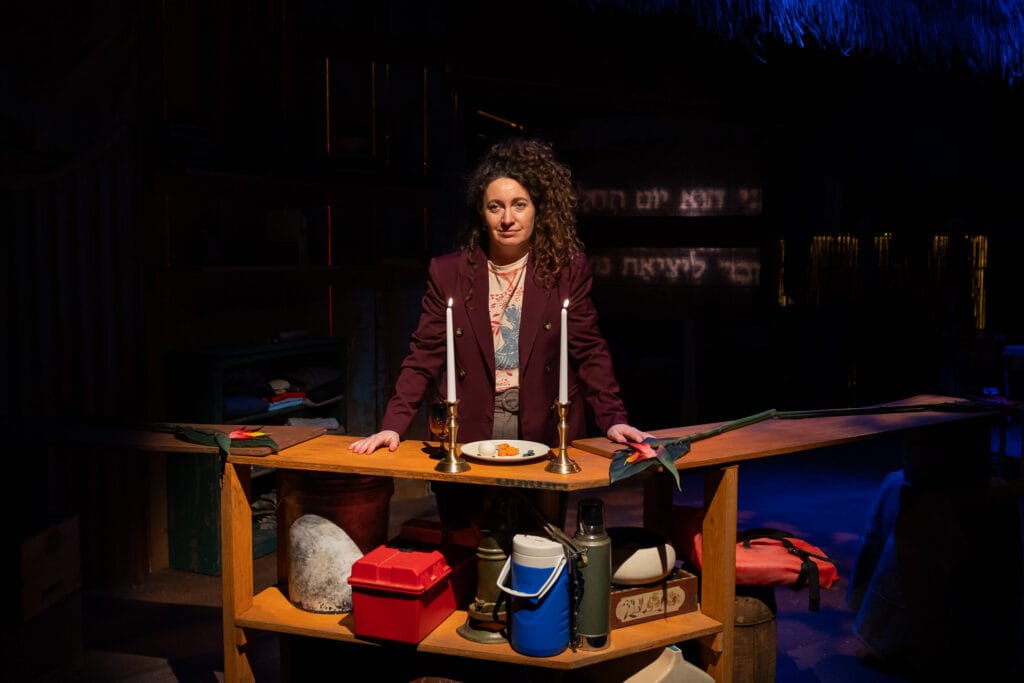
FAU Theatre Lab’s world premiere of CONVERSA – a one-woman show starring playwright/performer/sketch comedy artist/satirist (also an expert on the Jewish History of Spain) Joanna Castle Miller – examines her personal, highly emotional journey from a Southern Baptist upbringing, including work as a Christian missionary, to her inexplicable draw toward, and ultimate embrace of, her great grandfather’s Jewish faith.
Joanna’s research into her past takes her from discovering ancestors who hid their identity in a tiny Spanish village, to exile in various countries, dislocation as a refugee, and lingering prejudice against the “other.” So, while her story may be personal, her issues are universal and will especially resonate today, where most everyone’s interested in “finding their roots.” Not to mention the fact that much of our population is derived from forced migrations (for economic or discriminatory reasons), with people from all religions and backgrounds seeking refuge. The playwright notes that only ½ of 1 percent of the world’s refugees are ever resettled through official channels. And while black and brown people are called “migrants,” their white counterparts are referred to more positively as “ex-pats.”
The plight of the refugee couldn’t be more timely! And Joanna Castle Miller’s 90-minute (no intermission) passionate depiction of her personal journey couldn’t be more searing, compassionate, amusing, personable, and informative. Her nonstop monologue overflows with theatrical cleverness that shakes us up (in a good way) and purposely keeps us surprised, engaged, incredibly entertained, and at the edge of our seats throughout. All the while dispensing quite an education! Here gentiles can learn fascinating specifics about Jewish rituals and generational traumas while Jews and Christians alike may be shocked to discover the true, earth-shattering scope of the “Jews for Jesus” messianic movement, and its dark, hidden agenda. And would you believe Christians raise some $33 billion per year just to fund their missionary work?
When one starts investigating one’s origins with a list of “begats” that begins in the Bible, everything’s fair game and even ancient crises can be fodder for laughs. Get ready for a comedienne’s take on the ten plagues that led to the Hebrews’ exodus from Egypt, puppetry depicting the roles of King Ferdinand and Queen Isabella in the Spanish Inquisition, and a questioning 12-year-old’s view of “Big Box” religion.
Castle Miller comments that despite her mom’s original goal of becoming a rabbi, by the time she went away to college, fell in love and married a Christian (even if he’d agreed to a Jewish wedding), when her parents “begat” her, they were a solidly Southern Baptist family, fully committed to their evangelical 33,000-member megachurch. Joanna spent her youth solely consuming Church-authorized media, amassing collections of cheap Jesus trinkets … and being indoctrinated in missionary sales tactics to raise money for the church and convince others to join. At least in her case, the church’s brainwashing didn’t completely take. (She couldn’t bring herself to proselytize to strangers when her group of 12-year-olds were dispatched on their first mission – to a public park.) Sadly, however, her family’s conversion to Christianity did keep her mother estranged from her own Jewish mother, and so Joanna never got to know her grandmother.
Castle Miller’s comic and improv expertise shines throughout … alongside her humanity as she addresses us in an open, honest, “good friend” sort of way. She recites the Hebrew prayers traditionally, but also in a ludicrously Southern drawl during her brief stint among local Messianic Christians. The multi-faceted actress is adept at numerous accents which she employs to illustrate distinct characters – both in her family, and throughout history. Beginning with a brief, but grand, costumed entrance by none other than the Pope!
I was soon startled to discover a further talent that isn’t mentioned anywhere in the program. JOANNA CASTLE MILLER CAN SING! Many times, to convey a historical event in her backward-looking search for identity, Castle Miller will break out in a full-throated and perfectly accented song! She’s a forceful and highly emotive vocalist with perfect pitch and utilizes that gift, backed by musician/composer Paul Curtis’s spirited instrumental accompaniment, fairly often. Her musical numbers range from popular local tunes to haunting liturgical prayers.
In bringing her work to light, Castle Miller’s truly blessed to have found a believer in director Matt Stabile and Theatre Lab’s uniquely nurturing new play environment. As producing artistic director, Stabile is famous for his hands-on modus operandi and tireless work with playwrights to help refine and shape a new script to its best and most impactful form. Their combined efforts practically guarantee a successful debut and appreciative audience. And, yes, audiences and critics alike were deeply moved by Conversa, both in laughter and tears, while beingly blown away by Joanna’s powerful, multi-faceted performance.
A big part of that impact was also due to the inclusion of gifted songwriter/composer Paul Curtis of HolaHi onstage. His original compositions and one-man-band performances always enhanced the story’s atmosphere via bespoke musical interludes to instrumental accents in general. Featured instruments ranged from Spanish guitar to recorder, cello (for violin-like highs to low foreboding), keyboard, kazoo, and a detuned banjo with nylon strings – all employed to deepen the emotional depth of the narrative and bring us into the vibe of various locales.
Credit also goes to stage manager Carley Knotts and assistant stage manager Gianella Yanez Camino for their handling of the playwright’s non-stop action. (This was hardly a static one-woman show; it employed the entire stage, including the grand entrance from the rear of the audience by the Pope). His Holiness and various characters throughout were impressively or appropriately dressed by costume designer Dawn Shamburger.
who knew Moses’s interactions with the Almighty re his choice of plagues could
be so amusing?!! In this segment, Joanna Castle Miller’s comedic prowess is on full display. All photos by Morgan Sophia Photography.