
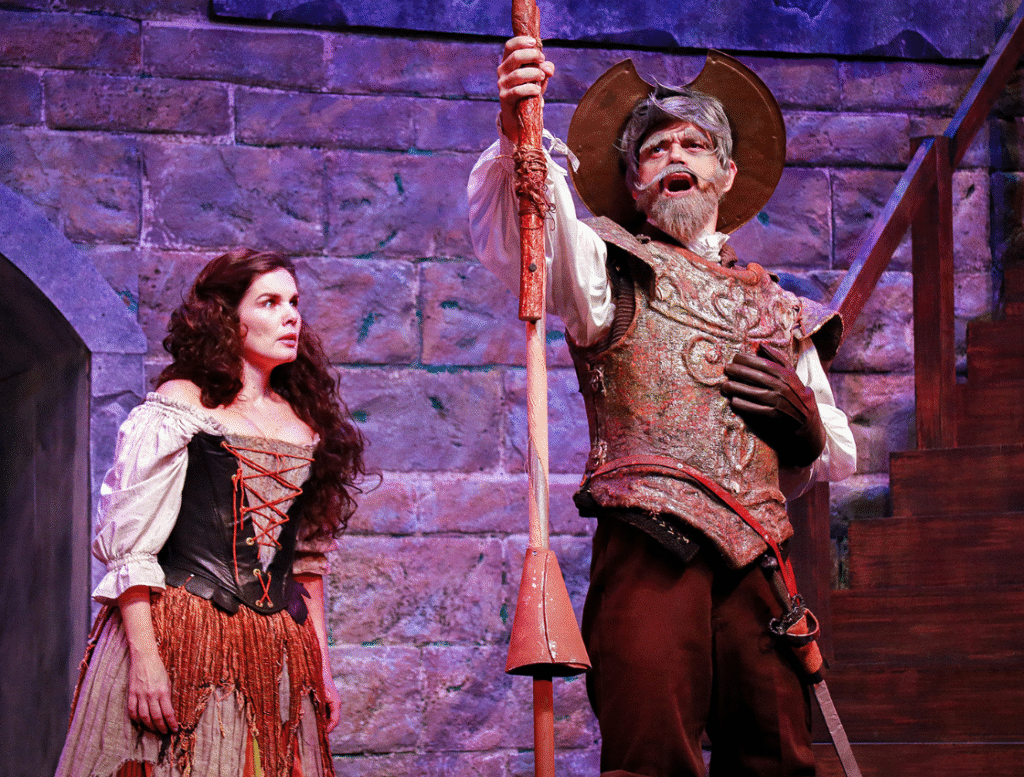
Aristotle’s quote, “No great mind has ever existed without a touch of madness,” seems right on the mark for Man of La Mancha, a story conceived by Miguel de Cervantes. What drives mankind to reach greatness: power, determination, perhaps even madness?
Miguel de Cervantes wrote Don Quixote in two parts: the first in 1605 and the second part in 1615.It is important to understand some background material to put the play in its proper perspective.
The main character is in prison awaiting trial by the tribunal of the Spanish Inquisition. He ferociously reads tales of chivalry, which may be the cause of living in a world of fantasy.
Cervantes quotes, “When life itself seems lunatic, who knows where madness lies? Perhaps to be too practical is madness. To surrender dreams, this may be madness; to seek treasure where there is only trash. Too much sanity may be madness! And maddest of all: to see life as it is and not as it should be!”
It appears to be a very reasonable concept for a very sensible author. Even in the 21st century, we question that perception every day, especially considering the chaotic and unjust world we live in today.
The play was turned into a Broadway musical in 1965. Written by Dale Wasserman, music by Mitch Leigh and lyrics by Joe Darion, Man of La Mancha won five Tony Awards including Best Musical. Because of its rich characters and play within a play format, it withstands the test of time brilliantly. That seems incredibly apparent since Actors Playhouse opened the original Miracle Theater with Man of La Mancha more than 30 years ago.
Act One of the show opens when Miguel de Cervantes and his trusty servant are imprisoned in a jail cell in 1597 in Seville, Spain, for crimes against the Inquisition. Here he meets his fellow rude and raucous cell mates. This unscrupulous group decides to hold their own “mock” trial, knowing full well the outcome, and providing these unsavories the opportunity to steal Cervantes’ belongings and his most prized possession, his manuscript. To protect his precious manuscript, Cervantes suggests reenacting his story.
He and his trusty servant reimagine themselves as Don Quixote and Sancho Panza and a miraculous transformation ensues. Additional cellmates join this fullhearted cast of characters but they still question his desperation and his mental stability. They set out in their glorious adventure as a knight and his loyal servant trying to right wrongs and discover chivalry. Here is where the play within the play begins.
Cervantes improvises his written tale in order to keep his precious manuscript and persuade his cellmates of his innocence. Sancho Panza is eager to participate in this charade.
Theater relies on the concept of suspension of disbelief. If we believe what we witness is real, then it is real. We readily accept horses cleverly choreographed trotting or drinking out of a water trough. What is also real is that audience members have all attempted something they deemed impossible at some point in their lives, which is why Quixote’s singing of “The Impossible Dream” resonates so deeply.
Don Quixote and his trusty companion take on the formidable task of fighting windmills, which Quixote claims are giants, but he fails miserably. On their travels, he and Sancho Panza venture into an inn he imagines as a castle. The inn is run by a husband and wife who will let any despicable hooligan stay as long as they can pay to drink, dine and stay the night. Here he meets Aldonza, a bawdy and promiscuous barmaid. Beauty is in the eye of the beholder and, to Don Quixote, he envisions Aldonza as a rare, innocent and delicate flower named “Dulcinea”. He attempts to return his “Dulcinea” back to her more refined and sophisticated glory days.
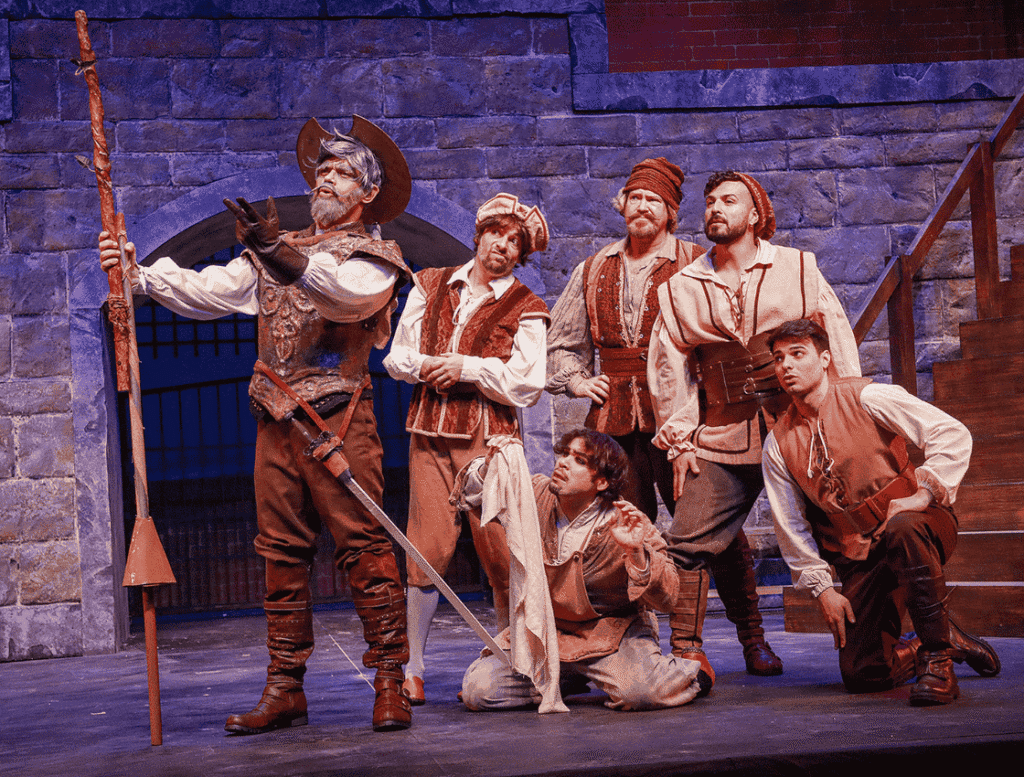
Act 1 closes when a simple barber arrives wearing a shaving bowl on his head to shield himself from the strong summer sun. Only Quixote can think this “golden helmet” is the perfect accessory for a knight to wear when he goes to battle the giants. Once again, the players are indulging him while questioning his sanity.
Act 2 begins with an encounter with some of the more raucous inn patrons, mostly muleteers. Quixote, through a comedy of errors, comes out victorious. His intention is to not only win his true love’s hand but to also become dubbed a knight for his courageous acts of chivalry. The innkeeper plays along by pretending to be the head of the castle, as opposed to his true position as owner of a rundown inn, and indeed dubs him “Knight of the Woeful Countenance”.
Quixote and Sancho Panza leave to celebrate but, unbeknownst to the two of them, the muleteers take out their frustrations by violently attacking and raping Aldonza. When Quixote reappears, he sees her tattered and ravished appearance. Despite his attempts to console her, she rebukes him and challenges his delusions of her being a refined lady.
Dr. Carrasco and the Padre both arrive at the inn to observe Quixote during his moments of delusion and to declare him mad. Aldonza also questions his sanity. To prove Quixote’s emotional instability, Dr. Carrasco disguises himself as the Knight of The Mirrors and forces Quixote to look at his reflection, only to reveal him as a shell of his former self: a senile old man. The shock of this revelation breaks his spirit and he succumbs to his deathbed. Aldonza takes on her Dulcinea persona briefly to help Quixote regain some semblance of chivalry, moments before his death.
Keep in mind, Man of La Mancha is cleverly a play within a play. Following the death of Don Quixote, the scene returns to the jail cell where Cervantes is being held. The prisoners, having found him to be innocent after the story he performs, return the manuscript to him. Moments later, Cervantes and his servant are taken away to face the accusations of the Inquisition tribunal. Inspired by his heroic tale, the prisoners sing a strong and haunting closing reprise of “The Impossible Dream”.
David Arisco selected the dream team for this production. K. April Soroko’s set was amazing. The ambiance of the jail cell/castle worked beautifully. Way more than functional, it set the overall tone and ambiance for the show. Eric Nelson’s lighting design was spectacular. Not only were the performers highlighted but shifting shafts of light created different areas where the story occurred, making it extremely effective to showcase scene changes. Reidar Sorenson, sound designer, added that hint of authenticity needed to portray a jail cell during the Spanish Inquisition. The opening of the iron gate, the squeaking of rusty hinges and the prison door opening and closing showed true attention to detail. Ellis Tillman did a wonderful job costuming these actors. His eye for color, fabric and visually depicting the story was spot on. His attention to detail, especially during the dance and fight scenes, helped establish the authenticity of the Spanish Inquisition. The simple but perfect transformation of Cervantes to Don Quixote was magical to watch by the audience. Lastly, the orchestra, under the direction of Bruce Barnes, was flawless. It was obvious these musicians played to their strengths, as the music they produced made them sound like a lot more than eight pieces. They could match with any touring or Broadway pit orchestra.
It was difficult to find flaws in this production. Once again, David Arisco cast an ensemble of actors that were beyond fault. Each actor portrayed his/her character with depth and integrity. Those individuals who showcased their individual voices during the show are to be applauded. Their vocal abilities truly set a very high standard. Not only did each one of them sing beautifully but their voices captured the essence of their particular moment in time. The three main characters, Miguel de Cervantes/Don Quixote, Sancho Panza and Aldonza, completely embodied their roles in both speaking and singing. The interpretation of “I’m Only Thinking of Him”, cheekily sung by inn workers and the Padre, portrayed by Lauren Horgan, Joline Mujica and Henry Gainza showcased flawless voices. Another vocal highlight was Aldonza, Sancho Panza and the innkeeper’s “Knight of the Woeful Countenance”, performed with care and strong tonal quality. Their singing and reactions provided some well-needed comic relief.
Man of La Mancha touches a deep chord with its audience. Whether this performance brings feeling of sadness, bewilderment or accomplishment – or all of the above – it certainly is thought-provoking. This was made possible due to the especially brilliant performances of E.L. Losada, Jose Luaces and Gaby Tortoledo, each in their own right trained professionals with star power.
E. L. Losada’s performance of Miguel de Cervantes/Don Quixote was beyond remarkable. His powerful singing voice, along with superb acting skills, enabled him to transform into the characters he portrayed, and is a credit to both his training and his innate talent. His version of “The Impossible Dream” as well as the title song, “Man of La Mancha”, displayed strength, passion and believability.
Jose Luaces made the perfect sidekick. His Sancho Panza showed his strong acting skills. Loyalty, friendship, compassion and understanding are all qualities for his character but there is a good chance he possesses them in real life, as well. His version of “I Like Him” was very believable and beautifully performed.

