The 1930s was a very special decade in theater history. It’s when Moss Hart & George S. Kaufman won the Pulitzer Prize for Drama for their Broadway comedy hit YOU CAN’T TAKE IT WITH YOU (adapted a year later into a Frank Capra film that won the Academy Award for Best Picture). In 1947, a group of theatrically minded volunteers first gathered at the Parish Hall of St. Paul’s Episcopal Church to launch what was then called “The Little Theater of Delray Beach.” With J. Stuart Warrington’s professional guidance, high standards were set from the onset and after years of fundraising, the Delray Beach Playhouse was built on Lake Ida to serve as a cultural hub and exceptional regional theater to this day.
So, I found it particularly heart-warming to see the company close its 79th season with such a charming and exciting “blast-from-the-past” production that showcases both the physical theater and its superior talent in the best possible light. For naysayers who might wonder if a 1930’s comedy, awards notwithstanding, can still amuse and feel relevant today, I’ll say outright: YES and YES! If, The Wolf of Wall Street, Succession and countless popular streaming dramas involving cut-throat business practices and family dynamics continue to resonate with the populace, then of course this play is relevant! Though I must add in its defense (and grant extra points for originality), Hart & Kaufman’s iteration reflects a far kinder and more humanistic vision of achieving the American dream.
The lovely traditional playhouse setting and its large stage also serve as the ideal canvas for creating Grandpa Vanderhof’s expansive New York City living/dining area – replete with elegant period furnishings, wallpaper and hangings capable of accommodating up to 19 actors at a time (all costumed appropriately by Penelope Williams). Kudos to scenic designer Kat Davis, master carpenter Jeff Davis and props designer Elizabeth Guerra. Old-time radio tunes as the show opens, like “Summertime and the Living is Easy,” set the tone as well. Along with the insanity of loud fireworks blasts from the basement, keeping sound board operator Johnathan Thompson, lighting designer Lowell Richard, and light board operator Matthew O’Hara very busy. But perhaps busiest of all was the guiding hand of the play’s exemplary director James A. Skiba who managed to keep the active – both verbally and often physically – highly skilled actors in their proper places, paces, and never missing a beat! My compliments also go to stage manager Bridget Linda Froemming, technical director/fight choreographer Jimmy Cartee and assistant technical director/deck manager Tanner Fults.

While the sitting room may look conventionally elegant, we’re immediately put on notice that its occupants are a bunch of eccentrics – family and permanent hangers-on who are fond of one another while accepting that each happily lives in a reality of their own making. Often found seated in his corner chair is master of the house Martin “Grandpa” Vanderhof who, despite major business success, 35 years ago decided to cold-turkey quit his high-stress, corporate finance job in order to simply enjoy life, which he does with gusto, surrounded by his mostly similarly inclined extended family.
Grandpa now cares for his pet snakes that tend to roam free, collects stamps, attends commencement ceremonies, and offers a supportive and compassionate ear to everyone he meets. He also has not paid taxes for the past 34 years, for which he has a “logical” explanation. The man’s good intentions appear to win blessings from on high. We might all wish for a grandpa like the one so beautifully portrayed here, with strength and love, by Bob Sharkey.
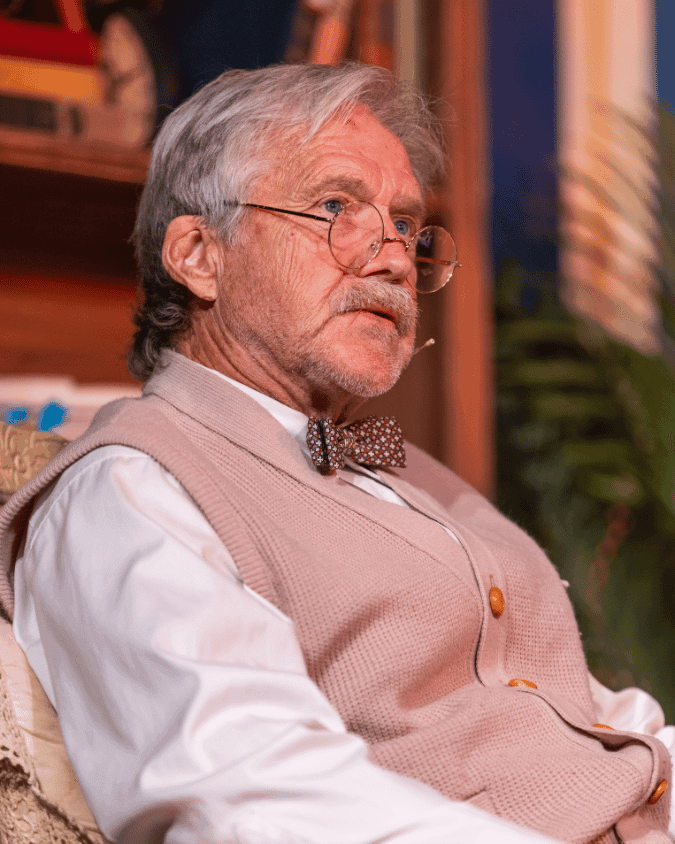
seated in the corner minding his pet snakes, but wisely intervenes when necessary.
He’s surrounded by the love of family members and extended household friends to
whom he imparts a special wisdom and unique take on what makes for a happy life
and family. If we ever need an example of goodness prevailing in the end, he’s our
man. Photo by Jerahmeel James.
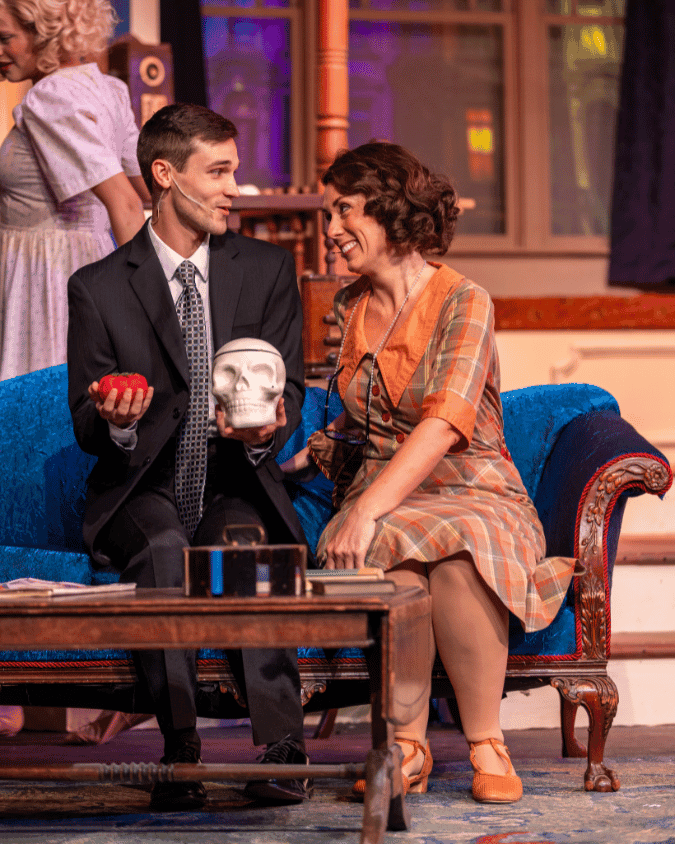
The first spotlight falls on Grandpa’s daughter, Penelope “Penny” Sycamore, an ever-aspiring playwright who’s busy pecking away at an old manual typewriter. She next holds up a skull and recites Shakespeare’s famous lines from Hamlet, “To be or not to be…” Then gives up, opens the skull and has some candy (yes, this skull is also a candy dish). Penny has been trying to write a play for the past eight years (well actually six, as “the first two were spent learning to type,” and she has quite a few drafts “in progress”). She’s also a portrait painter – when the whim strikes. Played to eccentric perfection by Kathleen Shelton, Penny’s also a highly tolerant wife and mother – especially when it comes to the idiosyncratic obsessions of her husband Paul Sycamore and their daughter, Essie.
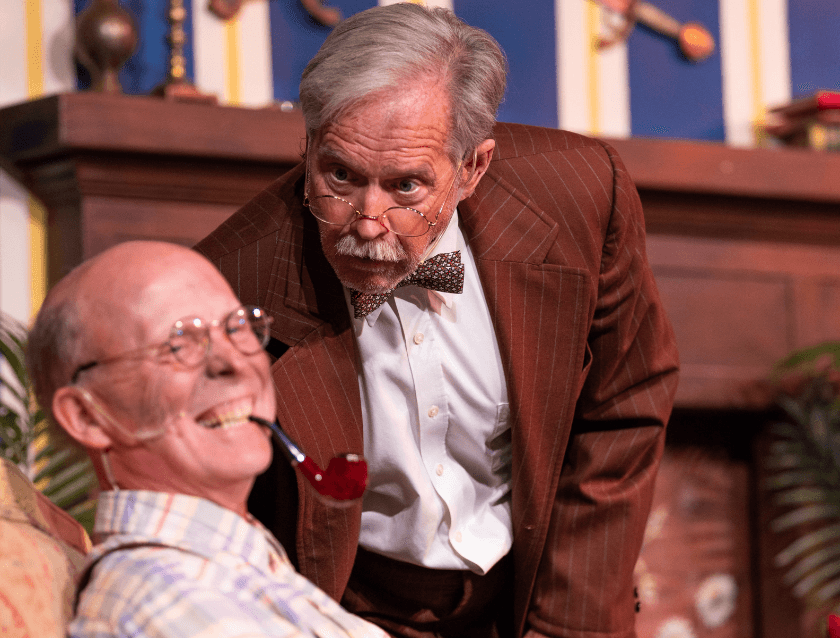
Husband Paul (John Hernandez) spends much of his time working on his fireworks business with his assistant Mr. De Pinna (Tom Hallett) who used to be the family’s iceman. They are seen arguing about the placement of a parachute for upcoming July 4th celebrations, wondering if it’s too close to the ignitor (it is!) and there are constant blasts from the downstairs basement, causing a picture to fall off its nail and be matter-of-factly rehung by whichever family member happens to be in the upstairs vicinity. I use the term “family” loosely as the maid/cook, handyman, and even constantly visiting dance instructor are all treated like family here. And might even join John Hernandez and Tom Hallett in serving up continuous helpings of verbal and slapstick shtick.
Meanwhile, Penny and Paul’s daughter Essie – a starry-eyed ballerina-wannabe who’s spent the past eight years pursuing her goal of becoming a ballet dancer which her Russian instructor acknowledges will never happen – continues to “practice” perfectly incompetent ballet positions, and dances for whoever’s around. Lili Mueller’s (who plays Essie) wide splits and unbalanced falls are impressive feats of physical agility. Essie also runs a candy-making enterprise out of the family kitchen, forever testing new variations that may not taste as delectable as they look.

When a possible beau arrives for a date and the next day asks for Essie’s hand in marriage, she says “yes” to cute but also clueless Ed Carmichael (Kole Rosin). Kole Rosin apparently has some talent on the xylophone and, as Ed, makes a perfect husband for Essie when he orchestrates simple background notes for her dances and plays “music” for other family members. Ed is also a hobbyist printer who’ll print whatever catches his eye. This includes naively inserting Communist phrases in his wife’s candy boxes which he distributes throughout the neighborhood. He also enjoys printing menus for family dinners.
Serving as the family cook and general housekeeper is good-hearted Rheba, played by Lenore Goldfeder, aided by her helper/handyman Donald (Joe Blecher). These two are sweet on each other, but Rheba dominates, often seen sending slow-moving, hunched-over Donald on shopping errands for last-minute kitchen supplies. Two more perfectly cast actors who, in their own idiosyncratic way, play a believable couple.
The play consists of three acts: Long Act I, a Wednesday evening at the Vanderhof home; mid-length Act II, a week later; followed by short Act III, which takes place the next day. Act I ends on a high note with the engagement of the play’s two most “normal” characters. The Sycamore’s younger daughter Alice (employed outside the house as a secretary) is dynamically played by Clare Bawarski. Alice finally accepts a proposal by her boss, handsome young VP and Wall Street banker-heir Tony Kirby, sensitively portrayed by Jonathan White. It takes some persuasion for Tony to convince Alice that her unusual family (whom she loves but also realizes are quite strange) need not present a roadblock to their union. In fact, he encourages her to invite him and his parents over to her house for dinner.