
An oft-cited attribute of live theater is its ability to transport audiences into the hearts, minds, and lived experiences of the actors. More than just opening a window into another place and time, when good actors fully embody their roles, they also viscerally invite us into their character’s very soul. At its highest altruistic level, theater can foster understanding and compassion for individuals who are different – whether culturally, socio-economically or, as in this case, biologically neurodivergent.
By now everyone’s heard of autism and is familiar with people “on the spectrum” – whether personally or through familiarity with celebrity high achievers (like Elon Musk) who are constantly in the news. We also recognize their problems with everyday social skills and the tendency to hyperfocus on a single subject, cornering anyone who shows even a modicum of interest with a lengthy, excruciatingly detailed recital of its history and merits.
But it took an extremely talented, award-winning young playwright who is autistic himself to “rip off the Band-Aid,” exposing the open wound, inner life of an autistic young man navigating the world we live in today. Like many with the syndrome who would be characterized as highly functional, the main character in LIGHT SWITCH by Dave Osmundsen is an intellectually brilliant academic success. In this case, the play’s protagonist, like the playwright, also realized from a young age that he’s a homosexual.
So it should come as no surprise that one of our premier LGBTQ+ oriented theater companies, Island City Stage in Wilton Manors, was eager to mount the Florida premiere of this groundbreaking contemporary comedy-drama. And because, as Island City’s artistic director Andy Rogow states, “The exploration of a young, autistic gay man’s quest to find love in a world that isn’t as romantic as the Victorian-era novels he is obsessed with is so heartfelt and engaging.”
I’ll add here that while Light Switch can at times be viewed as a rather humorous bildungsroman (coming-of-age story) focusing on a gay youth’s and later young adult’s search for love, I found it to be even more of a search for acceptance – of finding like-minded individuals one can relate to, and be seen and appreciated for being themselves. But most of all, by exposing how the main character’s autistic brain works – like a single “light switch” – we glean possible insights into the “why” of some socially divergent manifestations of ASD (Autism Spectrum Disorder).
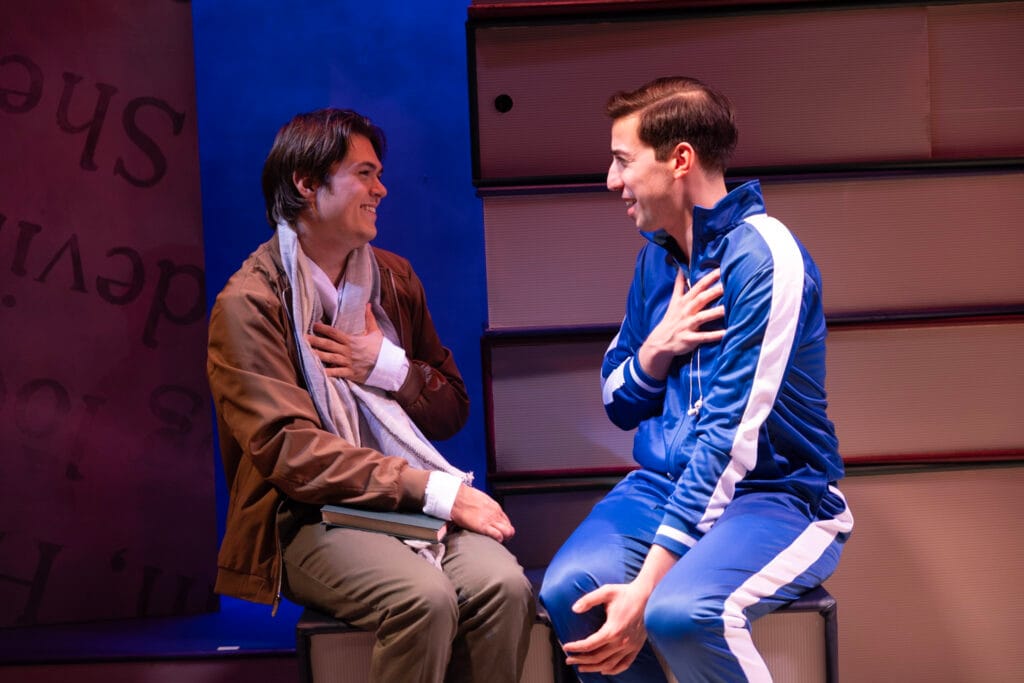
South Florida-based Gage Callenius plays central character, Henry – a fast-paced, emotional roller-coaster of a role – with such exemplary finesse that I overheard audience members wondering if he actually was autistic. Upon meeting a young man who finally talks to him like a person, and with whom he would later enjoy a first positive sexual experience, Henry explains how their liaison turned on his inner “light switch.” An exalted natural high that, up to that point, he’d only experienced reading 19th century romance novels by Emily Bronté and Jane Austen. Unlike other people who turn their lights on and off at will and are capable of shining light in many directions at once, Henry says, “I only have the ONE SWITCH; it’s either ‘on’ or everything’s black.”
It says a lot to think that Henry’s obsession of promoting his favorite Gothic romance novel, Wuthering Heights (of which he owns 19 copies and has read 57 times), might also be an altruistic attempt to get others to feel the blinding light “high” he gets from the literary experience of Heathcliff and Catherine’s all-consuming love affair.
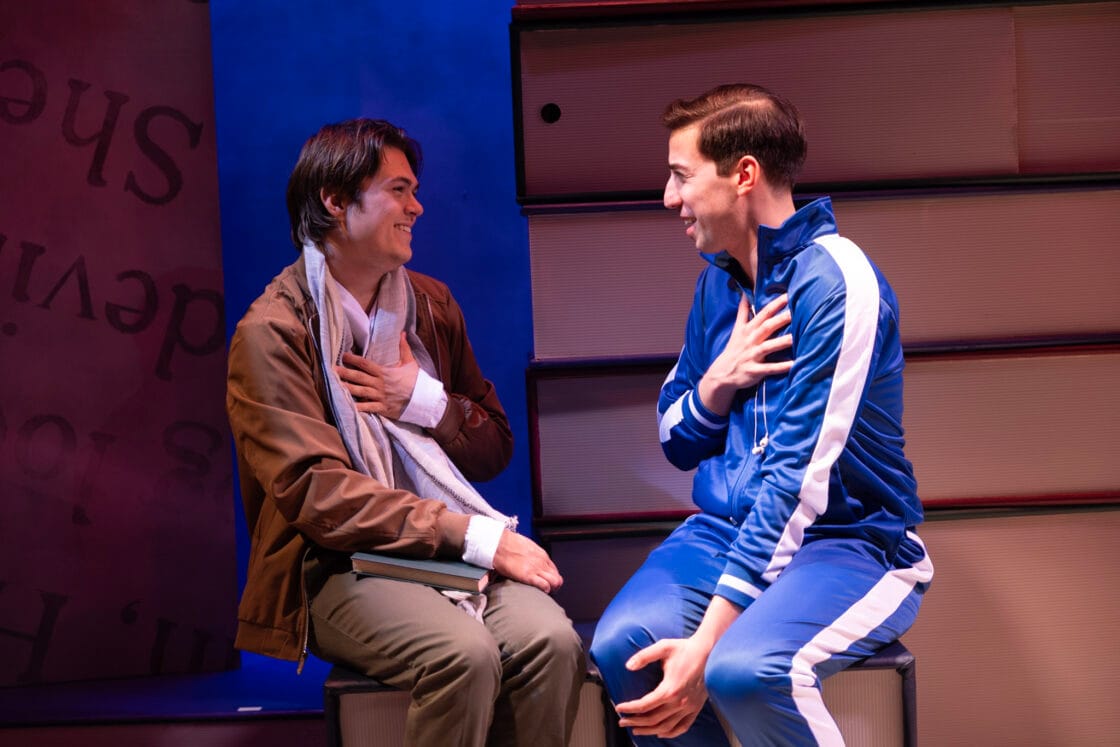
Henry is lucky to have met a true friend in his sophomore year of college who goes on to be his roommate throughout their years at university and then joins him in an NYC apartment. “Normal” gay Roggie is caring and supportive but suffers from obsessive relationship issues of his own. (Roggie is hopelessly in love with a callous, incorrigible player.)
Larry Toyter as Roggie plays the kind friend who accepts Henry’s quirks and especially enjoys having Henry read him to sleep from a Victorian or Regency-era novel when he stumbles home wasted after yet another night of nonstop partying. Roggie uses his experiences for a video channel featuring gay-scene dating advice. Surprised when Henry suddenly quotes one of his episodes, he encourages Henry to start a channel of his own, something like Literary Life on the Spectrum. When Roggie admits he envies Henry knowing what he wants while he still has no idea what he wants to do in life, Henry suggests: “You should be a gay male therapist.”
If you’re wondering why these two – who obviously like and accept one another and have been roommates for so long – don’t hook up sexually or romantically, Roggie always claims he doesn’t want to complicate their great roommate friendship. Interestingly, at the end, when reconciled after what Henry saw as a major betrayal, they do kiss, causing Henry to comment, “I don’t feel the light switch.” Roggie’s response: “You flipped a light switch in me. For YOU.”
An early scene in Act 1, date flash “Upstate New York August 2017,” shows Roggie annoyed at finding Henry in a downstairs library at a large gay party: “I brought you upstate to get laid – not by books, by humans!” he shouts. But Henry tends to judge people by the books in their house. He is happy to have met the house’s temporary resident owner, Joseph, saying, “He actually talked to me.” They had a light flirtation, and he’s eager to meet him again … but not enough to venture to more parties. Now completely focused on Joseph, Henry will not hear of going out to possibly connect with anyone else.

intimate encounter with Henry (Gage Callenius). Photo by Matthew Tippins.
Henry does, by accident, get a second chance with “player” or as he claims, “former player” Joseph, who reveals he has a younger brother who’s autistic and can’t speak but is also quite bright. Smartly played by Eric Gospodinoff, Joseph is a complex character who you don’t know whether to forgive or hate for his subsequent careless (or malicious?) behavior. He does, however, provide a “light switch” blissful sexual encounter for Henry who pushes a copy of Wuthering Heights on him afterwards. We next see Henry doing a Happy Dance and waking up wasted Roggie with the exciting news that not only did Joseph take the book, but he’d also left a note with his phone number.
Timeline date flash “New York City September 2017” opens to Henry speaking into his cellphone: “Hello Joseph. This is Henry. Fifteenth message I’ve left you this past month.”
We later learn these messages could run for half an hour while Henry explains parts of Wuthering Heights which, since Joseph took the book, Henry fully expects him to read and discuss within a few days. When Roggie can’t take Henry’s misery any longer, he visits Joseph, who says he hates feeling pressured and if he knew he’d be obligated to read a book, would never have had sex. Still Roggie implores him to at least get back to Henry out of kindness … I’ll simply say things do not go well for anyone in the aftermath. Although Joseph does end up with a real boyfriend in Ken, whose favorite book, ironically, is also Wuthering Heights. Luis Roberto Herrera does a fine job portraying often kicked out or waiting-in-the-wings, Ken.

emotionally by frustrated “friend” Aaron (Luis Herrera). Photo by Matthew
Tippins.
Herrera is also practically unrecognizable as Henry’s young playmate Aaron in the opening scene wherein he’s continually badgered to play Heathcliff to Henry’s Catherine while holding a ball and insisting he just wants to play kickball. Frustrated Aaron finally yells they need to play sports because “Everyone thinks we’re going out on dates!” Henry’s innocent response of “I love you Aaron because you are my best friend” makes Aaron lash out that he’s only playing with Henry cause his mom made him, knocks Henry down and calls him a nasty gay pejorative. We get the feeling that this sort of bullying by Henry’s peers is fairly common.
Luckily, Henry has a lifelong champion in his mom, Marian, dynamically portrayed by popular and critically acclaimed local Carbonell winner Irene Adjan. Marian’s surprised when her son not only “gets” but can also explain the movie based on Jane Austen’s Emma when he’s only eight and sits glued to the TV at their home in New Jersey. Henry’s mom had tried to get him acclimated to interacting with normal society by taking social cues classes, and is frustrated that he won’t even look up when she repeatedly calls his name.
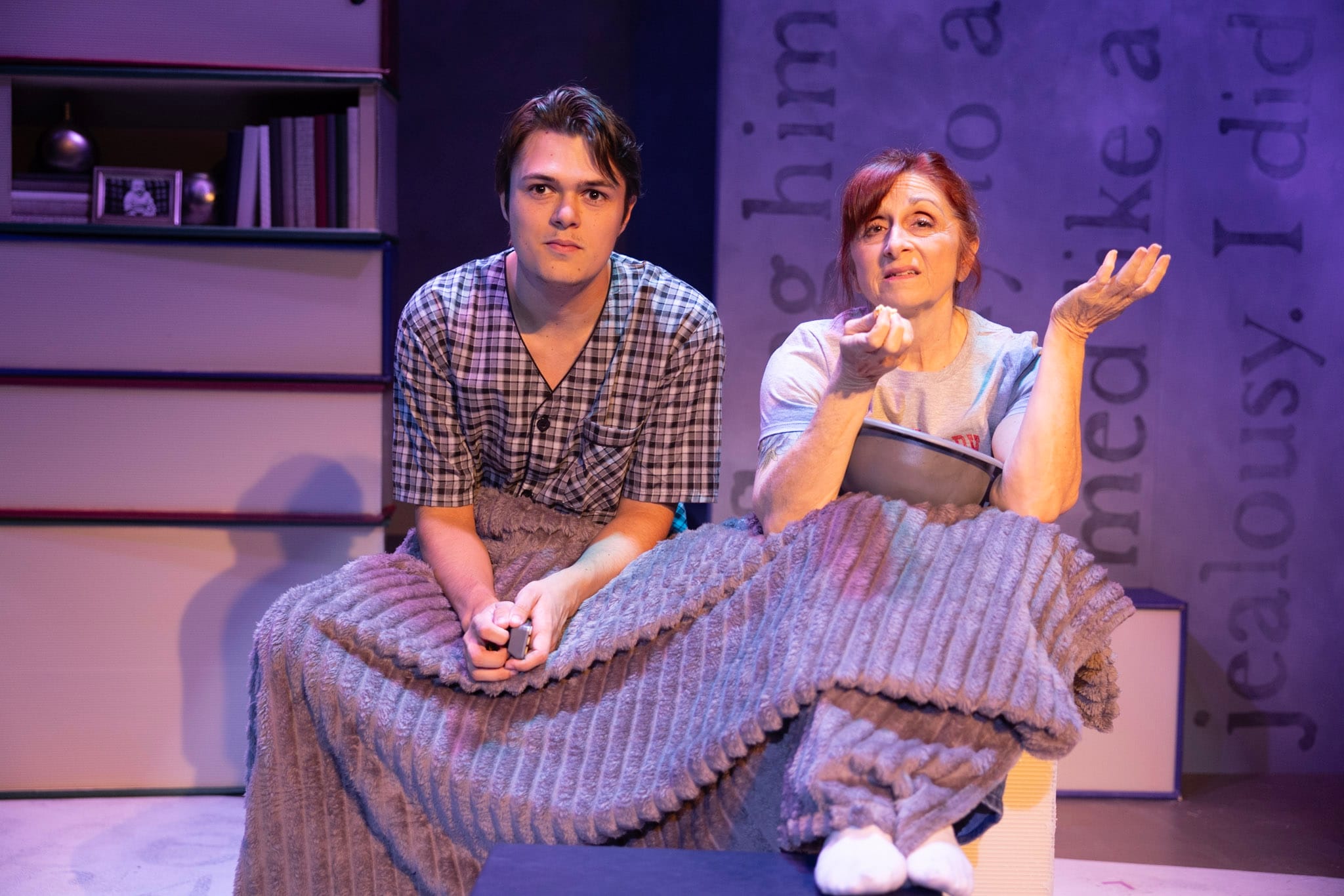
When at age 15 his mother asks why he insists on calling her “Mama,” Henry says that’s how she’d be addressed in the 1800s and he prefers speaking Victorian English. She worries when he next informs her that he’s a “homosexual,” as that adds yet another layer of social difficulty to his life. But she’ll continue to support her son no matter what, while wishing he wouldn’t look down on her for enjoying soap operas and categorizing most people as “imbeciles.” I assume all geniuses can’t help but look down on the rest of us in some way. Despite her parental and, frankly, human frustrations in getting through to Henry, mom always insists: “I love you and hope you find someone who loves you the way you deserve to be loved.”