
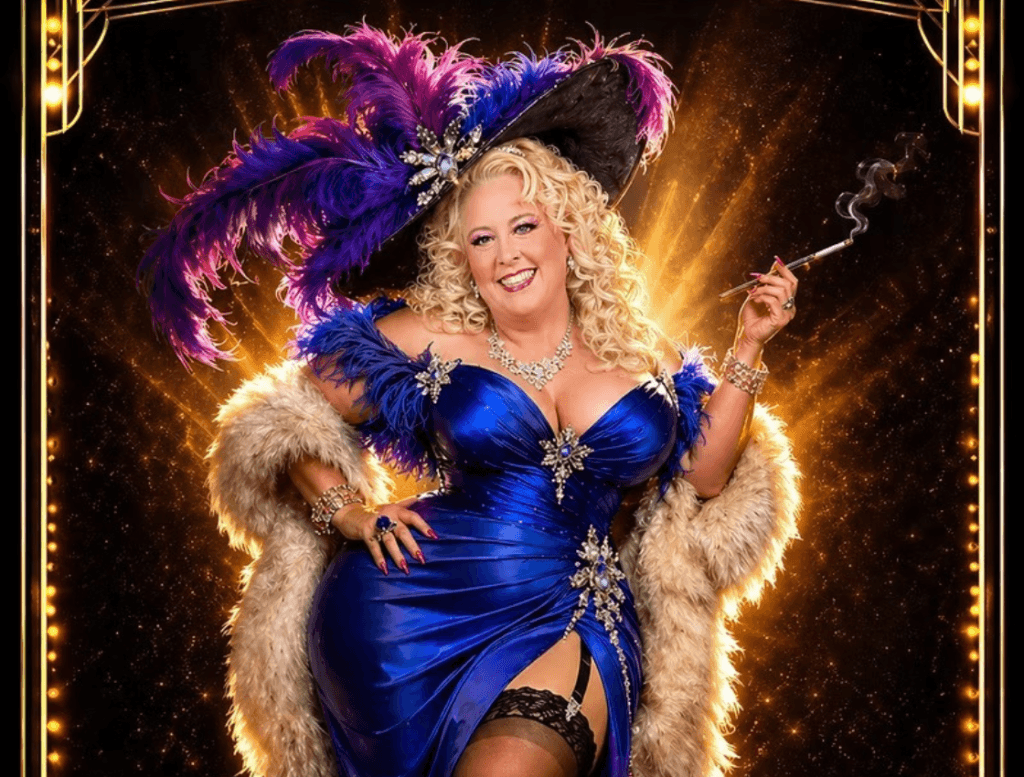
A World Premiere Now Playing at The Foundry
“Could of” … “Should of” …. Hollywood, CA, is littered with ghosts of missed opportunities and roads-not-traveled to stardom. If our own obsessively creative and talented local playwright Ronnie Larsen – also founding producer/artistic director of Plays of Wilton (POW!) at The Foundry in Wilton Manors – had decided to write a typical “alternative universe” story, he would have had Mae West say YES to the Oscar-winning role of Norma Desmond in Billy Wilder’s legendary noir movie, Sunset Boulevard.
After all, was she not the director’s first choice? Wilder, himself, said he’d co-written the black comedy skewering the studio system while focusing on an aging silent film star, discarded when “talkies” took over, specifically with Mae in mind. To the point of opening the film with a funeral for the star’s pet monkey! (Mae West was far from “silent” but she did own pet monkeys throughout her life.) Once she rejected the role, Wilder was heard to say, “What was I thinking?”
Wilder’s Hollywood exposé became a massive critical and popular success. Sunset Boulevard went on to win multiple awards and universal accolades. (It is still considered not only the number one, noir-style movie but also a major contender for best film of the 20th century.) The movie also bolstered the reputations of its two main actors, Gloria Swanson and William Holden, who won Academy Awards for their performances. But anyone who knows Mae West would realize, as she forcefully later points out in Ronnie’s version of events, that “Norma Desmond is like a cartoon.” “You want me to play a washed-up star with a pet monkey who thinks Joe Gillis is in love with her?” she mockingly asks Wilder’s emissary who’d arrived with the script and an offer of the starring role.
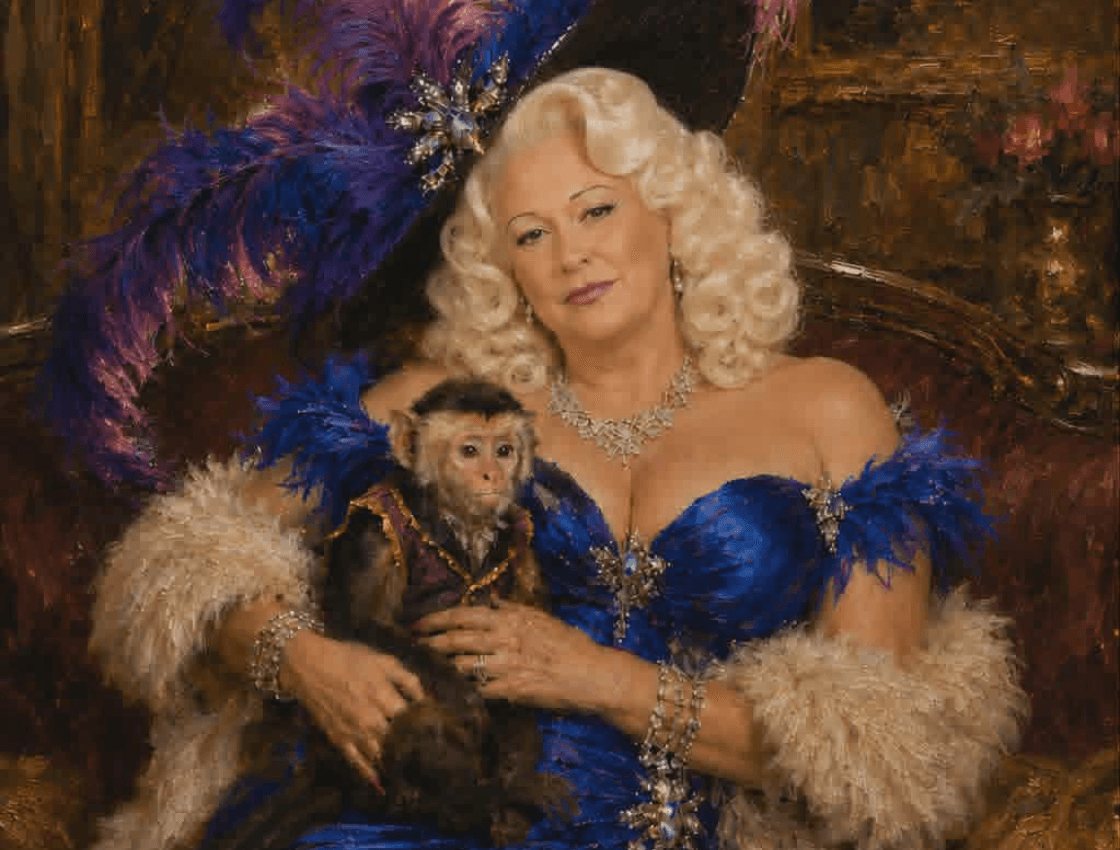
She goes so far as to call Wilder’s script “garbage” because the Mae West everyone’s come to love – even when no longer on the big screen and reduced to answering her own door – is still tough, blunt, and obnoxiously opinionated, not to mention very sexually alluring (in her mind, and still likely to others). She’s also aware of life’s harsh reality (mostly), not at all like desperate, delusional Norma Desmond. After spending years building a “take no prisoners” persona, Mae West refuses to see her carefully curated identity tarnished by this role.
So rather than give us a happy, alternate Oscar-winning reality for Mae, Ronnie digs deep into the actress’s feelings on how she came to her decision, followed by the emotional aftermath of anger, regret and repercussions. Then ends with a review of the incorrigible performer’s subsequent pursuits (with still some interesting surprises in store!). And when it came to his script, Mr. Larsen had far more luck than Mr. Wilder in procuring the leading lady he had in mind for the role from the start.
Ronnie Larsen wrote his play specifically with longtime local cabaret icon (and gay community favorite), Jennifer McClain, in mind. Sometimes one might think McClain is simply channeling Mae West – given her impromptu sassy dialog and those powerful vocals employed for cabaret and Broadway standards that have solidified her reputation as a Wilton Manors institution, hosting three cabaret shows a week. She’s also performed several times at The Foundry, though “Mae West” marks her Foundry debut in a full-length play. And she rocks every minute!
It doesn’t take much to get McClain as Mae to sing briefly or burst out in full-throated song like in a musical (though this isn’t technically one) to convey the emotions in a scene. Jennifer McClain is always met with raucous audience applause after belting out numbers from famous 1930’s Mae West movies. Like her powerful rendition of “I Like a Guy What Takes His Time” from the film She Done Him Wrong. Or the titular song to “I’m No Angel” from the pre-Code censorship era, along with “I Found a New Way to Go to Town.”
Rare for the times, but standard Mae West, that musical comedy featured an independent woman supporting herself as a burlesque dancer and lion tamer (now that’s really breaking the glass ceiling!) who must confront the most frightening reality of all, marriage and life as a socialite. The film includes signature line: “Well, it’s not the men in your life that counts, it’s the life in your men.”
Our play also showcases a song wherein even the most independent woman can become vulnerable to love when Mae sings, “I Want You I Need You.” Understandable, as in the movie she’s addressing young heartthrob Cary Grant. And in our play “somewhat younger” Seth Trucks, whose primary role as Billy Wilder’s emissary is to present Mae with a “Can of Beans” script – so named because it’s being sent to the studio in small stages to camouflage dark reality-based Sunset Boulevard from the censors.
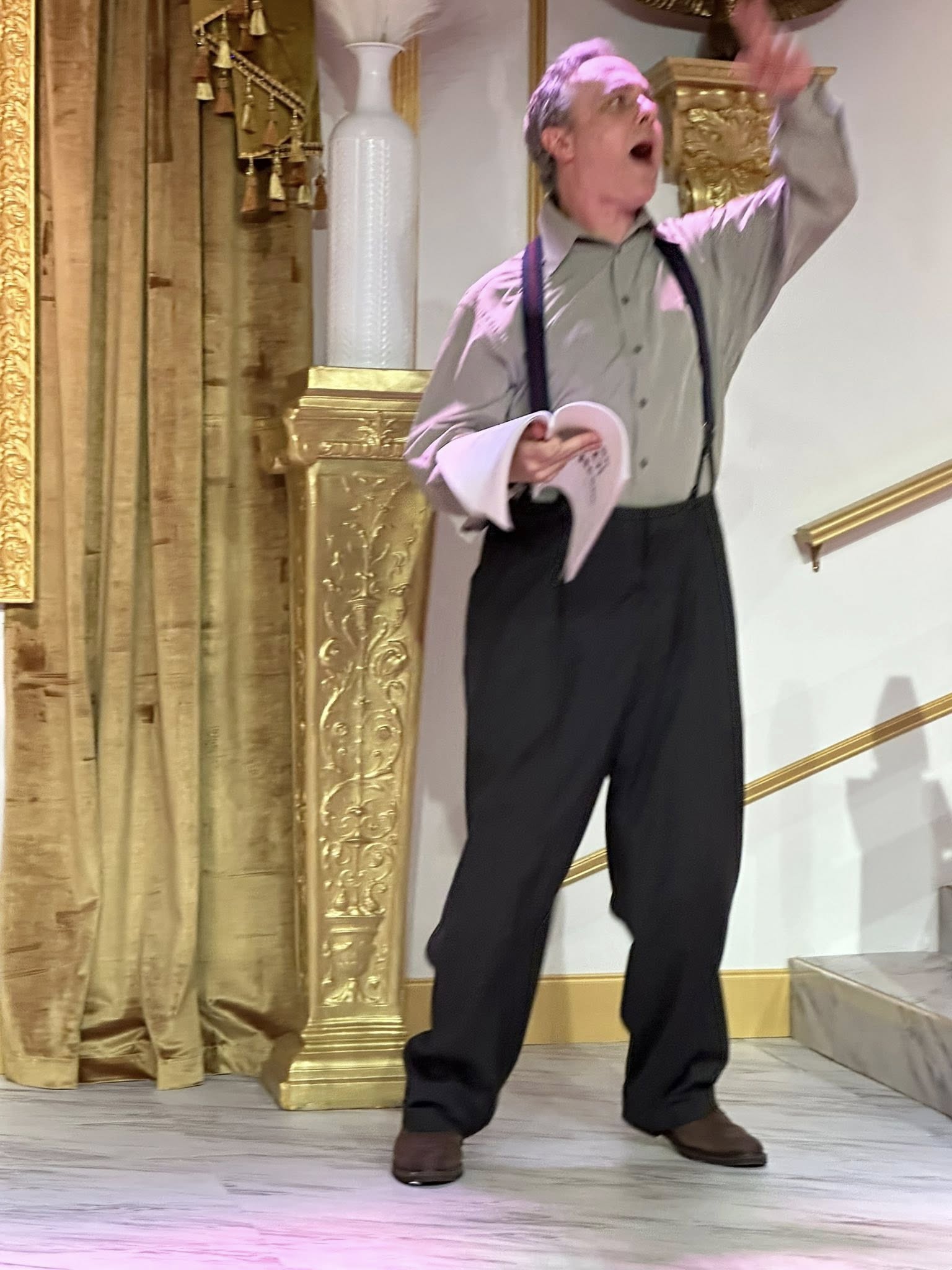
Seth Trucks as John Gordon is nothing like the Joe Gillis character in the movie – a jaded and exasperated scriptwriter who can’t get a break in a studio system notorious for its mistreatment of creative writers who form the backbone of their industry. Gillis ends up misleading aging screen star Norma Desmond by posing as a script doctor who can fix and sell the film script she’d written for her grand return. He then takes advantage of her feelings for him to move in and live a life of luxury, but ultimately feels disgust both for himself and the reality-challenged former star when he sinks into the role of gigolo.
In contrast, Seth Trucks plays a rather nervous, conservative, and inhibited man who, if anything, is completely surprised and intimidated by the famous star’s reactions to him. John’s personality is a direct opposite of Mae’s. At first, he’s like a scared rabbit who can’t wait to leave the script and flee the scene. But she, being Mae West, can’t keep herself from playing games with his emotions, attempting to entice him through flirtation, intimidate him through domination – she insists on calling him “Randy” as she prefers that name to John – and even insults his masculinity and sexual identity when she announces: “I see a vegetable who’s really a fruit as no man, unless he’s gay, can resist me.” (It doesn’t seem to matter in the least, but I must add here that her stated age is 58.) “I consider Ravenswood (her home base) to be a haven for the homos,” she adds after questioning John about his personal life, why his wife is divorcing him and they stopped having sex. And then she orders him into the kitchen to make her a sandwich.
John comes and goes. There’s something about Mae that attracts and fascinates him, makes him feel challenged but also completely alive. And he rightly believes that the script for Sunset Boulevard is a great one and a singular opportunity for the aging actress. So we get to enjoy the great Seth Trucks in a fast-track comedy sketch of frantically reading both the Joe Gilllis role (in his normal voice) and a silly-sounding higher-pitched Norma Desmond while Mae West “listens” from somewhere behind a closed door.
This is but the first full-scene starring role of highly versatile Seth Trucks – an award-winning local actor who can always be counted on for exemplary performances in everything from haunted Shakespearean kings and nobles to Bard clowns. From emotion-laden roles in The Timekeepers and The Pillowman, and zany characters like Larry in Little Montgomery.
And here, with a quick suit change, wearing a straw hat and wielding a cigar (great costume design by Tim Bowman which, of course, includes Mae’s ostentatious gowns), we enjoy Seth Truck’s impressive cameo portrayal of W.C. Fields. Spouting sardonic one-liners as he stands spotlighted in front of the red curtain, he introduces Mae West, who happens to despise the man. As she explains: “I’m always disappointed meeting famous people. They are never who you want them to be. W.C. Fields was the worst.”
Regarding her budding relationship with John, when she turns down the script and he mentions how instead of just dropping it off, he’d now been there three hours, she simply says: “You are a very good sandwich maker.” He responds: “You are a very good Mae West.”
She next asks: “Do you think I’m Norma Desmond, and so it would be easy to play the part? Tell him we have nothing in common! Do you think because I live alone, have kept a monkey, haven’t done a movie in a while, I’m getting old, like younger men …”
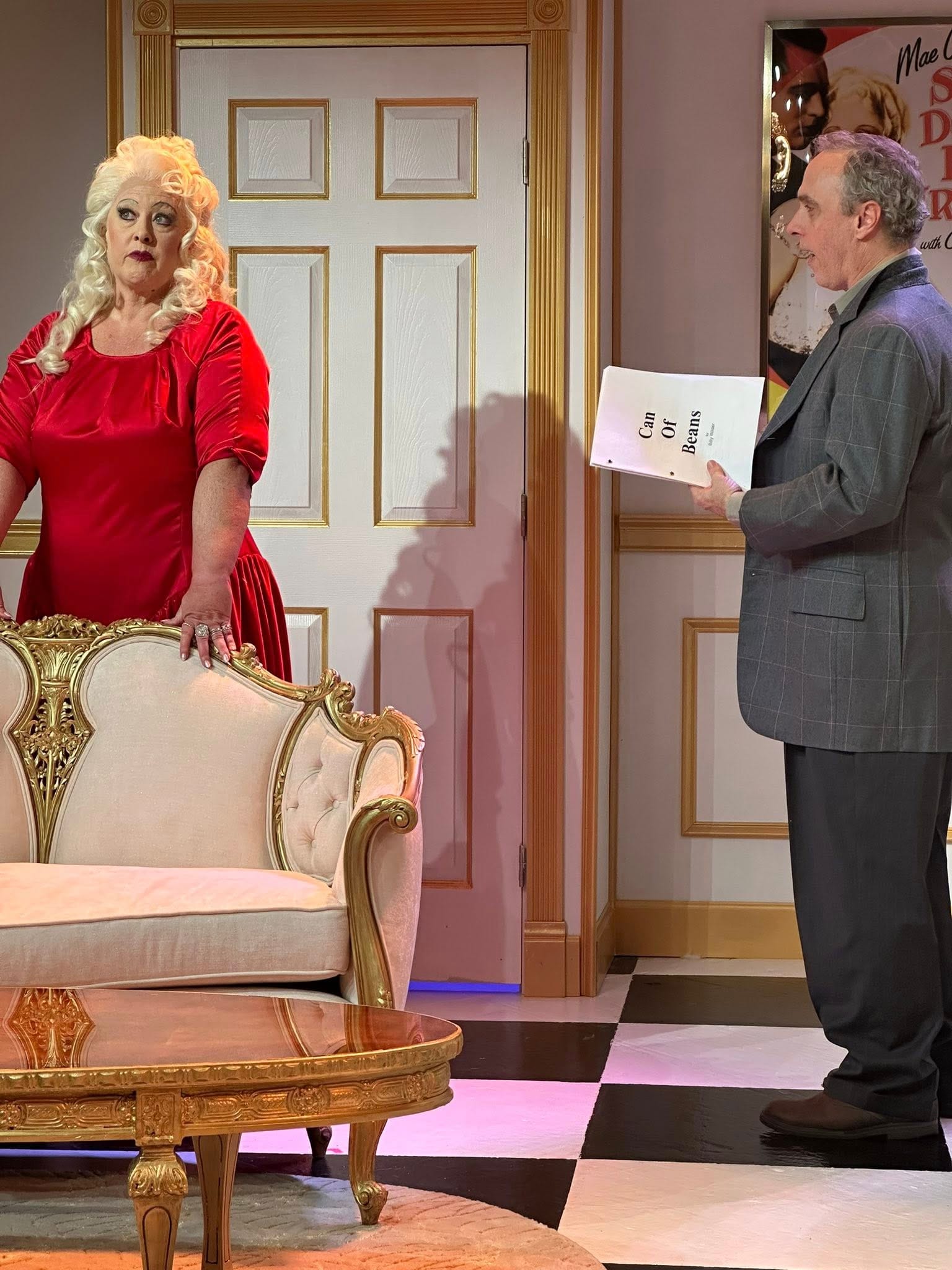
script-in-disguise for Sunset Boulevard offered by Billy Wilder’s emissary Seth Trucks as John Gordon.