When the producing artistic director of one of the premiere new play destinations in the country can’t get a new play he’d read years back out of his head – we can be assured it’s going to be a winner! I’m speaking, of course, of none other than Matt Stabile, the dynamic creative force behind Theatre Lab, the professional theatre company of Florida Atlantic University (FAU). And his latest new play production, which survived a Covid-era delay to arrive at just the right time for the right actors, designers and crew … not to mention coinciding with the year’s theme of exploration and seeing the world through another’s eyes. Stabile proudly presents THE CITY IN THE CITY IN THE CITY by Matthew Capodicasa as the opener of their 2025/26 MainStage Series (and the Lab’s 18th world premiere!).
Now that I’ve seen it, I must agree with Stabile, who also served as the play’s director, that this is a once-in-a-lifetime, adventure story experience. Jam-packed with mystery, intrigue, and surprise shockers (both external and internal), its visceral scenes will continue circling in your heart and mind for a long time to come. Much like the movements of its two award-winning actors, Niki Fridh (Laura) and Vaishnavi Sharma (Tess), who are seen circling within the fabled Mideastern/Slavic city-state of Mastavia (that’s both ancient and contemporary) on a time travel loop that never drops them back where they began.
But isn’t that what “travel” is supposed to do to a person – i.e. expand one’s outlook and change how you see yourself, others, life itself? Or as Stabile would say: “Experiencing what we know of ourselves and a place, and then seeing it as the other, can change what we know of ourselves and a place.”
Niki Fridh and Vaishnavi Sharma don’t only appear in their primary roles of Laura (Tess’s pretend mother) and Tess (Laura’s daughter on a mission to retrieve a package left by her estranged father), they also perform lightning-fast switches into 30 distinct characters. And we easily follow and believe – their physical agility and theatrical sleight-of-hand is that perfect! In Mastavia, they are both everyone and everywhere all at once, or as Fridh reflects, “The play is about kismet, adventure, and unexpected connection. With Sharma adding, “Stories are the lifeblood of how we communicate.”
These two lost souls do plenty of communicating, or at least attempting to, as both women, in their way, are at loose ends – unmoored from family, prospects and home. Tess’s mother, Laura, was an overspending recluse who lived in squalor a few blocks away from her daughter in Brooklyn. But Tess hadn’t spoken to her in eight years when she suddenly invites her to accompany her to Mastavia to retrieve a package left for them by her father, a man she never met and her mother never spoke about. They purchase two airline tickets in their names and secure a place to stay, but mom abruptly dies shortly before the flight.
Tess, who is afraid of flying but likely more afraid of navigating a strange land on her own, puts an ad on Craigslist for a woman with her mother’s exact name, so she can use her ticket to join her on a free trip to Mastavia. And we watch the first comic role-play switcheroos of weird applicants who line up to be interviewed by Tess for the prize. Fridh’s Laura with the exact last name comes last, and while she admits to a criminal record – “I was arrested two years ago for kidnapping my son” – she adds that her husband didn’t press charges when she took off to keep their then four-year-old safe from imaginary terrors, and the incident happened while they were getting a divorce.
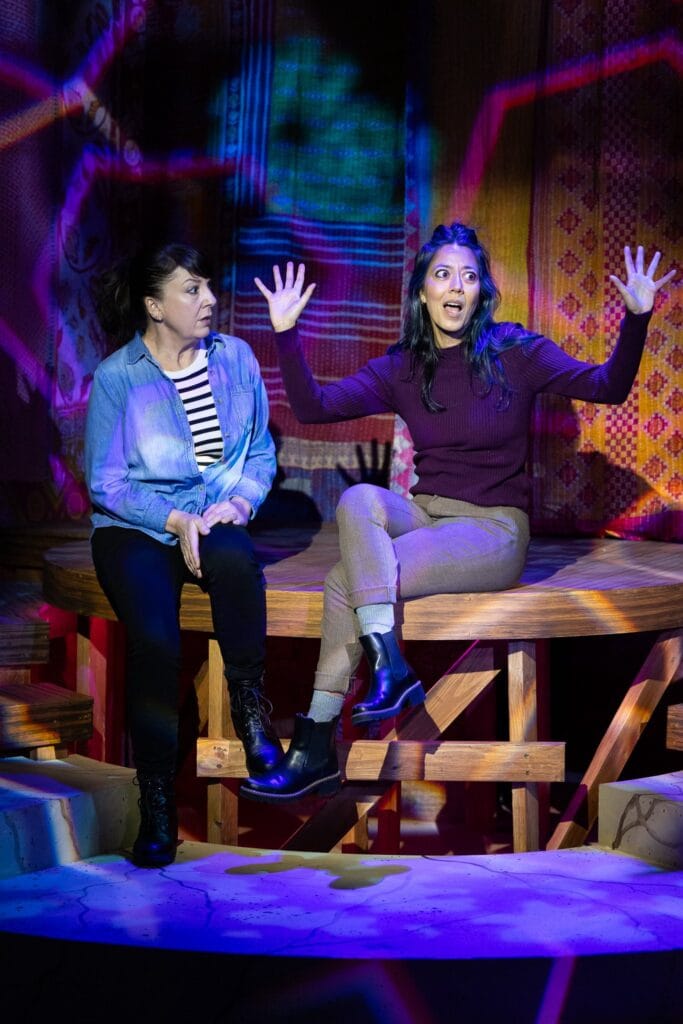
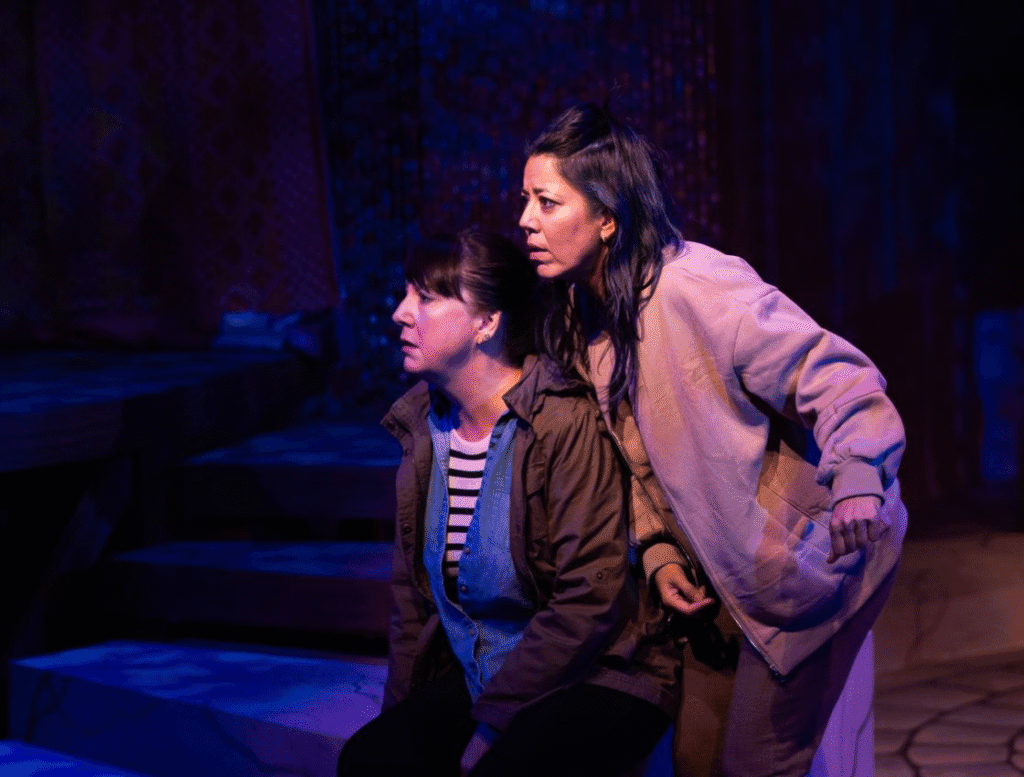
Sharma (Tess, with raised hands) attempt to assess their next move in the strange
and ancient city of Mastavia. Morgan Sophia Photography.
Laura thinks her confession is a dealbreaker and begins to leave, but Tess calls her back and asks her to be ready to fly with her the next day. There’s something about this Laura that Tess trusts (or maybe simply recognizes a kindred spirit in distress). Throughout their journey, they will both challenge and sympathize with one another, ultimately connecting on a deeper level and even acting as each other’s savior.
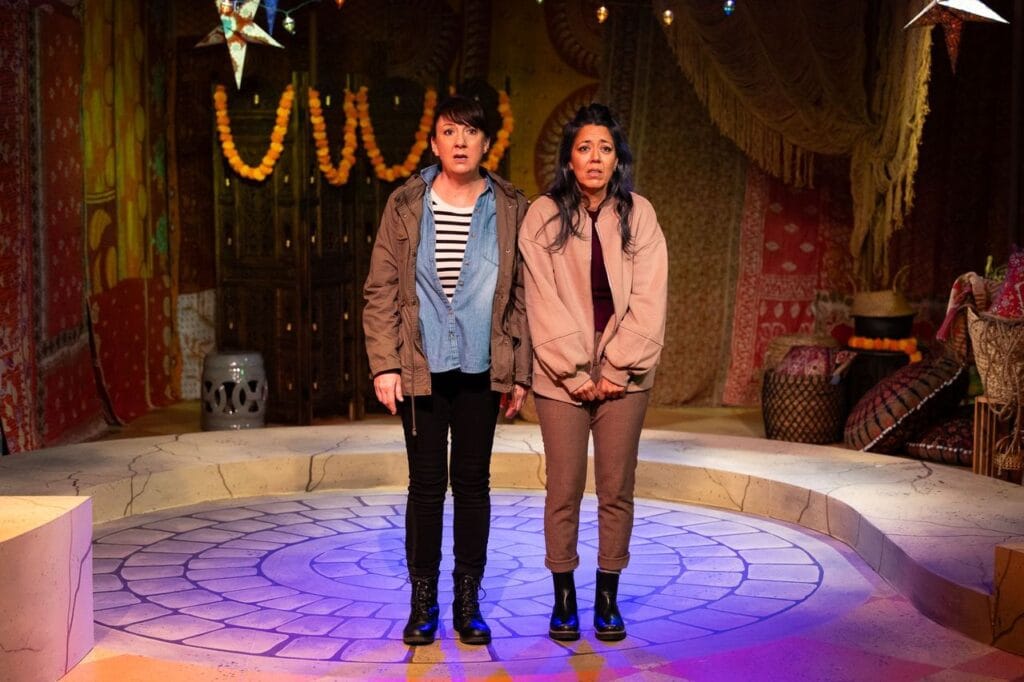
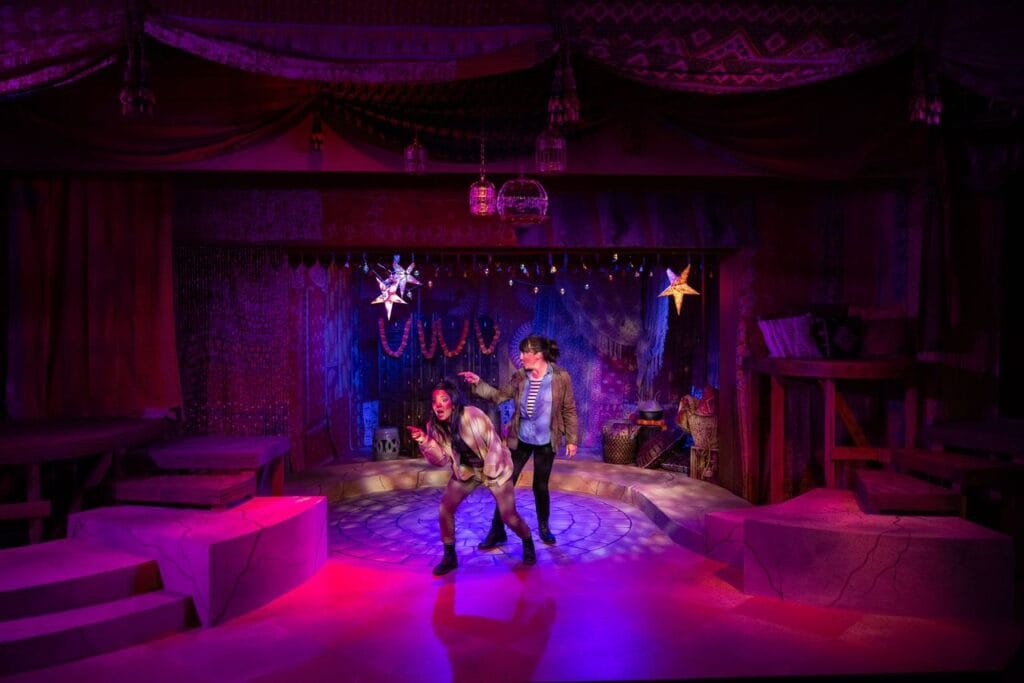
We, the audience, enter Mastavia from the second we step foot into the intimate, but suddenly expansive-looking theatre. We almost feel as if we, too, are onstage from the vantage point of whichever close-by stadium seat we occupy. For we’re completely surrounded by what I can only describe as a profuse, Moroccan-style bazaar of colorful tapestries, blankets, rugs and drapery which hang from backstage walls, on all sides, and behind us. The last time I felt immersed by such a colorful market atmosphere was many decades ago, while wandering the narrow cobblestone market streets of East Jerusalem’s busy shuk that lead to the Western Wall.
Here, we even find a well-stocked stand of fresh fruit at one corner, while an impressive display of ornate, Turkish-style ceramic plates fills the other. One can almost smell the scent of fresh spices for sale in the air. There’s also a wooden staircase (much ascended and descended with heaving difficulty by the actors) toward a small sleeping loft that holds the women’s single-bed accommodation. I advise coming a bit early so you can “tour” scenic designer Michael McClain’s remarkable stage set before the 100-minute, no intermission, show begins.
And there’s more! At center stage, beneath bright lit (at times) three-dimensional hanging stars, a circular cobblestone pathway gets much use, and incredible antique-looking brass chandeliers, both in globe and cylindrical forms, hang everywhere overhead. Lighting designer Tom Shorrock will make full use of these fixtures, as well as stage spotlights, while Matt Corey’s sound design adds proper musical notes and heightened drama. As for the myriads of colorful characters our two leading ladies portray within this set, we are mostly left to imagine their outfits (there would be absolutely no time for physical changes) so, other than occasional outerwear for the weather, costume designer Penny Koleos Williams dressed the actors in simple, modern tops and stretchy slacks for quick moves and maneuvers.
Through director Matt Stabile and stage manager Rose Figueroa’s expert guidance, and of course our two actors’ incredible talent, we “see” the dozens of extra characters they inhabit – whether for barely a minute or quite longer – completely formed in our imaginations. Some are comical, some threatening (or both), some mysterious, some very old, almost ghostly. From early on, the city-state of Mastavia – which features so strongly, it can be viewed as a third character – is described as “morbid,” a place where many people come to die. This most-conquered city built a 100-foot-high wall to keep out invaders, but when it became too difficult to enter the inner city, a mercantile outer ring grew around it, a “New Mastavia” of vendors and eventual settlers, and then another ring circled that one as well, ergo “the city in the city in the city.”
This city of refugees also often served as a final stop, and escape, for invaders who were being pursued by their enemies. When their pursuers arrived, they simply discarded their weapons and mingled with the residents, and so on. Thus, the population of this end-of-the-world place locked in an earlier time continued to grow. Rumor had it that those who stayed within the inner city or entered Old Mastavia’s walls never came back out, making it a city of graves – though there is a surprise inside that I won’t reveal. But I will say we learn early on that people who are dying come here “because death in Mastavia does not mean the end, it’s just one more way of adapting.” And I’ll leave you to ponder for yourself the city’s multiple allegories that reflect our own troubled times.