
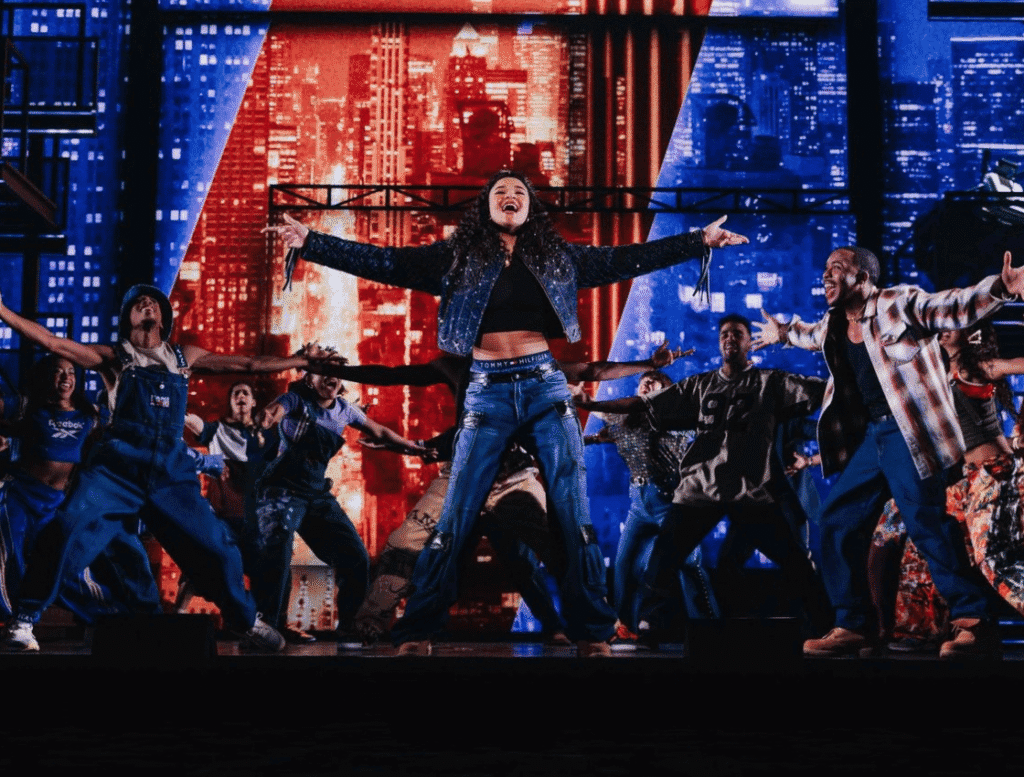
The “City That Never Sleeps” (aka “The Big Apple” aka New York City) is often seen by outsiders as a cold and impersonal concrete jungle. And it might be – for some new arrivals. But to those who’ve lived there for a while and put down roots, “mean streets” mean home, with all the warmth and connection of a small-town neighborhood. None more so than the creative dreamers who bask in the city’s energy while connecting with, and being supported by, like-minded artistic and/or financially strapped individuals who thrive in their particular slice of town.
Many of these talented, Big-City dreamers have turned to musical theater to share the experience of their formative years – in a particular NYC place and time – with the rest of us. Providing not only incredibly enlightening entertainment but also ensuring the spirit and legacy of their unique city neighborhood and its inhabitants (for as we know, city blocks are forever changing and evolving) live on in memory and audience appreciation for generations to come. As examples, I need only mention a few perennial hits like “West Side Story,” “Rent,” “In the Heights.” And recent blockbuster musical, “Hell’s Kitchen.”
Broward Center’s Broadway in Fort Lauderdale series is currently featuring the North American Tour of Alicia Keys’ HELL’S KITCHEN through March 22. It’s the long-held dream (13 years) of 17-time Grammy Award winner Alicia Keys who was born in the neighborhood in 1981 and takes place when she was a teen in the 1990s. The musical – for which she’s credited with music and lyrics, alongside arrangements with music supervisor Adam Blackstone (who joined music consultant Tom Kitt for orchestrations) – is inspired by her life story but not a biopic. Keys describes the plot that revolves around 17-year-old Ali (in an outstanding professional stage debut by recent high school graduate Maya Drake) as “a story about family relationships and identity: Who are we? Who do we want to be? Who are we becoming?”
Keys describes her early life as filled with neighborhood contradictions. Her Italian-American mom signed her up for classical piano lessons at age seven; soon after she wrote her first song. Growing up, she was surrounded by the music of Thelonius Monk, Billie Holiday, and Louis Armstrong. But she also carried a home-made knife for protection. There are instances of perceived (though not real) danger in the musical. The few actual threatening incidents are the biproduct of racial bias by white cops against young black men. An unfair fact of life we can still sadly identify with to this day.
We enter the theater to a high, bright neon “HK” sign which instantly broadcasts we’re not in for the traditional musical theater experience but rather something contemporary and new! Alicia Keys’ heavy helpings of both new (composed just for this musical) songs and older, popular hits that were specifically reformulated to advance the story (no jukebox-style side numbers here!) are one “key” to this difference. As is her unique brand of pop music – alternately featuring R&B, soul, jazz, some classical, and hip hop! We get to enjoy fantastically choreographed, athletic dance numbers practically throughout, thanks to choreographer Camille A. Brown, dance captain Timothy Wilson, and the uber-talented Dance Ensemble. Alternately, we are awed by soulful lead solos who can hold single notes forever and bring applauding audiences to their feet!
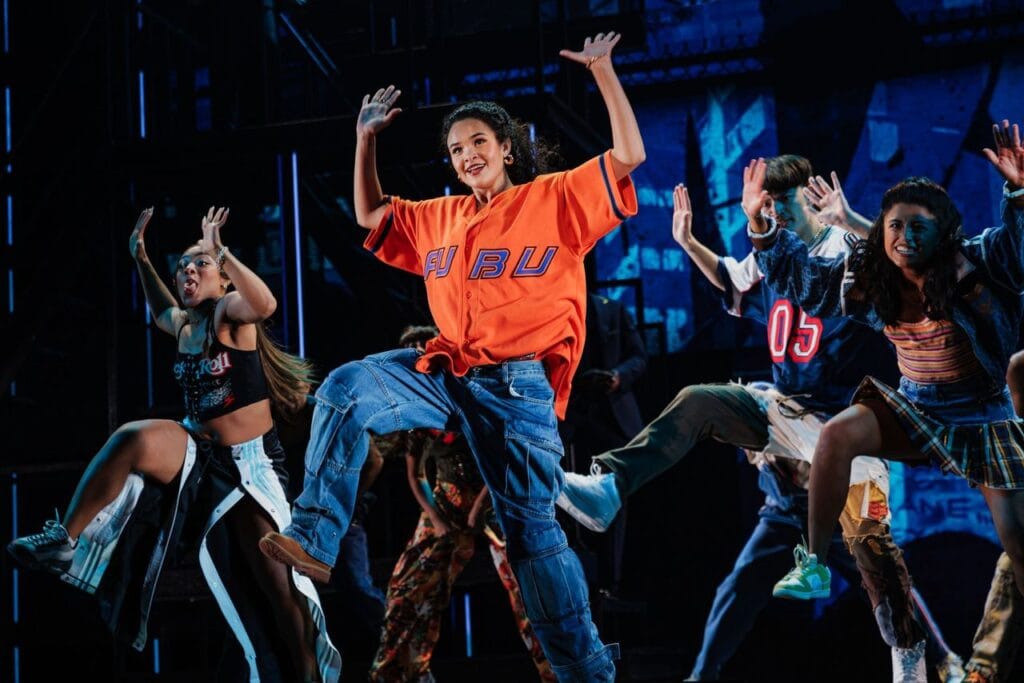
All facets of the production were helped along by the genius of director Michael Greif (of “Rent,” “Next to Normal,” and “Dear Evan Hansen” fame) who admits to being drawn to heavily emotional stories and working with “a group of artists that have pushed the musical form, who have opened up the subject matter of what great musicals can be.” He also echoes the opinion of “invigorated” cast members, wherein everyone involved is “excited to share this show.”
Before I get into extolling the uniformly excellent cast, I must point out a spectacular stagecraft aspect of this show which continued to amaze and delight me throughout. I’m speaking of the highly creative use of lighting in every shade and saturation that not only perfectly highlighted characters and scenes but practically presented a sound-and-lightshow of its own. (I’d described a pulsating, multi-dimensional backdrop in my notes as a “kaleidoscope,” then laughed at seeing confirmation, with “Kaleidoscope” listed in the program as a musical number!)
Kudos to lighting designer Natasha Katz and projection designer Peter Nigrini, who not only turned the steel rods and levels by scenic designer Robert Brill into multi-purpose high-rises and elevators through fluorescent highlights, but also created what I can only describe as a lovesong to the city. Closing number “Empire State of Mind” sent us off with birdseye views of majestic Manhattan culminating in a close-up of Miss Liberty and her held-high torch.
Brill’s scenic design levels supported a piano and pianist on an upper platform, stage left, with a drummer and complete drum set on the level below. Other levels were often frequented by the actors and, especially, the gymnastically active dancers! So, in addition to a small sound board and sound design by Gareth Owen, with music supervision by Emily Orr, we enjoyed live music.
Costume designer Dede Ayite placed us solidly into the world of young and hip 1990s fashion. I’d almost (thankfully) forgotten about those outrageously baggy, low-slung pants, pointless hanging loops and cut-off tops. (Nowadays we’ve managed a complete about-face with leggings so tight they practically look painted on.) Hair and wig design by Mia Neal and makeup design by Michael Clifton completed the pre-Y2K look.

as Ali finally share a warm, mother-daughter bond. Photo by Marc J. Franklin.
“Hell’s Kitchen” opens with outgoing and talkative 17-year-old Ali (engagingly portrayed by 19-year-old Maya Drake) introducing us to her Manhattan Plaza, Hell’s Kitchen home. She’s fond of the colorful neighborhood where she lives with her single mom in a small one-bedroom on the 42nd floor of the large, subsidized housing unit favored by artists, especially musicians. As Ali rides up the bright rectangular “elevator” she introduces us to a medley of floor stops that exude beautiful sounds of piano, percussion, violin, dance class … and more.
Ali’s mother was once a singer but now holds down two jobs to make ends meet and provide her daughter with a better life. Ali is mixed race. Her Black dad, Davis (Desmond Sean Ellington, who’s also vocally gifted) plays a talented musician who got her white mom pregnant when she was about her age. Charismatic and self-centered, he’s notorious for suddenly appearing and bringing joy into their lives, then just as suddenly disappearing for months or even years in pursuit of music opportunities anywhere in the world.
Ali’s mom, Jersey, beautifully portrayed and sung by dynamo Kennedy Caughell, is inordinately strict with her daughter, fearing her raging hormones and the possibility of an unplanned pregnancy, like her own. But we don’t get her reasons till much later, making it hard to sympathize with the Mayor Giuliani fan who also embraces strict policing. (She goes so far as to enlist local allies to keep her daughter from interacting with any of the young men – especially those she typecasts as hoodlums who hang out in the plaza jamming on construction bucket “drums.”)
Ali has the hots for one handsome, muscular drummer in particular, named Knuck, played with vitality and sensitivity by JonAvery Worrell. In typical gal-pal fashion, Ali’s friends Tiny (Gigi Lewis) and Jessica (Marley Soleil) push her to stop her mooning and dare to approach the young man. She follows him to his place of work, where he likely senses her naiveté (though he IS later dismayed to discover she’s only 17) and at first puts her off. He’s not at all what her mother fears, but rather a decent, church member who’d rather play drums but keeps a steady job as a house painter to support himself and his close family. And of course he can sing buckets!
