
Many of us recall watching John Waters’ groundbreaking 1988 hit film Hairspray at movie theaters, on TV, or in some other fashion. And everyone recognizes “Good Morning Baltimore,” the opening number that’s become part of America’s musical theater lexicon. But fewer people had seen the Broadway musical adaptation that went on to win eight Tony Awards, including Best Musical, in 2003. Shall I tell you now that there were Slow Burn Theatre Company patrons who’d attended the original Broadway show and/or various revivals and said Slow Burn’s was the best!!
I can believe it because our award-winning musical theater company (based at Broward Center’s Amaturo Theater) has been wowing audiences with bold, innovative productions since 2009, and with HAIRSPRAY: The Broadway Musical has once again hit pure gold. Company co-founder and celebrated director, Patrick Fitzwater, was right on the money when he stated: “Hairspray is a joyous celebration of courage, community, and unapologetic self-expression. Audiences won’t just watch it, they’ll feel it in their bones.”
It’s almost surprising how joyous and optimistic one feels throughout – thanks to a cleverly witty and heartfelt book by Marc O’Donnell & Thomas Meehan, music by Marc Shaiman, and lyrics by Scott Wittman & Marc Shaiman. All despite serious underpinnings reflecting social mores of the time, and characters who embody some of the worst attributes of American society – both in 1962 Baltimore, where the play is set, and even more disturbingly today. (We’ve come so far and are suddenly regressing so fast!)
Hairspray’s lead characters reflect dramatically popular and recognizable stereotypes ranging from success-obsessed moms (here also racially prejudiced) to overprotective ones (who raise mean and entitled or insecure kids) to naturally feisty and rebellious offspring. We meet big dreamers – rebels for a cause who won’t accept unfairness toward themselves or others. As well as the selfishly career-driven or greedy – ready to turn on anyone and back anything that will make them a buck. Because these characters are so blatantly satirized, we feel free to revel in their cartoony evil portrayals and astounding vocals and dance numbers … all the while knowing the “good guys,” who entertain equally well, will prevail.
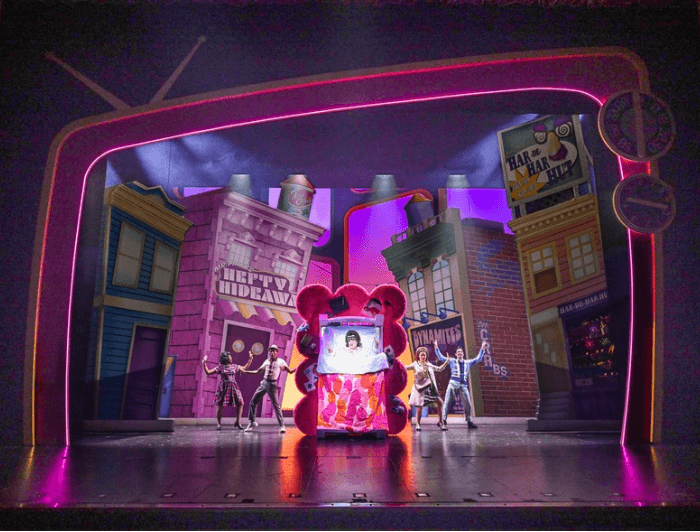
Hairspray opens to a bright and colorful, storybook-like stage set enclosed within a giant, old-fashioned TV console (stunning scenic design by Nikolas Serrano and lighting design by Eric Norbury). We’re also instantly transported to the early 1960s via costume coordinator Rick Peña’s wardrobe selections and Patrick Fitzwater’s over-the-top wig designs.
The spotlight is on Tracy Turnblad (Jennifer Massey) tucked into a bed that vertically faces the audience. I wish I could wake up as joyous and optimistic as Massey welcoming a new day in her favorite city with a marvelous rendition of “Good Morning Baltimore.” (Here I must add that throughout the show I kept looking for where they’d hid the musicians – the taped music was just that perfect, thanks to music director Paul Tine and impeccable sound design by Dan Donato.)
After school and receiving yet another warning about the improper height of her hair, Tracy rushes home with her devoted, gum-chewing sidekick Penny Pingleton (expertly enacted by pigtailed Jessica Balton) to watch their favorite TV program. The Corny Collins Show features a recurring cast of local teens dancing up a storm to the day’s pop hits – somewhat like a Baltimore version of American Bandstand. When Corny introduces us to “The Nicest Kids in Town,” we’re treated to an array of electric 1960s dance styles interrupted only by even faster and slinkier “downtown” negro moves and some rhythm and blues. (Kudos to choreographer/associate director Trent Soyster and dance captain Cat Pagano.) 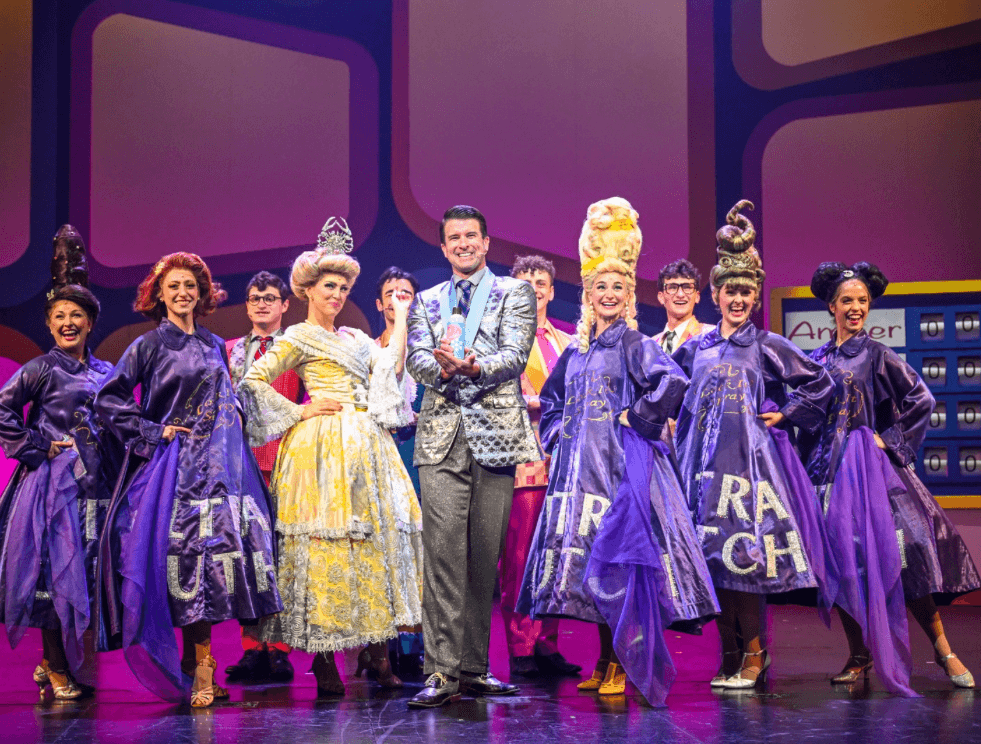
A familiar generational battle ensues when Tracy’s supersized, deep-voiced mom, Edna Turnblad (an immediate audience favorite, perfectly played by Eric Swanson in the traditional male-as-female role) yells at her daughter to turn down the volume. Then Penny’s strict mom Prudy (Colleen Pagano, who also perfectly portrays various nasty authority figures) arrives to fetch her daughter and stop her from listening to “that race music.”
The girls, however, are all excited about Corny’s (cooly enacted by Chris Stevens) announcement that one of their regular dancers, Brenda (Kristi Rose Mills), will be taking a leave of absence “for nine months” and they’re inviting local kids to cut school tomorrow and come audition as her replacement.
While her mom’s busy ironing the clothes she washes and mends for a living, Tracy tells her it’s always been her dream to dance on TV, while Penny can’t wait to watch her friend perform. But Tracy’s very overweight mom is worried about her very overweight daughter suffering ridicule and rejection because of her looks. She turns to her husband, Wilbur Turnblad (played by Slow-Burn co-founder Matthew W. Korinko in one of my all-time favorite Korinko performances – he sings, he dances, he’s both sensitive and daring!) to talk sense to his daughter. But Wilbur’s living his dream as proprietor of the Har-De-Har Hut, a joke novelty shop. So, when Tracy announces, “It’s my dream,” he can’t take that away and instead encourages her to go for whatever she wants in life.
This is followed by a popular number in which three sets of very different, yet uniformly anxious, mothers seated at heart-shaped vanity tables observe their daughters’ strident rejection of helicopter parenting when they take turns singing the high-spirited, doo-wop style anthem of independence, “I’m a Big Girl Now.” Tracy’s and even Penny’s strict mom are pushovers when compared to the third mother-daughter pair with mom bringing to mind Disney’s Cruella, and her daughter encapsulating the ultimate Mean Girl.
Popular local, touring, and Slow Burn star Gail Bennett plays gorgeous, svelte but horridly racist producer Velma Von Tussle, a viper you can’t take your eyes off of, yet love to hate. She’ll stop at nothing to get her daughter, Amber (perfectly cast and enacted by Maryann Traxler) crowned Miss Teenage Hairspray. Thus following in the footsteps of her mom, a proud former “Miss Baltimore Crabs.” (I’ll add here it’s well worth including so evil, yet entertaining, a character as Velma if only to hear Bennett’s beautiful vocals in the above number.)
As it happens, auditioning for the Corny Collins Show becomes a major turning point in Tracy’s life. It’s where she encounters first love, harsh body and racial prejudice, and later discovers that selflessly standing up against authority to do the right thing can be successful, as well. Young Tracy sings “I Can Hear the Bells” when she bumps against her TV celebrity crush, “he touched me” Link Larkin (an ambitious singer and somewhat complex young man, believably enacted by Scott Silagy). Link is led by the nose by his similarly attractive girlfriend, Amber, but after meeting Tracy, wises up to what really matters in life and ultimately develops a spine.
Despite instant rude rejection for her girth by producer Velma, Corny, whose name headlines the show, refuses to relent and gives Tracy the spot after seeing her exuberant dance moves, based on steps she’d learned from the school’s negro contingent while in detention (she’d joined them as a regular for her loud mouth and “monumental hair-don’ts”). Next Corny asks Link to join her in singing “It Takes Two,” much to the Tracy’s utter delight and Amber’s vociferous horror. Sadly, Tracy also witnesses Velma’s immediate audition dismissal of sweet Little Inez (Sarai Gerard) based solely on the color of her skin.
Long abhorring how her negro friends are treated differently and not allowed to dance together with their white counterparts at Corny’s show, Tracy advocates integration wherever and whenever given the chance. Tracy knows it was only due to special dance moves she’d learned from her negro friend, Seaweed (amazing dancer Logan Green), that she earned a spot on Corny’s show. When she realizes Little Inez, who was rejected outright, is his younger sister, she feels doubly bad. Her meteoric rise to stardom on the show brings a reporter’s question if there’s anything she’d change. Her instant response is she’d have negroes and whites dancing together all the time.
This brings us to the protest organized at Motormouth’s Record Shop. But first we enjoy the dazzling, knockout number, “Run and Tell That,” headlined by Seaweed, boasting an R&B sound and African roots that speak to the beauty of a world where everyone is allowed to fully blossom to their full potential. It’s followed by “Big, Blonde & Beautiful” starring Motormouth, Little Inez, Tracy, Edna & Wilbur. Here Motormouth encourages Edna to join in their integrated Mother-Daughter Day protest march where just as being Big and Black is beautiful, so is being Big and Blonde!
The show’s musical numbers start out strong and, if anything, especially the solos, only seem to get better. Seaweed’s mom, Motormouth, works for the TV station’s monthly Negro Day, but she also owns Motormouth Maybelle’s Record Shop, a popular gathering place for the Black community that’s been surprised by, but still welcoming, to white kids like Tracy and her friends, and so has become effectively integrated. Toddra Brunson embodies the perfect Motormouth, a spitfire force of nature who’s also a wise, kind, and gentle soul – fiercely protective of her kin but also patient when it comes to the deluded and misinformed. When Brunson let her powerful voice go all out in her featured solo, “I Know Where I’ve Been,” she was met with shouts of “Bravo” as audience members stood up to applaud.
There’s a lot more surprising action in Act II, including seeing practically the entire female cast in lockup. Tracy’s dad comes through with bail, then shares a genuine, tender song about aging together with his wife in “Timeless to Me.” Link sees the light, and arrives to rescue Tracy from solitary confinement while hair product show backer Mr. Spritzer (played by Slow Burn regular, Michael Materdomini, who also shines in various “authority figure” roles) suddenly sees monetary prospects by joining popular opinion in favor of an integrated dance show. He even goes so far as to launch a new Ultra Clutch product line tailored to Black women’s hair.
Speaking of hair, newly coifed and glamorized Penny gets to be with her longtime crush, Seaweed, and guess what? Her mom is happy if she’s happy! And everyone attending the show gets to go home with a new skip in their step and a huge smile on their face, after joining in the company’s joyous final dance number, “You Can’t Stop the Beat.”
To get back to the good stuff of the 1960s, specifically its catchy music and high-energy dance moves, tease up your hair (or sport any look you prefer) and dance on over to the Amaturo Theater at Broward Center for the Performing Arts where Slow Burn Theatre Company’s unstoppably vivacious production of Broadway musical, HAIRSPRAY, is impressing and delighting audiences now through April 26. Broward Center is located at 201 SW 5th Ave, Fort Lauderdale 33312. Get tickets online at www.browardcenter.org, Homepage – Slow Burn Theatre Company, Ticketmaster.com, by calling 954-462-0222 or by visiting Broward Center’s AutoNation Box Office in person.