
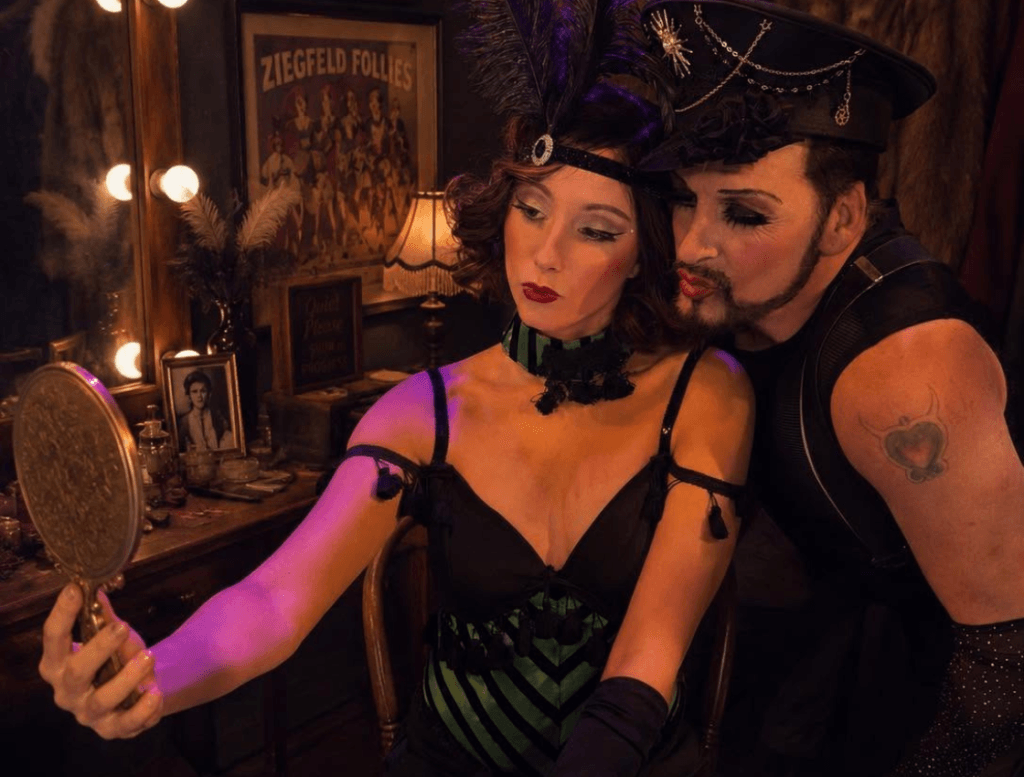
By now, many of us have seen CABARET at least once – typically performed on a large stage with flashy scenic design and memorable musical numbers. The 1967 megahit is also famous for its explosive style and controversial subject matter (personally decadent, politically horrifying), haunted by a sense of foreboding during the last gasps of the Jazz Age in 1929 Germany. A time when violent clashes between left and right and gathering stormclouds of a Nazi takeover were often met by blind disbelief, and escape into the hedonistic pleasures of seedy cabarets. Everyone was welcome in these underground clubs where locals of every stripe could revel in hilariously provocative skits and libations with their fellows before true Nazi depravity put the kibosh on all such pleasurable (albeit morally questionable) pursuits in the1930s.
Cabaret, the musical, graphically depicts the lives of Berlin’s Kit Kat Klub performers, frequenters, and their acquaintances, with legendary music by John Kander and lyrics by Fred Ebb. Book writer Joe Masteroff based his script on Anglo-American writer Christopher Isherwood’s colorful escapades while living among Berlin’s gay writers, prostitutes, and cabaret performers during the twilight hours of the Weimar Republic, and John Van Druten’s ensuing play. The longest-running Broadway musical at the time went on to win eight Tony Awards in 1967, including Best Musical and Best Original Score. In 1998, Cabaret also won a Tony for Best Musical Revival (that’s the version we’re seeing), and then in 2022 an Olivier Award for Best Musical Revival at London’s West End.
Obviously, this is a phenomenal piece of theater that continues to excite audiences around the world with its provocative, soulful, and outrageous musical numbers, intense yet all-too-relatable storylines, and powerful message about the dangers of complaisance in the face of encroaching fascism, antisemitism, and persecution of perceived “others” – whether they are condemned for their sexual orientation, race, nationality, genetics or religion – that manages to resonate anew with each generation … maybe now more than ever.
So of course, there’s always a reason to revisit the Kit Kat Klub and “Come to the Cabaret”! Though I must admit, at first I was taken aback at being invited to see the show at our beloved but diminutive Empire Stage. I’ve always admired David R. Gordon, founder/producing partner of the facility, for encouraging new, off-the-beaten-track (not unlike the theater’s hidden train-track location), original (even quirky) new plays that turn out to be memorable, professional productions you won’t encounter anywhere else. He’s developed quite the following of patrons who simply adore his little theatre’s artsy off-off-Broadway vibe. Plus, every unassigned seat feels like front row!
But when I saw that this latest Cabaret was a co-production of Larry Buzzeo’s ArtBuzz Theatrics and Florida Theatrical Events and that Buzzeo would not only serve as director but also play the iconic role of Emcee – I absolutely knew I had to be there. I’m a big Larry Buzzeo fan and have followed his career as both director and actor in a variety of roles, always with excellent results. So I was confident the show would be worth seeing, though I’ll admit to also being more than a little curious about how he’d pull it off in so small a space! (To be fair, over the years, I’ve witnessed some miraculous stagecraft sleight-of-hand which utilized every possible inch of the facility.)
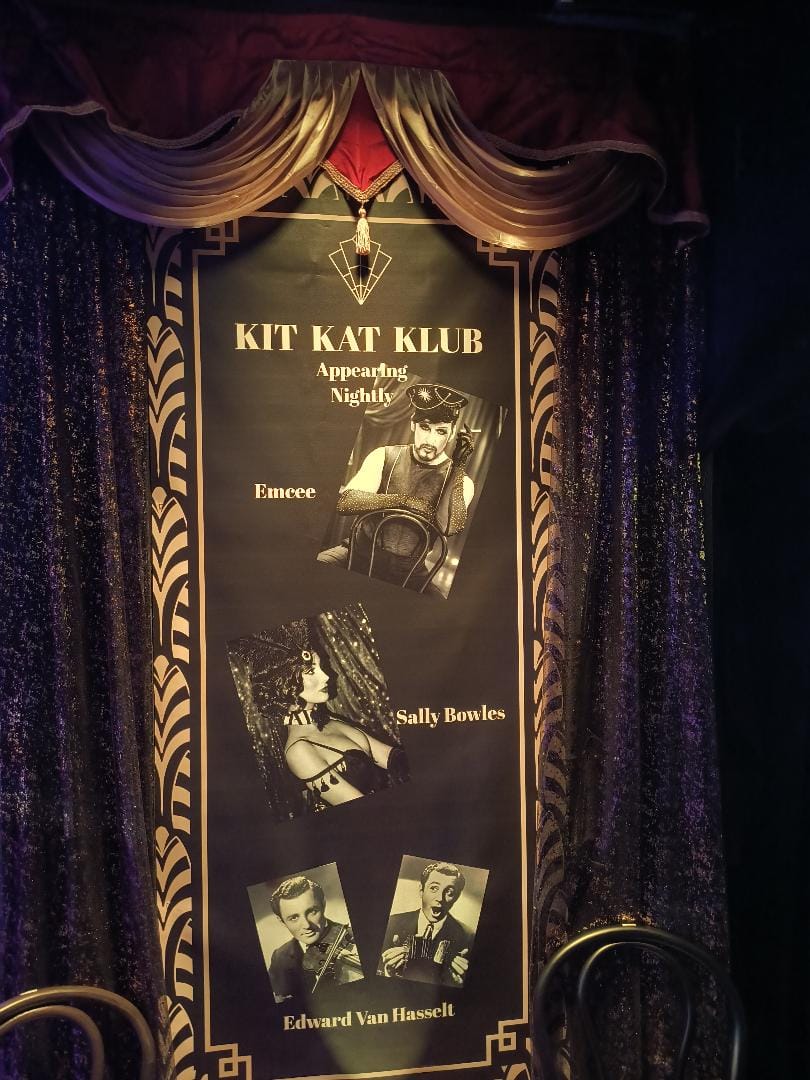
grandfather!
I’ll keep you in suspense no longer. Not only did Florida Theatrical Events & ArtBuzz Theatrics manage to pull off staging the show at intimate Empire Stage, but I also now consider this little theatre to be the ideal venue for recreating a cabaret atmosphere and delivering an outstanding, pitch-perfect version of the 1998 hit revival. Even their dimly lit, shabby-chic lobby recreated a true Berliner cabaret experience from the get-go. Not to mention being greeted by scantily clad, German-accented cabaret performers 15 minutes before showtime.
The actors also posed on stage, inviting the audience to join them for photos. I watched an acquaintance who happens to be a dedicated Empire Stage fan gleefully dance with a male cabaret performer while the music played. On this level alone, if you’ve never been to a real cabaret or are curious about its pre-war heyday, you’ll love feeling as if you’ve been transported back in time to 1930s Berlin. Where you are “welcomed” to “leave your troubles outside” because “In here life is beautiful….”
But wait! Lest we forget the danger that looms just beyond the nightclub’s door, everything goes suddenly dark, save for the harsh sounds of stomping boots and violent punches. And when the cabaret lights and music return, they reveal beaten-up Emcee Larry Buzzeo – sporting black leather, fishnets, and heavy makeup (with sultry dark lashes that really bring out his eyes!) – who staggers inside before pushing himself up to valiantly sing the iconic “Willkommen” opening song.
As master of ceremonies, the Emcee then introduces us to the show’s beautiful “girls” that comprise three curvaceous young ladies and two young men in drag. Among small side roles, these five are almost constantly onstage performing real cabaret-style dances – often combined with outlandish comedy routines. And there are plenty of them. Because despite dramatic, human-interest storylines (that also feature catchy and soulful songs), we’re constantly “coming back” to the Cabaret to be entertained by low-brow sexy or sharply satirical numbers (or both at once!).
Opening up the typically bifurcated stage floor all the way to the back wall provided ample space for high-kicking dancers (though those seated in the front row might want to keep their legs tucked in!). My admiration and appreciation go to Caroline Macchiarola as Rosie, Abbie Fricke as Fritzie (also Fraulein Kost), Lauren Swartzendruber as Frenchie, dance captain Anthony Lobo as Helga (also Bobby), and Charles Page as Texas (also Ernst and Victor). Not only did these versatile dancers take on additional roles, including some major ones, they also served as stagehands who briskly and practically invisibly set up and removed chairs, tables … even a chaise lounge, between scenes.
Next scene’s on a train bound for Berlin. Where we’re introduced to handsome young American writer Clifford Bradshaw (Chad Raven) who’s traveling around European cities on the cheap in search of inspiration for his new novel. Raven has appeared in several local shows, can sing as well as act, and shines as a naive but also inquisitive visitor from Harrisburg, PA. Cliff gets hold of a copy of Mein Kampf to learn about Germany’s politics. When he wakes up to what’s happening, he’s disgusted and outraged.
Shy but no prude, Cliff’s closet gayness comes out when encouraged (although he discovers he can love a woman as well). And when fellow train compartment passenger Ernst Ludwig (played by impressively busy young actor, Charles Page) shifts his contraband suitcase behind the American’s luggage that had already been cleared by the passport inspector, he watches bemused. To Ernst’s relief, Cliff offers that he’d been known to smuggle excess items in his day. Ernst is then quick to befriend him, setting him up with a place to live, English tutoring work (with himself as the first customer), and even offers a way to make easy money via Paris deliveries (as the authorities rarely stop Americans). There’s obviously something fishy about this, but at first Cliff is just happy not having to worry about rent.
Ernst brings Cliff to Fraulein Schneider’s boarding house for a “cheap” room. The elderly, set-in-her-ways spinster is played with great veracity and vocals by Elissa D. Solomon, a veteran actress who’s performed locally, off-Broadway, and on national tours. I’m so glad she mentioned in her bio that she’d played the role of Fraulein Schneider earlier at Broward Stage Door! I recognized her at once and was going crazy trying to remember where I’d last seen the show. Fraulein Schneider stars as one half of an older generation’s, idealistic but mismatched love-interest storyline that runs parallel to that of young Cliff. So we get to enjoy her acting and vocals a lot. Starting with coming to terms with renting the room at a lower rate to “the famous American writer,” through her sarcastically funny reflection on accepting whatever life has to offer in “So What?”
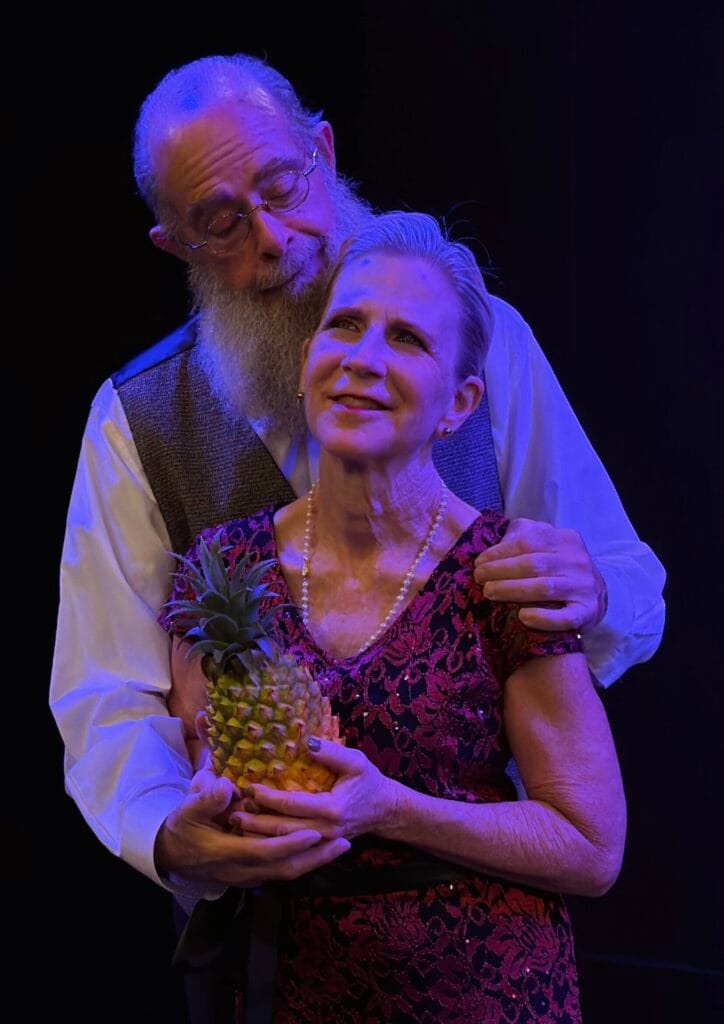
We also meet fellow boarding house occupant Herr Schultz whom Schneider introduces as being the proprietor of the Number One fruit emporium in town. Powerfully played and sung by veteran performer of stage, film, and TV, Michael H. Small as Schultz instantly establishes his Jewish cred by wishing Cliff “mazel” (luck). Deeply enamored with his landlady, he regularly arrives bearing gifts of delectable fruits like oranges and apples, culminating in the ultimate rarity – a pineapple! These two adoring old-timers then join in singing “It Couldn’t Please Me More (A Pineapple).”
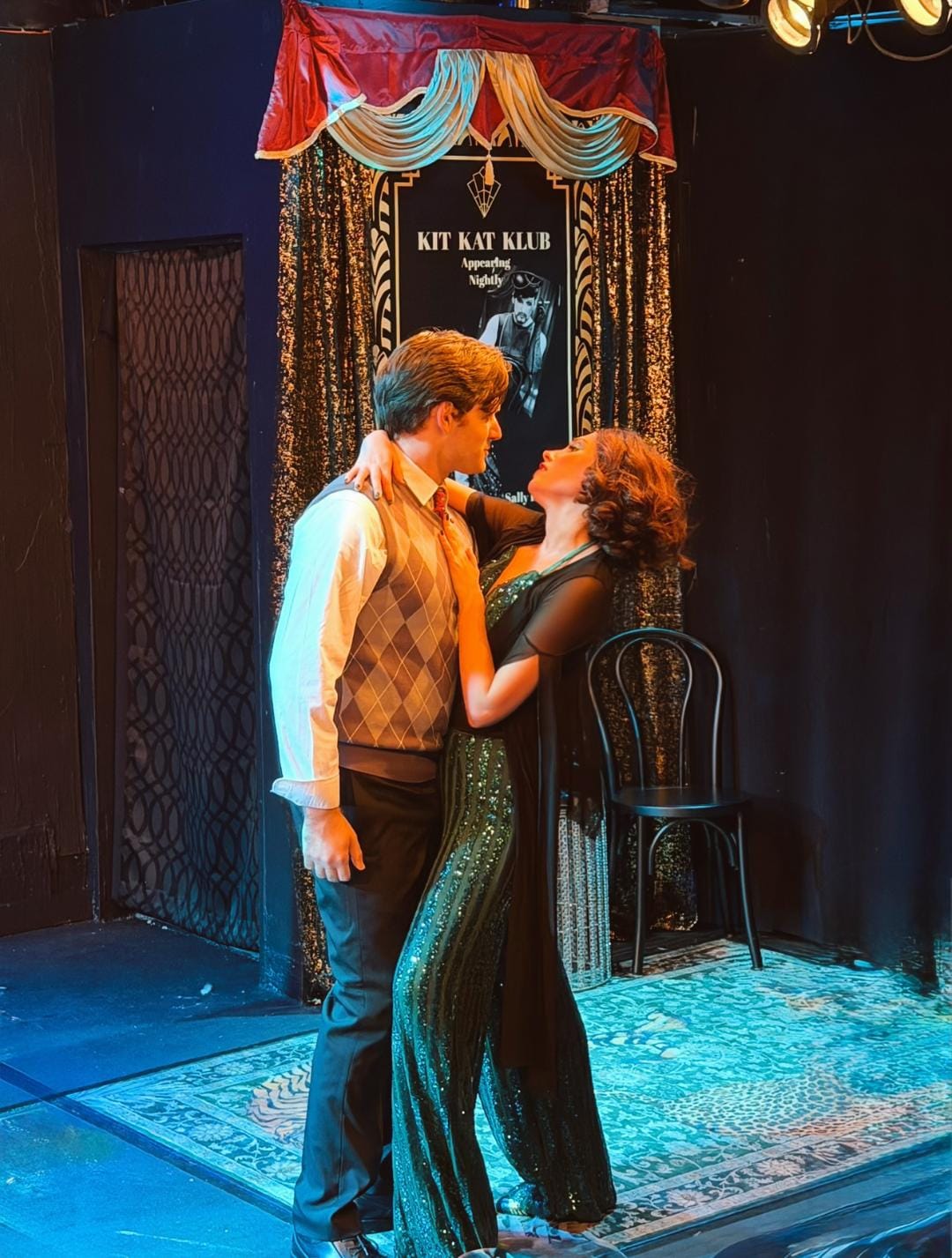
mercurial cabaret singer Sally Bowles (Alexandra Van Hasselt). Photo by Patty Kopelman.
When Fraulein Kost (lovely, comedic Abbie Fricke, an Empire Stage regular) who’s constantly berated by her landlady for “entertaining” sailors (but that’s how she earns her rent!), catches Schultz sneaking out of Schneider’s room, he impulsively asks her to marry him to protect her honor … but he did have it in mind all along. For a brief shining moment, the hopeful spinster joins the elderly German-Jewish widower in singing about the perks of being “Married.”
Cliff arrives in Berlin on New Year’s Eve and his only contact, and now “friend” Ernst, insists he visit the hottest spot in town, the Kit Kat Klub, where telephones on tables allow attendees to call each other and get together (an early form of Tinder?). When the club’s English superstar, introduced as “Sally Bowles, The toast of Mayfair,” steps onstage to much fanfare and performs the hilarious, highly sexualized number, “Don’t Tell Mama,” everyone’s smitten. Including Cliff … and us.
Popular local actress Alexandra Van Hasselt not only moves us deeply with her emotional acting prowess that includes real tears, her beautiful singing voice – ranging from intensely powerful to ethereal – is absolutely amazing. And her proficiency as a cabaret dancer would make her an instant hire in any club. Van Hasselt represents the epitome of a triple-threat, and I relished watching her dominate every scene she was in, which happily were many. Alexandra also holds a special relationship with this musical, dedicating her performance to her Dutch Jewish grandfather, Edward Van Hasselt. Edward was a touring musical entertainer in 1930’s Europe, where he often assumed the role of Emcee in venues like the Kit Kat Klub. He narrowly escaped to America in 1940 where he continued to work as a musical comedy emcee throughout his life.
Alexandra comes from long-established theater stock; in the program, she also thanks her mother, Melanie, for being her inspiration. If anything, our local Van Hasselt family is extremely hardworking and artistically creative. Melanie Moore Van Hasselt not only heads Florida Theatrical Events, co-producer of this show, she also served as its choreographer and was in charge of staging, set, and wardrobe design! I already complimented the easily movable and perfectly functional set pieces. I was going to look up the wardrobe designer for effusive praise because, honestly, the forever changing and often matching cabaret dancer outfits featuring all sorts of glittery accents, along with hats, boas and, especially the dazzling, perfectly fitted cocktail dresses in Act II, rivaled anything our premier Boca-based costume company could come up with. They certainly were a lot more exciting than the rather drab pale negligee worn in 1998’s Broadway run!
And I don’t think anyone can beat Bobby Peaco when it comes to music direction. I know there’s no way they could have added a live band of even a few members without removing a group of audience seats from a side balcony, and available seating was limited enough. But if I didn’t know better, I’d swear the music emanating from stage right at just the right intervals and volume was coming in live! Masters of lighting design Preston Bircher and sound design Davit Hart were impressively flawless as usual. And stage manager Patrick Vida must have had his hands full, as did director Larry Buzzeo whose riveting onstage presence as Emcee was constantly evolving both physically and emotionally. To their immense credit, these dedicated pros kept everything running smoothly through even the most madcap moments.
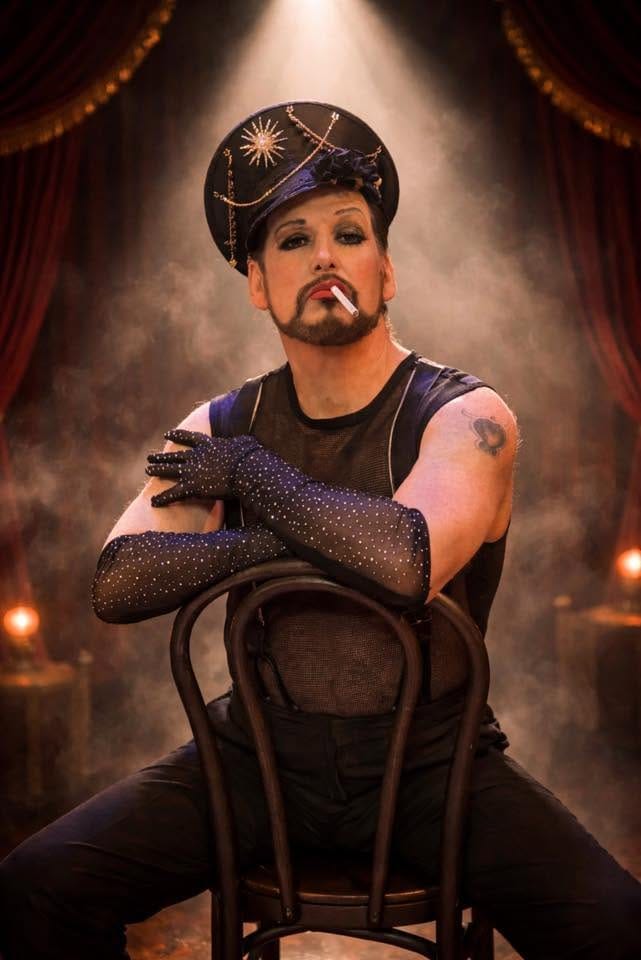
Kat Klub’s perversely sexy and enigmatic Emcee. Photo by Patty Kopelman.