
JAGGED LITTLE PILL is harsh, it’s real. It cuts, it stings, it challenges and resonates … crushes and exhilarates! The contemporary Tony Award-winning musical featuring the music and lyrics of Alanis Morissette’s landmark 1995 album – winner of four Grammy Awards and a worldwide sensation (number one in 13 countries with sales of over 33 million!) – has taken Broward Center’s Amaturo Theater by storm. Where professional resident Slow Burn Theatre Company is mounting the final show of its super-charged 16th season with all the high-energy song-and-dance numbers, magnificent vocals, superior staging, lighting and sound, one has come to expect from the highly rated theatrical company. And this latest production also features an explosive live orchestra!
Just so you know (and might already have guessed) – having been originally conceived by brutally honest, independent Morissette – this is no typical “jukebox musical.” Among Jagged Little Pill’s megahits from her titular album – songs like “All I Really Want,” “Hand in My Pocket,” Ironic,” and “You Oughta Know” – are two new numbers, “Smiling” and “Predator,” specifically written for the stage.
And while all the songs reflect the deepest emotions and observations of lyricist Alanis Morissette, with music by Morissette and Glen Ballard (as in the album), the musical is not autobiographical. Academy Award-winner Diablo Cody (Juno), who was recruited to write the book, decided to base her story on the trials of a fictional high-achieving, upper-middle-class suburban family in Connecticut who is determined to live up to, and exceed, societal expectations of 1990’s America. Sort of a next-generation iteration of Sondheim’s angst-filled, pretentious New Yorkers of the 1970’s. But with even sharper running social commentary and more frightening personal repercussions.
Sad to say, if anything, pervasive problems in achieving “the American dream” – including toxic family dynamics, rising rape and drug addiction numbers, soul-crushing competitive academic and business environments, and difficulties forming honest and trusting human relationship among all genders – have only exacerbated over the years. Nowadays, life for many is more socially isolated, harsh, and self-absorbed than ever. Meaning the issues that confront the still well-intentioned, if often deluded, members of our musical’s Healy family are bound to resonate as we alternately laugh and shudder in recognition.
It all begins with the traditional writing of the Healy family’s annual Christmas Letter where only things worth bragging about are shared (not unlike how most Facebook and Instagram posts are curated nowadays for maximum FOMO [Fear of Missing Out] envy). We first meet Mary Jane Healy (aka MJ) – wife, mom, and self-appointed backbone of the family who keeps everyone in their place to meet her goals. Externally, she’s the ideal invested school mom who eats healthy, exercises, enjoys a good marriage and raises perfect children.

And it’s all a sham. As we immediately discover when she writes/speaks aloud about her husband Steve’s promotion with a raise she loves spending (while she looks at us and admits he’s become an internet pornography addict), her adopted Black daughter Frankie who’s 16 and currently working with her friend Joanne on an art project (cut to Frankie’s bedroom where she and Jo are engaged in hot and heavy lesbian sex), and ends with how proud she is of their son Nick (who is the light of her life) for having just won early admission to Harvard University. Then she looks at us, adding “our” … no “his” dream school. After enumerating an extensive list of outside activities she’d chauffeured Nick to over the years, MJ reflects how “all those years of extracurriculars paid off!”
Citing external versus internal realities is frequently used to create dramatic tension. Starting with central character Mary Jane, portrayed with scorching emotional depth and impressive vocal proficiency by Kimberly Doreen Burns. MJ progresses from having a dual verbal persona to responding to an actual shadow image who expresses her inner anguish through dance, including heart-wrenching visuals of what it feels like to succumb to a drug overdose. Although not listed in the credits, I believe choreographer Madeline Dunn expertly performed the shadow dancer’s role, often dressed in identical outfits to those of Mary Jane. (Shoutout to Rick Peña’s period- and situation-perfect costume design.)
After an almost overpowering Overture featuring the entire company in “(I See) Right Through You” where we’re introduced to a spiky, jagged neon stage of glaring lights, blasting music, and incredible calisthenic dance moves backed by a boisterous live band that knocks your socks off, we’re off to the races. I was almost glad to get a moment of quiet, albeit distressing, reflection in Mary Jane’s subsequent Christmas Letter segment.
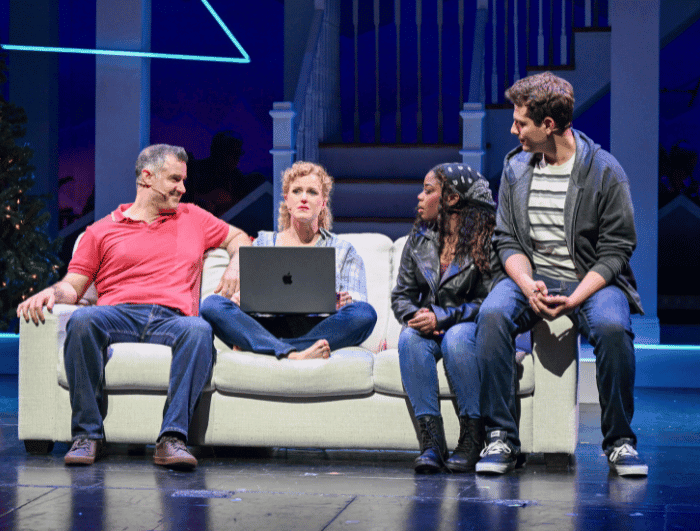
Which smoothly segues to meeting the entire Healy family – with each member taking a turn at singing a few lines from “All I Really Want” that depicts their feelings. First up is Frankie, an outstanding featured star played by Lauren Chanel, who says she’s thrilled to revisit the role she’d embraced in the Broadway National Tour. Frankie opens with “Do I stress you out?” after mom doesn’t approve of today’s skimpy shorts and many of her daughter’s choices in general. Mary Jane responds with: “I don’t mean to pick you apart, you see, but I can’t help it.”
She’ll then join husband Steve in singing, “And all I really want is some patience. A way to calm the angry voice.” He’ll later add, “And I have no concept of time…other than it is flying.” In many ways, Steve is your typical midlife, mostly absent, husband/father who works 60 hours a week and feels frustrated and underappreciated for his role as provider of the family’s high-end lifestyle. He also can’t understand why it’s been almost a year since he’d had sex with his wife and misses the early days of their romance.
Ben Sandomir completely aces the role of befuddled, occasionally angry and resentful, but also touchingly needy and wistful husband who can tell something’s wrong in their marriage but can’t even convince his wife to go to couples therapy (a problem typically voiced by the female side of the equation). Sandomir also has a powerful singing voice (as do all the show’s vocalists).
And then there’s MJ’s golden boy Nick, who’s had mom direct his life for so long, he’s practically lost himself in the process. We’ll discover how being unable to think, and act quickly in an emergency, leads to dire consequences. Isaac Kueber as Nick will later wow us with his solo, “Perfect,” that portrays the agony of trying to live up to ever-rising expectations to gain a mother’s love whose very identity is tied to her son being the best. But for now, he’s content in the role of peacemaker, singing, “And all I really want is some peace man. A place to find a common ground.”
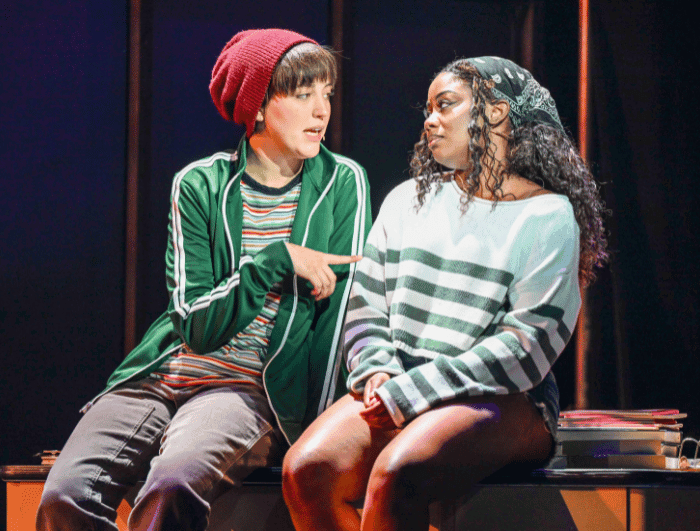
Best friends, and more, Jo and Frankie are the leads in audience favorite “Hand in My Pocket,” up next. Where we first sit up and take notice of Sidney Freihofer, as Jo’s intense vocals match her lezzie swagger. It’s pure pleasure to hear Jo sing: “I’m broke but I’m happy. I’m poor but I’m kind … I’m sane but I’m overwhelmed, I’m lost but I’m hopeful, baby.” “And what it all comes down to is that everything’s gonna be fine, fine, fine. Cause I got one hand in my pocket. And the other one is giving a high five.” Frankie joins her for the final refrain backed by the Company, and life couldn’t be sweeter.
I just realized this outstanding musical, whose cast recording album also went on to win a Grammy Award in 2021 for Best Musical Theater Album, was, afterall, conceived and written by a woman, actually two women when Diablo Cody joined Morissette to write the book. While still true to life, this might explain why many male characters turn out to be, shall we say, “disappointing” (at least from a female perspective). When honest and naive 16-year-old Frankie is swept away by love for heterosexual Phoenix (Manny Tuerina), he lets her down when she impulsively runs away to join him in the big city and professes her love. True, this is a childish move on her part, but the least he could do is see her safely back home. Instead, he makes an excuse when she calls for help. It’s best girlfriend Jo, whom she’d dumped for Phoenix and is still angry, who nevertheless comes to her rescue.
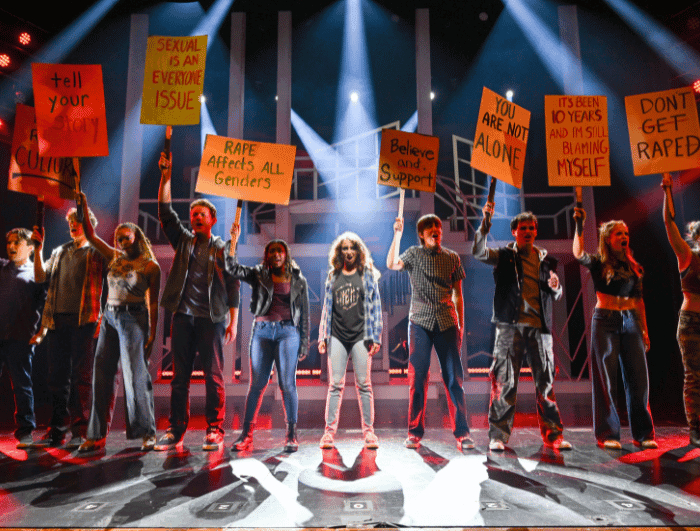
When another longtime member of their high school crowd, Bella, gets extremely drunk at a party, none of her “friends” look out for her safety. Instead, a classmate not only rapes her while she’s unconscious, but also posts a photo with her shirt pulled up that goes viral, humiliating the girl before the entire community. It eventually comes out that Bella’s longtime buddy Nick actually walked in on them while it was happening, but was too frozen to act at the time. If anything, even the women and girls around her (except for incorrigible activists Frankie and Jo) blame the victim for getting herself into this vulnerable position. And they don’t believe (or don’t want to believe) her “story” of being raped by the son of a prestigious local family.
Emily Van Vliet Perea enacts vulnerable and betrayed Bella so beautifully, it’s almost difficult to watch. When bolstered by two activist classmates, Frankie and Jo, who barely know her but care, it restores her mojo and she fights back. She files criminal charges in court and finally gets help from her single witness and a surprising confession of solidarity from that witness’s mother. Bella also performs two powerful solos (backed by the Company) in “Predator” and “No.”
Act II deals with far heavier issues than mother-daughter or even husband-wife arguments and misunderstandings. We get an ugly depiction of how easily rape can happen among inebriated teens and how, even when reported, the victims tend to suffer a lot more than the accused who often go free. And how even a highly functional member of the community like Mary Jane Healy, who was legally prescribed opioids for pain after being in a car crash, can so easily become addicted to the drug and nearly die from a street drug overdose that all too often, nowadays, is laced with fentanyl.
protest. Photo by Larry Marano.