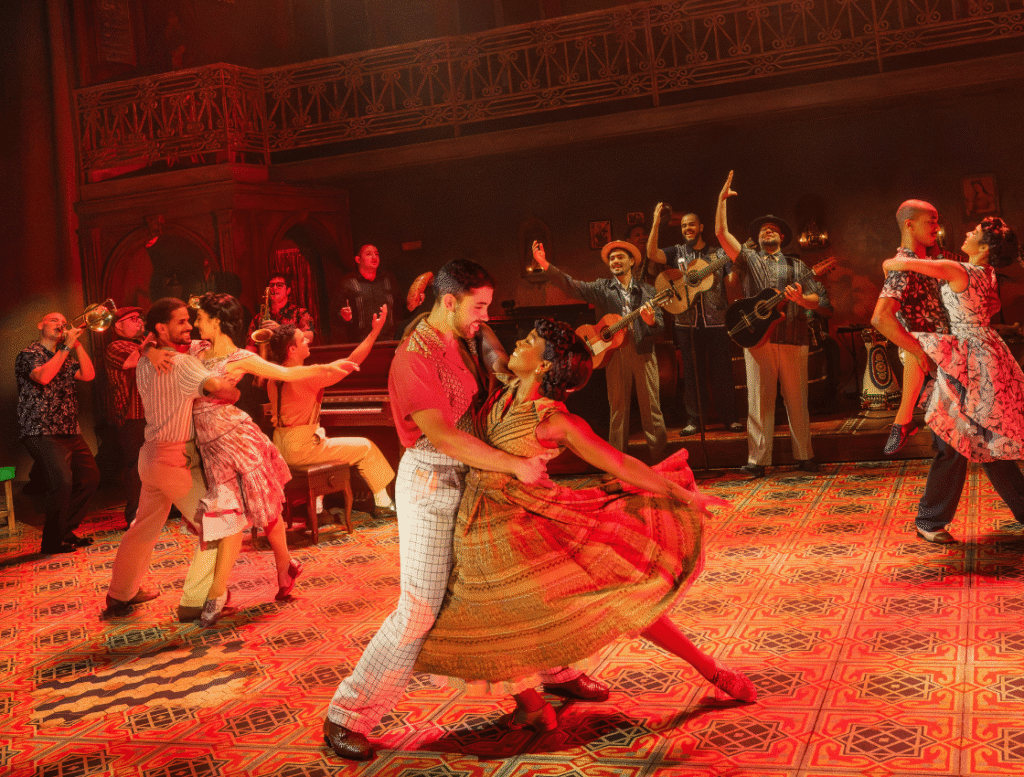
You don’t have to be Cuban or even Latino to LOVE the music, the passion, the non-stop rhythms of love, hope, and desire that fire you up – heart and soul (not to mention shaking your body to the beats) – from the second you arrive at the BUENA VISTA SOCIAL CLUB. But you need to hurry, because this incredible musical tribute to classic Cuban music and dance is only playing at the Au-Rene Theater of Broward Center through October 18!
That’s when the North American tour of 2025’s hit, five Tony Award-winning Broadway musical comes to town with a magnificent stage production highlighting popular Cuban music styles like son, danzón, and bolero in a score from the eponymous 1997 studio album, recorded in Cuba by many legendary local musicians. The album was named for an actual, Havana music-and-dance club that thrived in a sketchy neighborhood before Castro shut them all down (there were at least a hundred such clubs in Havana at the time). The “Buena Vista Social Club” ensemble album became an instant international sensation, a best-selling Latin album, a Grammy Award winner, and entered the Guinness Book of World Records for Best-Selling World Music Album. Their musicians embarked on a world tour and played Carnegie Hall in 2008.
All of which made the dream of resurrecting traditional Cuban music a reality. As evocatively predicted by Juan de Marcos (played by Holiday) in the opening scene of our musical adaptation: “There’s a music studio in Old Havana, on San Miguel, between Lealtad and Campanario. Right now, you and I are a thousand miles away. But a sound like this, it tends to travel …”
How true! As for the musical’s success and its “traveling” North American tour, we can thank original developer and director Saheem Ali, choreographers Patricia Delgado and Justin Peck, and offer special recognition to book writer Marco Ramirez who was the perfect choice for creating an original backstory that not only pays tribute to the ensemble and Cuban culture but manages to insert the album’s songs in context with events and character introductions. 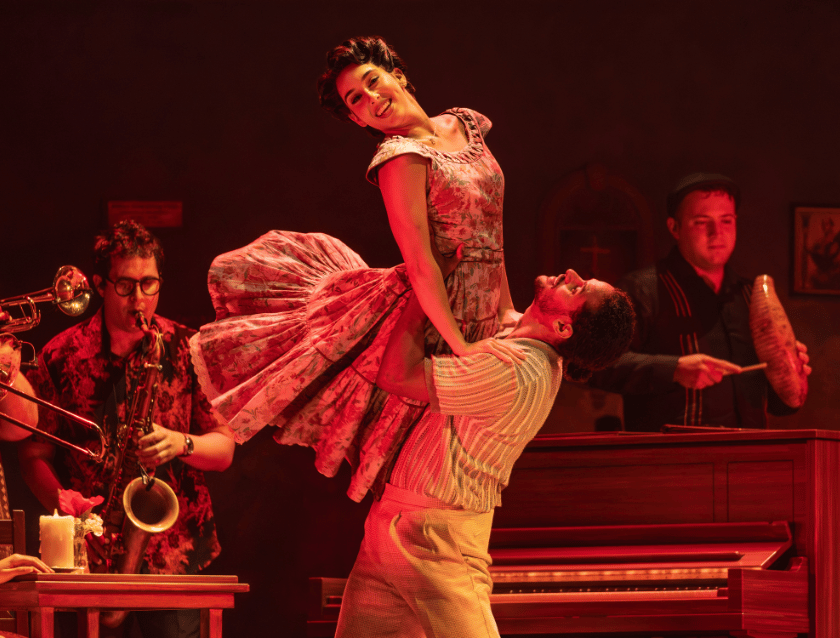
While all of the musical’s dialogue is in English, all songs are sung in the original Spanish, which can’t help but add a frisson of appreciation for Spanish speakers. But because Ramirez made sure to choose numbers with high emotional content – he cites “longing or heartbreak or loss or unrequited love or potential or betrayal” but there’s also exhilaration – the feelings conveyed by the lyrics can hopefully be appreciated by everyone; music is considered a universal language, afterall!
As a child and grandchild of Cuban immigrants, Ramirez remembers his grandfather constantly playing the “Buena Vista Social Club” album on his boombox and was thrilled when approached to write the libretto for a musical about the band. I love how he imagines their coming together at the Havana recording studio as a “reunion” of sorts which sets the story in two timelines, 40 years apart. Havana stage sets showcase the years 1956 (when there’s an underlying sense of danger and political unrest, just before the revolution) and 1996 (when the “Buena Vista” album was first recorded). We also meet the singers and musicians as their young and “older” selves, performed by age-appropriate actors who instantly involve us in the drama of all the alternating “before” and “after” events.
While the actual “how” story is fictionalized, its source and resolution couldn’t be more true to life. Great old-time Havana musicians were recorded and ultimately universally recognized by the world for the incredible beauty and skill of their unique form of music. The play’s opening scene in 1996 focuses on a young and hungry music producer called Juan de Marcos (Holiday). He’s a PhD graduate with two classical music degrees who’s determined to get a band, elite singer, and backing together for what he sees as one last chance to produce a true, Havana-style classical album with musician greats who are still alive or can play the music he considers in the same league as Mozart and Beethoven.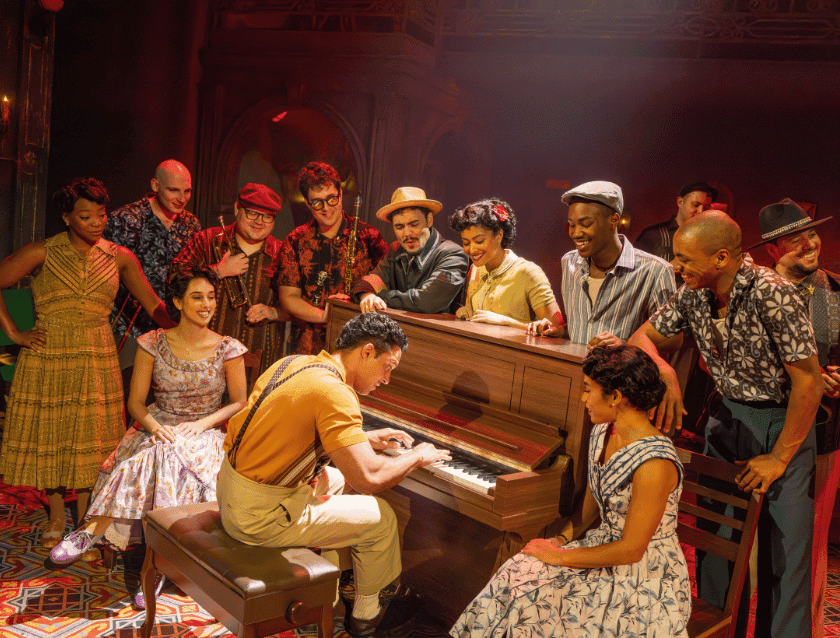
As we enter the theatre, we are immediately struck by the old-world magnificence of the stage with its ornate high, wide balcony under tall arched windows that reveal romantic evening sunsets where two young lovers meet. Or turned into a beachfront promenade favored by an incredibly talented black Cuban singer, Young Ibrahim, (Jaleel Battles Jr.) who literally “sings for his supper” beneath arch-framed vistas of sea and sky. Credit for scenic design by Arnulfo Maldonado and lighting design by Tyler Micoleau.
But even the magnificence of the stage is upstaged by the full Cuban band that dominates the floor, front and center, with a real piano, guitars – including Tres and bass, lots of bongos for percussion, trumpet, trombone, woodwinds … even a flautist! And then they’re off to the races with “El Carretero” and Prelude “Lagrimas Negras.” I was instantly dazzled by the great tunes and the fantastic musicians led by music supervisor Dean Sharenow and music director (conductor/piano) Nicolas Perez with sound design by Jonathan Deans.
The scene suddenly changes to spirited couples performing high-steppin’ dance numbers; their 1950’s swirly skirts swung so high, they exposed frilly white bloomers. My compliments to dance captain Ralphie Rivera de Jesus who didn’t miss a beat and period-perfect costume design by Dede Ayite with hair, wig and makeup by J. Jared Janas.
I admit that no matter how much I enjoyed the incredible live music – including a breathtaking solo by San Miguel Perez (as Eliades) on his shiny black Tres guitar – the clincher to winning me over was the unadulterated joyful energy of Buena Vista club dancers – where you can imagine occupying a table alongside pretty 19-year-old star Young Omara, exquisitely portrayed and sung by Isabel Gonzalez. I was so entranced by all the music and dance that it took a while for me notice how smoothly the entire band and their instruments (including a baby grand) were pulled back on a moving platform that supported them while they played, then curtained off to make room for an expanded dance floor and other set locations. Simple live theater magic at its best.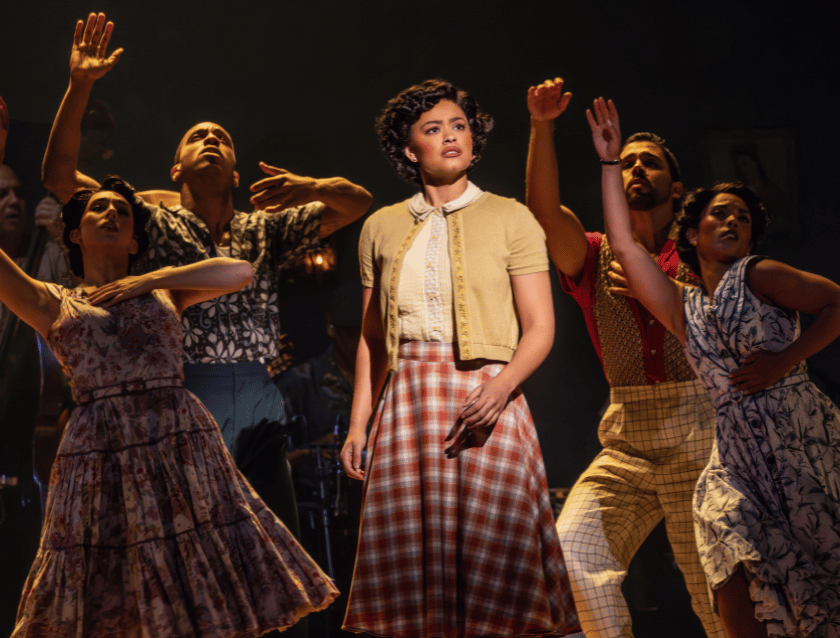
The older, retired Omara Portuondo, played by Karmine Alers, has seasoned into an even stronger presence with powerful vocals who’d gained a reputation as the “Queen of Feeling.” But a sudden tragedy stopped her from singing six years ago. Nevertheless, she is stubbornly pursued by Juan de Marcos for a comeback. When she at first grudgingly, and ultimately enthusiastically agrees to participate in his classic Buena Vista album, working with friends from her past and singing the old songs stir up bittersweet or painful memories of roads not taken (which we see enacted by her “younger” version, alongside the younger musicians that surround her).
Like Young Compay (Aidan Olmo) who first exposed Young Omara to a social club like Buena Vista where creative music and dance is given free rein for the pleasure of the Cuban people, not outside investors. Young Omara already enjoyed a reputation as a singing duo with her conservative older sister Young Haydee (Liana Morales) by performing at the Tropicana Club, a popular tourist destination. Her sudden exposure to original music of the people and the incredible unrecognized talent of black singer Young Ibrahim (Jaleel Battles Jr.) completely upends her life.
Young Haydee, who’s aware of the danger of imminent revolution and desperate to escape the island with her sister, signs a deal with Capitol Records for them both after their performance at the Tropicana. But Young Omara ignores the chaos on the streets and runs off after the show to sing with her new friends at the Buena Vista. When Young Haydee flees to New York, Young Omara insists on staying behind in her Havana hometown.
Things don’t work out quite as planned for either sister, with disappointments in both work and love. When all social clubs are instantly shut down by the Castro regime, Young Omara is quick to sign her own record contract and capitalize on her silky voice, eventually becoming one of Cuba’s most recognized female vocalists. And though she says she’ll bring along her excellent musician friends from the Buena Vista Social Club band, that never happens. At least not until 40 years later when several former club players are reunited for a classic album featuring music and song from their glory days. Including Older Rubén (Robert M. Jimenez) who’d impressed us with his performance as Young Rubén (Irving Aday O’Connor) earlier. And most importantly, Omara makes amends by inviting her super-talented early crush (now a married father of six) Ibrahim (Mauro Castillo) to join them.
Older Cubans who feel nostalgia for old Havana might experience the Buena Vista Social Club musical like a homecoming. But no matter your age or ethnicity, if you’ve lived in South Florida for any amount of time, you’ve likely become infected by the beat of Latin culture that surrounds us – from enthusiastic bands playing at libraries, parks, and restaurants, to authentic Cuban cuisine and colorful works of art. My advice is to just let yourself go and experience the wonderful music with joyous abandon … and feel free to bounce along to traditional song favorites like:
“Chan Chan” – the group’s signature son, evoking Havana’s streets and instantly recognizable for its infectious rhythm, melodic guitar picking, and soulful harmonies.
“Dos Gardenias” – A tender bolero featuring Ibrahim Ferrer’s emotive vocals, celebrated for its romantic and nostalgic feel.
“El Cuarto de Tula” – A lively son with spirited percussion and trumpet solos, showcasing the group’s danceable energy.
“Candela” – A vibrant son Cubano with bright instrumentation and joyful vocals, often cited as one of the most uplifting numbers.
“De Camino a la Vereda” – A rhythmic son that blends traditional Cuban elements with the group’s signature warmth.
The North American Tour of BUENA VISTA SOCIAL CLUB: A New Broadway Musical is only playing now through October 18 at the Au-Rene Theater of Broward Center for the Performing Arts, 201 SW 5th Ave., Fort Lauderdale 33312. Get tickets online at www.browardcenter.org, call 954-462-0222 or visit Broward Center’s AutoNation Box Office in person.