
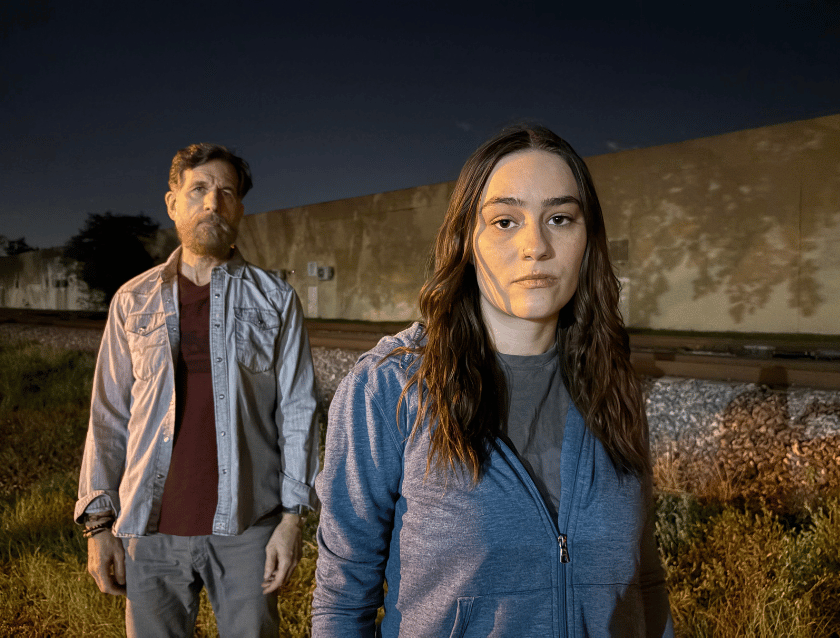
Have you ever wondered how far you would be willing to go for a job?
In this capitalist hellscape of an era, it’s not what I would call a particularly unusual question— but in the play Job, the character Jane is asked to go to some pretty extreme lengths in order to effectively do hers.
You see, as a content moderator, she’s asked to look at some of the most objectionable content on the internet in order to determine if it can “safely” be shared with the general public. And by the time we meet her in the opening scene of this intense two-hander of a psychological thriller by Max Wolf Friedlich, it’s clearly driven her more than a little crazy.
Later, when she starts describing some of the worst of what she’s seen to the audience, we get some idea as to why.
“Horses fucking women, people fucking dead animals,” she describes— and from there, it only gets worse.
In light of that, it’s unsurprising that Jane winds up in a therapist’s office, the setting for the entirety of her ordeal in Job— but to give away only the first of its many twists, I was pretty taken off guard when she immediately pulls out a gun.
But, luckily for Lloyd, the unsuspecting therapist who becomes the target of Jane’s wrath, this one only starts off with a bang metaphorically speaking. And, luckily for the audience, the piece is immediately engaging thanks not only to these life or death stakes but to both actors’ palpable commitment to the situation’s intensity.
Geoff Freitag viscerally conveys Lloyd’s shock and fear in those initial moments, then adeptly navigates the character’s shift into trying to seize control of the situation— but as he settles into being the “straight man” to the more unhinged Jane, his co-star Kimmie Pineda emerges as an even more compelling presence.
Drawing us in right away with an electrifying energy, Pineda conveys both the steely determination Jane seems to want to project and the desperate fragility that is perhaps actually driving her. As the script gradually delves deeper into Jane’s traumatic backstory, Pineda’s handling of the character’s contradictions and complexity only becomes more impressive.
In other words, she, like her character, does not have an easy job.

Interestingly, that fact was actually brought to my attention before I even saw the show by another actress who mentioned that she’d taken herself out of consideration for the role after auditioning, fearing she’d be compelled to seek out and expose herself to harrowing “content” herself in order to do the part justice.
In the show, though, Jane eventually forms an almost opposite relationship to her own work, developing a perverse pride in being able to withstand what Lloyd describes as “torture” for longer than any of her colleagues and growing to see her role in “protecting” others on the internet as a moral crusade. She hasn’t washed up in Lloyd’s office to complain about her job, but because, after having a public breakdown that became a viral sensation, she’s desperate for him to sign off on her mental stability so that she can go back to work.
But she’s not the only one who sees her job as a calling. Lloyd, too, seems to take great pride in being able to protect the vulnerable and rescue “hopeless cases” as a therapist—and the fact that he is able to form what seems to be a genuine connection with Jane even as she is basically holding him hostage speaks to how good he is at what he does. Considering the circumstances, he manages to analyze her behavior quite astutely in a way that obviously strikes a chord with her— and if we at times get the sense that he may just be trying to talk her down by telling her what she wants to hear….when she’s got a gun to his head, it’s not as if we can exactly blame him.
Honestly, I was probably predisposed to take Jane’s “side” in a play like Job as a millennial woman who’s had her fair share of career struggles and weird crash outs— so the fact that Freitag’s portrayal of Lloyd was warm, vivid, and three dimensional enough that I was at times almost more sympathetic to him speaks volumes about how well he handled the deceptively difficult part.
Based on a revelation towards the end of the play that I definitely didn’t see coming, I think I’d even say in retrospect that he might’ve had an even harder job than Pineda did. Though I won’t spoil the specifics of this twist here, I will say that it introduces a possibility about Lloyd that makes Freitag’s performance absolutely chilling to look back on no matter how you choose to interpret the play’s ambiguous ending.
If we take Lloyd at his word, he’s a loving father and caring professional fighting to save himself and his patient in unimaginable circumstances— but if we trust Jane enough not to write off her suspicions about him as paranoia, he becomes someone truly irredeemable who’s simply perfected his facade.
Walking out of this one, I was genuinely torn about which of the two interpretations I would lean towards— and that’s largely because both actors were so convincing that even though their “stories” were mutually incompatible, I somehow found myself basically believing both.