
Given our daily international news shockers, homeless and addiction numbers, soaring unemployment, not to mention the constant threat of gun violence, climate disasters, pandemics and poverty, many in our country would say we currently live in “miserable” times. Why rush to see more misery in LES MISÉRABLES, despite its exalted reputation as the “world’s most popular and beloved musical”? The musical is based on renowned French writer and activist Victor Hugo’s sensational (and banned by the Catholic Church) 1862 novel about the mistreatment and hopeless lives endured daily by the French underclass – especially, the number-tattooed, and thus marked-for-life as felons, incarcerated “criminals” who are routinely debased and used for slave labor.
All of whom, despite the French Revolution of 1789, are once again under the thumbs of a royal ruling class following the 1815 Bourbon Revolution. This is where our story begins; it peaks with the makeshift barricades of the 24-hour June (or “Paris”) Rebellion of 1832, and with nothing changed politically or economically for the masses, we nonetheless arrive at a conclusion that keeps hope alive through a confirmation of love and faith.
So maybe that’s the key as to why a 19th century French sociopolitical drama (and love story in many forms: romantic, filial, etc.) still resonates so deeply in 21st century America (and beyond). We can’t help but feel better about our own troubles when comparing our lives to those less fortunate. Many good guys in the musical die; a few bad apples manage to survive. But those most afflicted by life’s unfairness touch our hearts with their courage, faith and determination to never give up the fight for freedom and a better tomorrow. We witness powerful instances of redemption, selflessness, and love that won’t be defeated, even in death.
Towering above all the reasons why the public continues to embrace Les Mis (as aficionados fondly refer to the musical) is the outstanding, memorable, and frankly incomparable music by Claude-Michel Schönberg with lyrics by Herbert Kretzmer (from original French text by Alain Boublil and Jean-Mark Natel), with additional material by James Fenton, adaptation by Trevor Nunn and John Caird. In this case, so many chefs make for a wondrously rich and nuanced cassoulet that you’d think can’t get more delicious – especially given its famously celebrated original orchestrations by John Cameron.

But as if to insure the most dedicated repeat-fans don’t get bored, new orchestrations by Stephen Metcalfe, Christopher Jahnke and Stephen Brooker still manage to up the WOW factor! Ask most any Les Mis fan why they’re crazy about the show and keep coming back for more, and the first thing they mention is their love of the music.
The musical’s North American Tour, a highlight of Broward Center’s Broadway in Fort Lauderdale’s 2025/26 Season, is playing now through December 28. All the rapidly churning parts are directed with smooth precision by Laurence Connor and James Powell. From the very first, loudly aggressive orchestral notes, you are catapulted back into the world of Victor Hugo’s France – from Digne to Montreuil-Sur-Mer, Montfermeil to Paris. Where your heart and soul are instantly held hostage by the dreams, obsessions, predicaments, bravery and foibles (some of which can’t help but elicit [at least in my case] “guilty” bursts of laughter) of an unforgettable, recurring cast of the most colorful characters you can ever hope to meet.
At intermission, I took a peek into the deeply hidden orchestra pit, laden with typical orchestral instruments but also, at my end, a collection of oversized drums that were obviously often in use – from the second the lights go out to a drumbeat explosion of dark times to later cries of war. Presiding over all those harmonious, yet often melancholy, tunes we can’t stop humming days later is music director/conductor Glenn Alexander II, associate conductor/keyboards Tim Lenihan, violin/concertmaster Ally Jenkins, expert string, brass horn, woodwinds and percussion players, and music coordinator John Miller. Sound by Mick Potter, lighting by Paule Constable and projections by Finn Ross and Fifty-Nine Productions were put to great use in Geoffrey Garratt’s darker, more ominous and bare musical staging. The Napoleonic-era architectural set and image design by Matt Kinley was inspired by Victor Hugo’s paintings. They serve as the perfect background for choreographed numbers led by dance captain Kyle Timson with fight captain Steve Czarnecki. And everyone was dressed to the nines or the zeros – depending on their station – by original costume designer Andreane Neofitou with additional designs by Christine Rowland and Paul Willis.
Lighting and projections were especially important, as other than high balconies and a fancy mansion gate, physical stage structures (excepting the stark makeshift barricade of the 1832 Rebellion) were kept to a minimum. The background, and the poor people, were mostly tinged in somber gray. But when it came time for a solo or group number, a spotlight highlighted those cast members completely. Patrons commented about how they felt connected to the characters in this production as never before because they could clearly see every nuance of emotion they poured forth. Each solo, duet or group number could be labeled a showstopper and was often met (almost before the song was over) with resounding cheers and applause, engaging our eyes, our hearts, and our intellect.

As the musical progressed, I couldn’t help thinking that it would likely be banned from Kennedy Center today, given the current administration’s takeover. Reflecting its philosophical origins, this thinking person’s musical questions the existence of a god who would allow his flock to languish in such misery and there’s even an instance where the almighty is denied altogether. Yet, unlike our entrenched religious and cultural divides, here the same person who questions and denies will also seek solace in prayer (answered or not) and the musical ends with this self-evident truth: “To love another person is to see the face of God.” Perhaps Victor Hugo was observing (as today’s pundits often claim) that in order to achieve our highest, fully human selves, we should be able to hold two opposing opinions at once.
If anyone is a central star of the show, it’s Jean Valjean, or “Prisoner 24601,” who we meet on parole after he’d served a 19-year sentence of hard labor for the crime of stealing a loaf of bread to feed his sister’s hungry child. Valjean’s “yellow ticket of leave” marks him as an ex-con and he’s spat upon and rejected wherever he applies for work because of his past. (No kidding. It’s still extremely difficult for ex-cons to attain honest employment in our society.)
A kindly bishop finds Valjean cold, starving and beaten, and offers him food, shelter, and a warm place to sleep. But now, as if living up to what the world expects of him (a typical psychological response to ongoing criticism), Valjean takes off with the bishop’s silver. He’s quickly caught by his prison guard (and future lifetime nemesis) Javert (Preston Truman Boyd), who will continue to pursue the parole-breaking criminal in the name of “justice” when he rises to Police Inspector. Despite Valjean’s repaying kindness with treachery, the Bishop of Digne rescues his “guest” by claiming the silver items were a gift, and goes so far as to call out: “You forgot to take your silver candlesticks!” But there is a price for his Christian charity. “I have bought your soul for God,” the bishop tells Valjean, instructing him to use his newfound riches only for good.
Valjean takes this unexpected chance at a fresh start to heart, hides his identity under a new name, provides local employment at his factory, and even assumes the position of mayor of the town. But when he hears that Javert had arrested someone in his place, he wrestles with his conscience about letting an innocent man go to prison in “Who Am I?” Ultimately, he decides to take the high road by exposing his chest with the 24601 tattoo to Javert. Happily, he does manage to escape Javert’s subsequent attempt to arrest him … for now.
Nick Cartell’s portrayal of the many lives of Jean Valjean is a wonder to behold, and his vocals are nothing short of breathtaking. He’s the perfect anchor for the show, but I was nonetheless amazed to learn that among his various musical and stage credits, Cartell had clocked “over 1,500 performances as 24601.” So of course, his Valjean was flawless … but also incredibly fresh and exciting for everyone who joined me at the Au-Rene Theater’s opening performance!
Here are several musical number highlights (but like I stated before, they are all great!). The musical’s beaten-down, dismal theme is introduced early on in “At the End of the Day” featuring a large cast of Unemployed and Factory Workers. Lindsey Heather Pearce’s Fantine is so lovely and tragic a figure that I’m sure, for women especially, it’s difficult to watch her being targeted and pounced upon by (likely envious) fellow female factory workers through no fault of her own. Unless one counts getting knocked up by a faithless guy, though this innocent soul still hopes for his return. The plight of a stigmatized unwed mother was never so brazenly and cruelly portrayed.
Just this morning, I heard a sex worker activist on NPR radio complain about how prostitutes are marginalized in our country and subject to extraordinary danger. Because they fear getting arrested when reporting abusers to the authorities, dangerous male perpetrators are allowed to roam free while their victims face being charged with illegal prostitution. Sounds much too similar to what happened to Fantine when a rich, entitled bastard struck her after she rejected his advances at a whorehouse where she’d come to sell the last of her meager jewelry (and even her hair) to support her young daughter after losing her factory job.

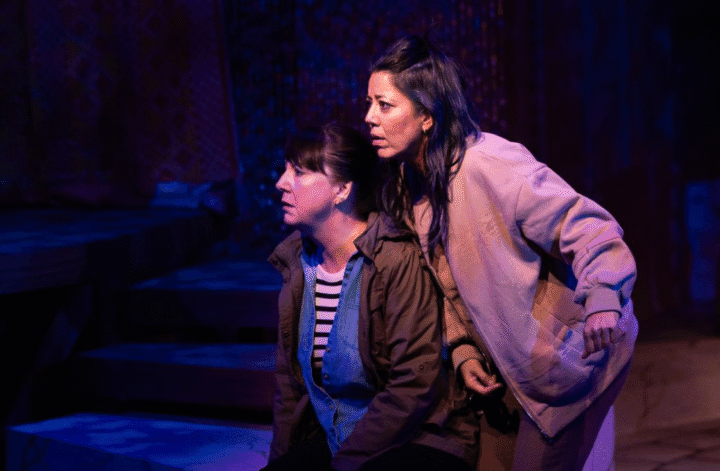
with her rendition of the iconic “I Dreamed a Dream.” Photo by Matthew Murphy.
The rejected elitist accuses Fantine of attacking him, and then she was beaten so badly, that even when Valjean recognizes her, regrets having fired her based on malignant accusations and gets her the best medical care, she can’t recover. He does, however, grant her dying wish to care for her daughter Cosette, like a father, for life. For us, too, it’s a shame that Lindsay Heather Pearce as Fantine departs the show so early as her rendition of “I Dreamed a Dream” couldn’t be more gut-wrenchingly beautiful.
Because of how naive and desperate Fantine was mistreated by the admittedly hardened prostitutes in “Lovely Ladies,” starring the Ladies and their Clients, I found it difficult to laugh at their out-their smutty shenanigans, though many in the audience loved this rollicking good-time girls and sex-crazed guys number. It definitely offered comedy relief.
The horrible, greedy innkeeper couple who Fantine paid to look after her daughter, had turned the young girl into a Cinderella-like maid, complete with one pampered, nasty “stepsister.” Lillian Castner or Kayla Scola-Giampapa play Little Cosette who’s shabby dress can’t hide her pure child’s heart as she dreams of love and comfort in a “Castle on a Cloud.” A place far away from selfish and manipulative “Master of the House” Matt Crowle as Thénardier and his equally amoral wife, played by Victoria Huston-Elem. It’s quite something to watch how these two social parasites manage to survive to prey on others for another day.
The Thénardiers’ daughter grows up to be coarse like her mother, but not as cruel. Jaedynn Latter as Éponine stuns the audience with her powerful vocals in “On My Own” which opens Act II. By spending their childhood in the same house, despite very different circumstances, both girls appear to have developed a penchant for living in their imaginations. For Éponine, it’s pretending she’s walking with, and being held by, the object of her affection, Marius … who’s actually in love with Cosette. Peter Neureuther as Marius is also a young student leader of the Rebellion, and it’s only thanks to Valjean that he barely makes it out alive when most everyone he’s fought with has been shot dead. His moving, melancholy “Empty Chairs at Empty Tables” will evoke tearful recognition of an old war memory or more recent Covid loss.