

Does a bull belong in a China shop? Well, when that “China shop” is actually “the patriarchy” and that “bull” is actually a woman ahead of her time, the takeaway from the standard cliche is actually far less obvious. For playwright Bryna Turner, the proverbial bull is early feminist Mary Woolley, whose bull-headed ways butt against glass ceilings in a way that makes for a compelling script’s worth of drama.
In only about 90 minutes, Turner’s Bull In A China Shop barrels through 40 years of Woolley’s battling with convention as president of Mount Holyoke College. But the real focal point of the script is the enduring relationship she shared with lover Jeannette Marks, a fellow faculty member about 10 years her junior. It was a romance that was visible enough to raise eyebrows at the college despite being a societally forbidden one, and one that would ultimately endure for nearly five decades against the odds.
Turner based her script on the real letters that were exchanged between the two, and ably spins a surprisingly affecting narrative from their century-old words. Rather than insist her story stay strictly anchored in these historical constraints, though, Turner takes a few liberties she refers to in the script as “purposeful anachronisms,” which presumably make the character’s experience more relatable to a modern day audience.
This feels like an appropriate choice for this look at women who rebelled against just these historical constraints, a vibe also reflected in the sound design team’s choice to use recognizable modern pop songs as transitional music.
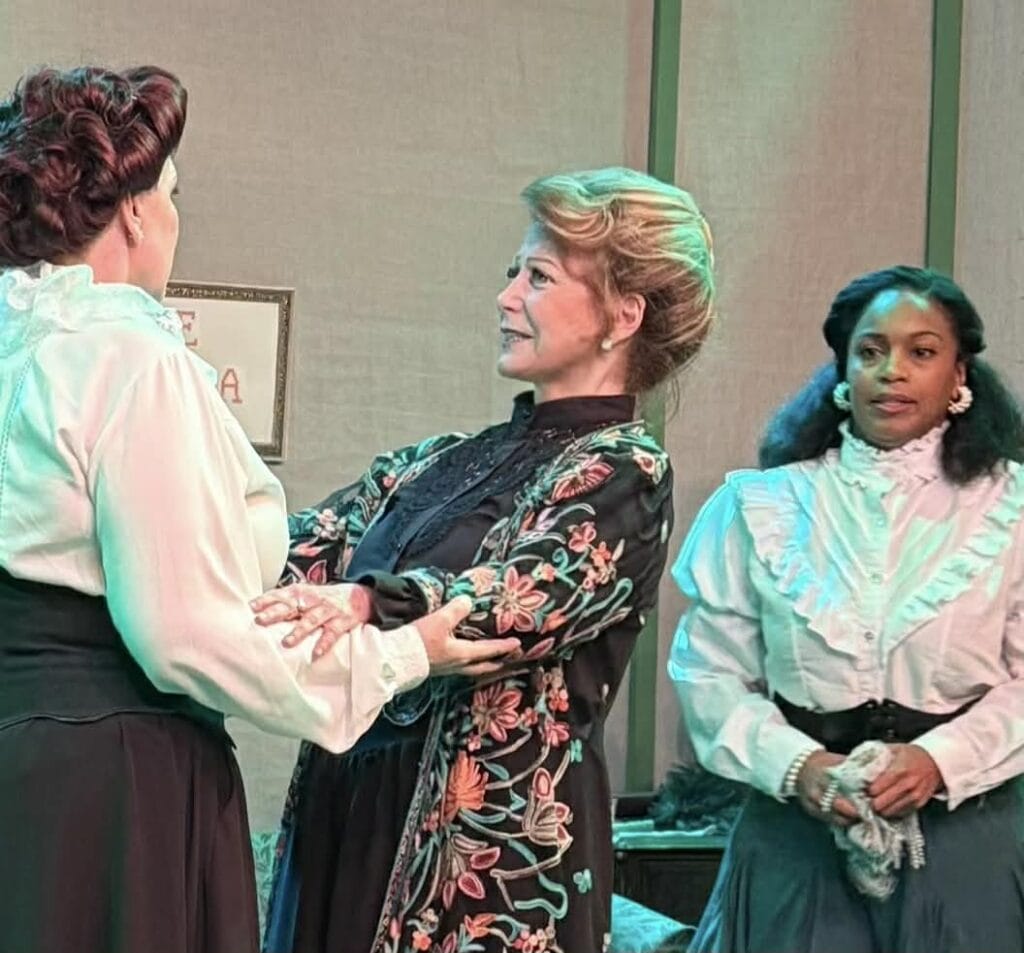
This also allows the play to feature a more diverse set of women as students and faculty at Mount Holyoke college than would have realistically been possible in the early 20th century, where it primarily takes place.
In this production, the all-female cast of five is another of its main selling points, with Beverly Blanchette giving a powerful central performance as Woolley herself. As Marks, Sharyn Peoples is the other most apparent standout, balancing the character’s idealistic intensity with the pettier, more immature tendencies that can emerge in her day to day.
The other three women in the ensemble are tasked with portraying more supporting figures. Lory Reyes can only show so much range as a fairly one note authoritarian administrator, but Xiomara Tejera is given the chance to show a little more vibrancy in the role of Felicity.
Last but not least, Keri Bruner makes the most of what otherwise could’ve been a forgettable role as Pearl, an earnest student who Marks engages in a brief affair. For Marks, the affair is clearly inconsequential, but for Pearl, the stakes of the moment are all too real.
In a provocatively staged monologue, Bruner brings plenty of intensity as Pearl delivers a poetic plea to Marks that expresses a striking mix of desire, aggression, and an overwhelming need to possess.
“I want my love to mar an institution,” she describes.
Director Gary Solomons does a commendable job of making the play’s dialogue feel intimate and engaging rather than dry or dated. And though women today may have far more freedom than they had in Woolley’s day, Bull in A China Shop struck me as a particularly resonant pick for the present moment because of our current administration’s efforts to condemn queerness and limit female autonomy.

Today’s women might do well to take a bit of inspiration from Woolley’s bullish stubbornness or Marks’ choice to risk her reputation by engaging in civil disobedience. All in all, this show is an impressive early offering from Bridge Across the Pond Theater Company, a relatively new group created by Solomons and fellow founder Dan Levine.
Their name comes from their stated goal to “bridge the atlantic through the power of performance” by “celebrating the artistic excellence of both American and British theater.” In Bull in a China Shop, they also happen to have built a bridge between the struggles of modern American women and of our historical predecessors.
This elegantly crafted and excellently staged piece will be playing at Empire Stage until only this April 26th, so don’t miss your chance to see this talented ensemble bridge the gap for yourself!