
I was blown away by Conversa (part 1 of Joanna Castle Miller’s autobiographical trilogy) and couldn’t wait to see part 2, INFERNA, another Theatre Lab world premiere that’s now also the featured opener of Forida Atlantic University’s (FAU) Owl New Play Festival. Once again, I was struck by the playwright’s originality, performance talent (she also acts in both plays), and breakaway message for the masses who are complacent about our bible brainwashed, sexist, and brand-manipulated society. Also, don’t worry if you missed Part 1 (which Castle Miller occasionally references, in jest, as “my other play”). My theater partner only saw this one and can confirm its standalone power to entertain, enlighten … and end with an emotional kick in the gut!
We can tell we’re about to see “something different” as soon as Joanna (Joanna Castle Miller playing herself), who’d been sitting in a chair quietly on stage, is asked if “she’s ready” and rushes to grab some papers before personally pulling the curtain shut over scenic designer’s K. April Soroko’s brick walls and wide central window (for projection designs by Manny Zaldivar). Now the spotlight’s on Joanna (Eric Nelson lighting design), and we get an inkling about what’s coming – but not in the way you’d expect – when “Get Me to the Church on Time” plays in the background (Matt Corey sound design with associates Manny Zaldivar & Tyler Grimes).
Keeping up with hyper-energetic Joanna Castle Miller is no easy task and her earlier show’s director, Theatre Lab’s producing artistic director Matt Stabile, was kept busy directing Deborah Zoe Laufer’s & Daniel Green’s new musical, By Any Other Name, for FAU’s Dept. of Theatre & Dance across the pond. (Wish I could have split myself in two and seen both!) But Stabile secured the ideal, highly experienced and local favorite artistic director of City Theatre Miami, Margaret M. Ledford, to take his place. As expected, director Ledford did an excellent job.
The third wall is immediately broken as Joanna proceeds to introduce herself, in a friendly folksy way, then points a handheld clicker to project the play’s title in big, bright letters while announcing,“Inferna, a play by me.” (She’ll subsequently click lit-up titles of future scenes such as “Imagine Not Dying,” “Total Depravity,” “Invitation,” and the finale that keeps us guessing, till it drops like a bomb, “I Don’t Like That Part.”
The play is set in “present day 1999” but opens several years earlier as it takes a deep dive into Joanna’s everyday life as an active and ambitious young participant of her 33,000-member Evangelical Southern Baptist Church. The church’s intense Sunday youth programs (not to mention their missionary zeal) provided a fascinating, if often horrifying (to the unfamiliar like myself), window into the machinations of the movement. Joanna describes endlessly active Sundays that include working with younger kids as Pickles the Clown, intense Bible Drill competitions, frank confessions with her “Accountability Partner” … but also participation in church-sponsored choir and theater with a youth pastor who preaches: “When you have God and pizza, you want for nothing.”
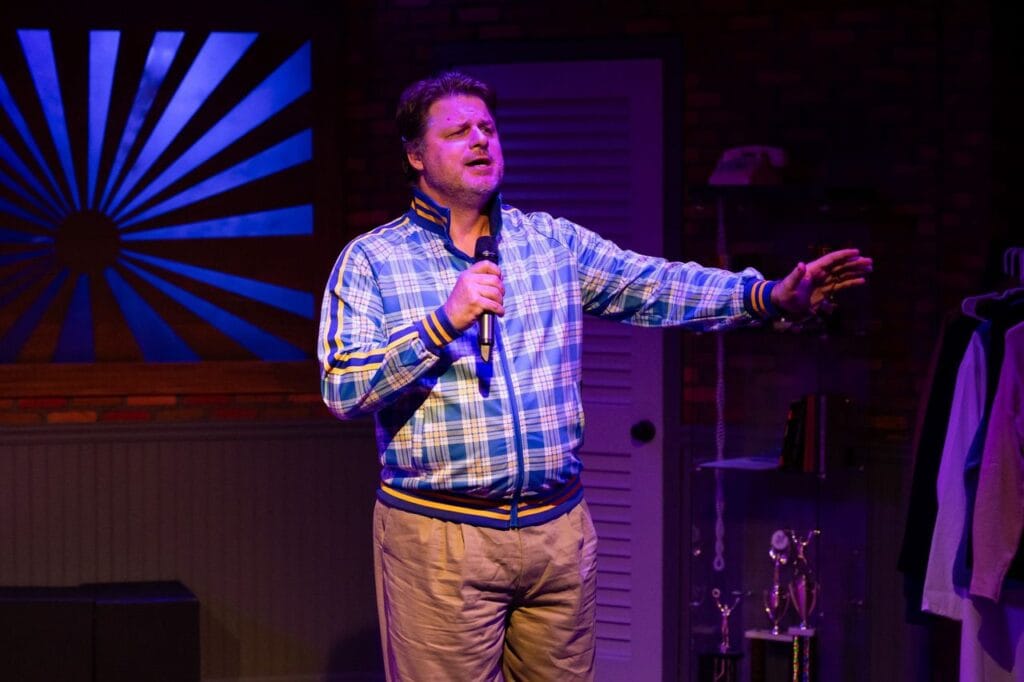
Assuming the role of Youth Pastor, and every other male position in this two-person play (including playing himself as Joanna’s onstage assistant, Jeff) is Male Actor, Jeff Burleson. Burleson was right on the button in portrayals as varied as a Southern-accented Almighty God, Joanna’s young church friend, to cringy movie director. (I wonder if he can now add all these cool parts to his resume?)
An annual event attended by Joanna’s seventh grade Bible Study class (I assume in lieu of Halloween haunted houses) is called “Judgement House,” a Fright Night recreation of a visit to Hell. The kids are led down plexiglass halls to a dark basement where they first see Greg (Jeff Burleson), whose car is still running, in a graphic, carbon-monoxide-poisoned tableau of dead teens guilty of making-out in the garage.
They observe drunk drivers involved in vehicular manslaughter and crashing airplanes where some rise in rapture while the unsaved are condemned to eternal damnation as depicted in immersive views of howling, flame-licked bodies in the burning pits of Hell. Horrified, concerned youngsters are told in no uncertain terms that it’s their responsibility to save their family and the people they care about by convincing them to accept Jesus before they suffer a similar fate.
Don’t worry, there’s plenty of wry humor inserted among Joanna’s horror stories, and even musical interludes wherein she treats us to her lovely singing voice, often accompanied by Jeff on guitar. Especially notable is Joanna’s beautiful rendition of Evangelistic hymn, “Angels, Ever Bright and Fair,” featuring music by Handel.
Ironically, despite presenting details on how she’d been brainwashed to follow the Baptist religious “script” for much of her young life, she’s often stopping her monologue to loudly shout “line!” to assistant, Jeff, who then rushes over with the play’s script so she can pretend-read her next lines. And, as is her way, she has a knack for also getting the audience involved in her scenes. Like when describing a famous theatrical tragedy from a woman’s point of view, she’ll stop and say that’s OK because … “It’s a comedy!” After a few such instances, she’ll point to us and we all shout back “It’s a comedy!” on cue!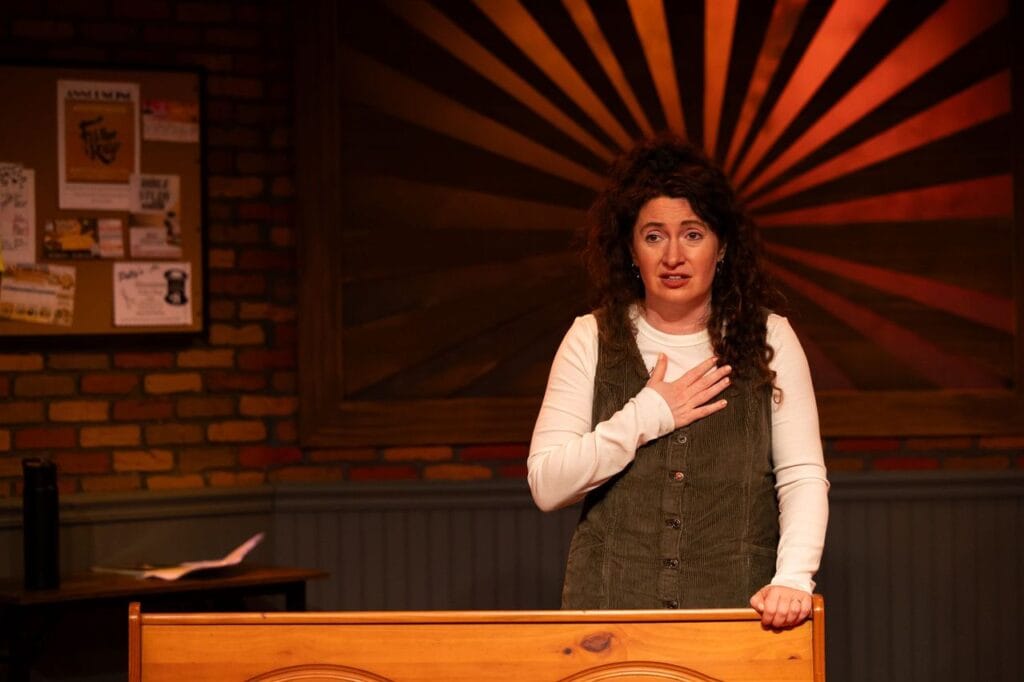
Here are a few examples that further illustrate Joanna’s burgeoning love for theater (she wrote her first play at age 13) and her unique conclusion (at least for a while) that she could worship two Gods – the God of her Church on weekends and, on weekdays, the God of Theater as embodied by The Playwright. She explains: “The playwright is God because you are not allowed to change anything he wrote.”
After seeing a live production of Camelot (an old family tradition still kept by her staunch Evangelical mother, who’d been born and raised Jewish), she adds the musical’s book writer and lyricist Alan Jay Lerner, who “had three Tony Awards and eight wives” to her hero list. Right after Jesus, Queen Esther, and certain Dogs. Joanna reveled in depictions of the plight of charismatic women in famous musicals where things didn’t end well for them … but not to despair, “It’s a comedy!”
In the late ‘90s when she was 12, Joanna applied for a part in Fiddler on the Roof and when asked if she could play someone “older” said, of course, and being homeschooled, had no problem with rehearsal times. So she was cast as 14-year-old Chava who, not particularly excited about a parental “match,” falls in love and marries a handsome Russian Orthodox Christian. Joanna enjoys playing against her good-looking, broad-shouldered adult counterpart and laments how Chava’s father (milkman Tevye, the fiddler) seems angrier at his daughter for going against his wishes (and tradition) by marrying outside the Jewish faith than he is at the Czar for allowing pogroms and ultimate banishment of Jews from their shtetl, the community’s generations-old home. But … “It’s a comedy!”
Joanna’s skilled performance in the local show also proves to be a turning point in her life. She’s seen by professional theater director Jack (played by Jeff Burleson, of course) who befriends her and ultimately convinces her parents to allow her to attend a public arts high school which she considers a godsend; she flourishes in AP classes and in Jack’s film course. But when she’s 16 and he casts her in a role where she’s suddenly required to appear pants-less (just in a man’s long shirt or, as they later compromise, in boxer shorts), she nonetheless “felt dirty,” having not yet learned to say, “I’m uncomfortable with that.” Still Joanna feels she owes so much to Jack for recognizing her talent early on and, in effect, turning her life around.
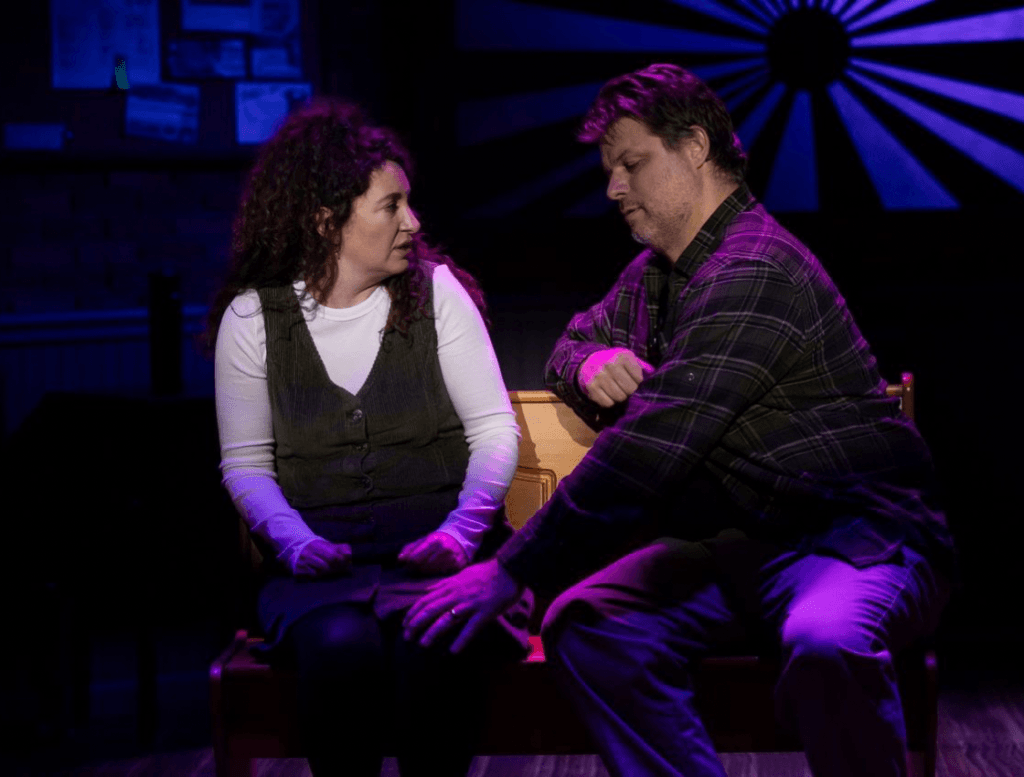
When allegations begin circulating about Jack’s predatory behavior against other young female actors, she becomes his loudest defender. We see similar scenarios being played out in Hollywood quite often nowadays, but back then men in the industry accused of sexual misconduct almost always prevailed. When Joanna realizes her error in not believing fellow female cast members, her anguish is so visceral, we feel heartbroken as well.
Distraught Joanna feels genuine regret for not having believed, and supported, accusations of sexual misconduct against her beloved film instructor. Morgan Sophia Photography.
Remember, this is an autobiographical play. Given the ferocity of the playwright’s nature – both in early Baptist indoctrination and its later abandonment in favor of a fiercely feminist take on art and life – we can understand her desire to “preach” the gospel of female wariness toward men. In truth, there exist far too many statistics to support her claim for caution. Joanna informs us that in our sexualized culture, one in ten kids will fall victim to groomers and pedophiles. Sadly, these numbers are much higher when it comes to coaches and arts teachers who have the greatest access to our youth.
As she did in her earlier play, Joanna again involves the audience in a prayer ceremony – this time acknowledging our abusive culture tropes, then having us promise, as bold creators, to ignore them and instead create only beautiful work for future generations. She asks the audience to close their eyes and repeat a few lines aloud that begin with “I am a human being steeped in a culture of abuse.” Sorry, Joanna, especially after all you’ve pointed out here and despite your honorable intentions, I can’t bring myself to affirm anything I haven’t seen or read first.
While the logical atheist in me can’t help but reject the group prayer aspect, as well. Though it was interesting to see how many (practically all, it appeared my friend and I were rare holdouts) followed Joanna’s lead. Like I felt (but didn’t say) earlier regarding Conversa: There’s no need to end your plays with a prayer. Inferna’s ongoing message and heart-wrenching final scene are powerful enough to stir anyone who’s paying attention to action!
Act fast to see INFERNA as it’s only playing through April 26 at Theatre Lab on the north campus of Florida Atlantic University (FAU), 777 Glades Road, Boca Raton 33431. For tickets to Inferna and info about additional, exciting Owl Festival world premieres, all ending by April 26, head to www.fau.edu/theatrelab/owlnewplayfestival/ Or call 561-297-6124.