As a writer, I’ve always kept a special place in my heart for the written word. My husband, a lifelong professional wordsmith and bibliophile, collected antique printer’s blocks in wood and metal that often found their way as decorative paperweights (yes, we still used paper) throughout the house. I could look up a letter’s design name in the hefty “Typeface” books he kept on shelves above his desk. How could I resist a man whose first dating gift was custom “Ex Libris” (From the Library of) bookplate stickers to identify my personal library?
I’m not a complete dinosaur. For quick access to my book club’s trendy novels, I will reserve e-books from the library. Still, I haven’t completely abandoned the special pleasure of communing with a literary work through touch and smell and the sheer visual appeal of words on paper whose typeface was carefully selected – at times even named and explained in the author’s comments. A purposely curated print design vibrates intimately with the reader at every stage of life – piercing or uplifting the heart, engaging the soul. Then, like reconnecting with a reliable, wise old friend, a reread can awaken ever-deeper mysteries while providing both comfort and new observations.
For all the pleasures and gifts of reading, we can thank German inventor and craftsman Johannes Gutenberg who invented the printing press in 1450, in effect bringing literacy and education to the masses. Ranked high among “the most influential people in history,” by establishing affordable, movable-type print production, Gutenberg is credited with setting off the information revolution that made the ensuing Reformation, Renaissance, and humanist movements possible. How and why the man embraced the life of an inventor and then based his technology on existing wooden wine and olive presses is fascinating reading on its own … and worth some personal research! But I admit, when I heard that Pompano Players, the excellent professional resident theater of Pompano Beach Cultural Center, was doing a show called GUTENBERG! THE MUSICAL! I immediately ordered tickets! Based on the title alone.
Which, ironically, made me almost as ill-informed as the show’s two lead characters who play earnest but clueless playwright/composer/lyricists enacting multiple roles as they pitch their musical to producers in hopes of securing backing for their new “Broadway hit” about the great printing press inventor. Despite having done little, if any, research into his actual life. And if some facts don’t exist or fit into convenient song-and-dance numbers … well, the show must go on!
I’ll try not to give away too many spoilers so you, too, will be gobsmacked (yes, it’s the perfect British descriptive for “stunned and astounded”) as you shake with laughter at the outrageously zany characters, clever Broadway song parodies, brash humor, wit, plot twists and surprises galore! In short, an ingeniously playful musical comedy concoction that’s truly one of a kind!
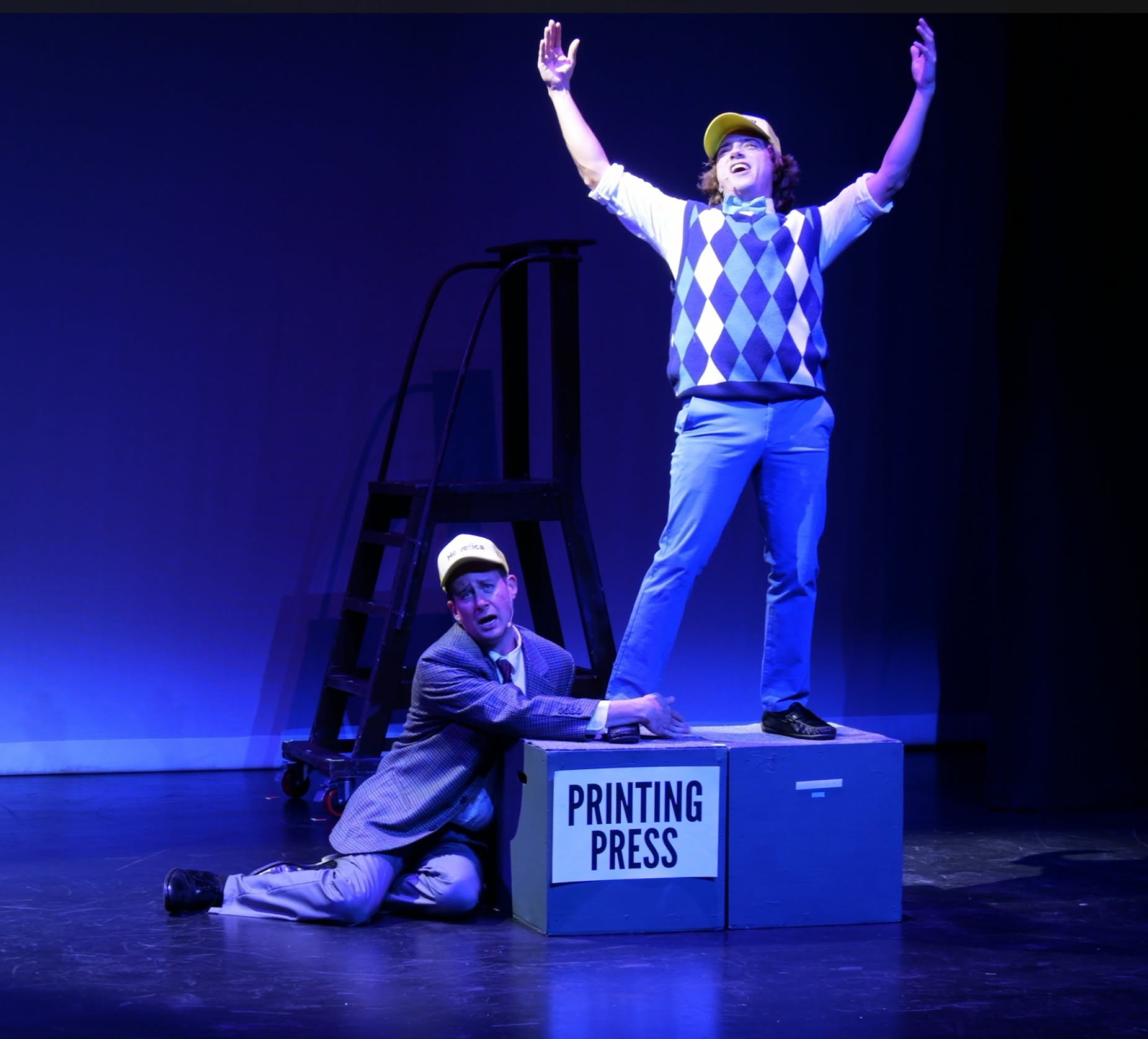
I did later look up the musical’s background, and was thrilled to discover we can now catch the South Florida Premiere on the exact twentieth anniversary of their original off-Broadway hit run. And following a more recent, critically acclaimed Broadway revival which earned a Tony Award nomination for Best Revival of a Musical in 2024 … to add to accolades from the Drama Desk, Drama League, Lucille Lortel and Outer Critics Awards. Proving, as asserted in the show’s finale – an audience-participation number called “We Eat Dreams” – that one should never give up on a dream. Just take the long – but ultimately successful – journey of this quirky little musical, first envisioned decades ago by creators Scott Brown and Anthony King (both credited for book, music, and lyrics), as a glowing example!
No problem convincing Pompano Players’ mega-experienced executive producer Kevin Barrett to mount the show. Here’s how he describes this unconventional musical to hesitant audiences: “If you think you don’t like musicals, this is one that changes your mind. It’s a comedy that happens to have songs, and it spends the whole night making fun of everything people say they don’t like about musical theater. Twenty years on, it still works and South Florida has never had the chance to see it until now.”
I must add for those of us who DO love musicals, this send-up of the genre, if anything, comes across as a no-holds-barred, SNL-style parody of what it really takes to bring a show to the stage … let alone Broadway. I also love how the actors continually address us, the audience – who’ve been hijacked into the role of potential producers – with their enthusiastically enacted “play reading” of a pitch. Though we must cut them some slack, because they often also drop the producer pretense to stop and talk to us as an ordinary, unschooled-in-the-workings-of- musical-theater folk. When they make a point to explain just why they’ve chosen a particular person or theme in their dramatic action sequence.
Like best-selling novels, popular musicals tend to follow a rather rigid blueprint that works beautifully, and we take for granted. Trust me, whether you’re familiar with any or most of these “theatrical rules,” you’ll be happy to hear them again because: 1. The examples given, mimicking the sound and style of recognizable hit numbers, are hilarious! And 2. This musical theater “master class” might actually teach you something new about what goes into creating your evening’s entertainment … with far less learning pains than even an Improv safe-driving course.
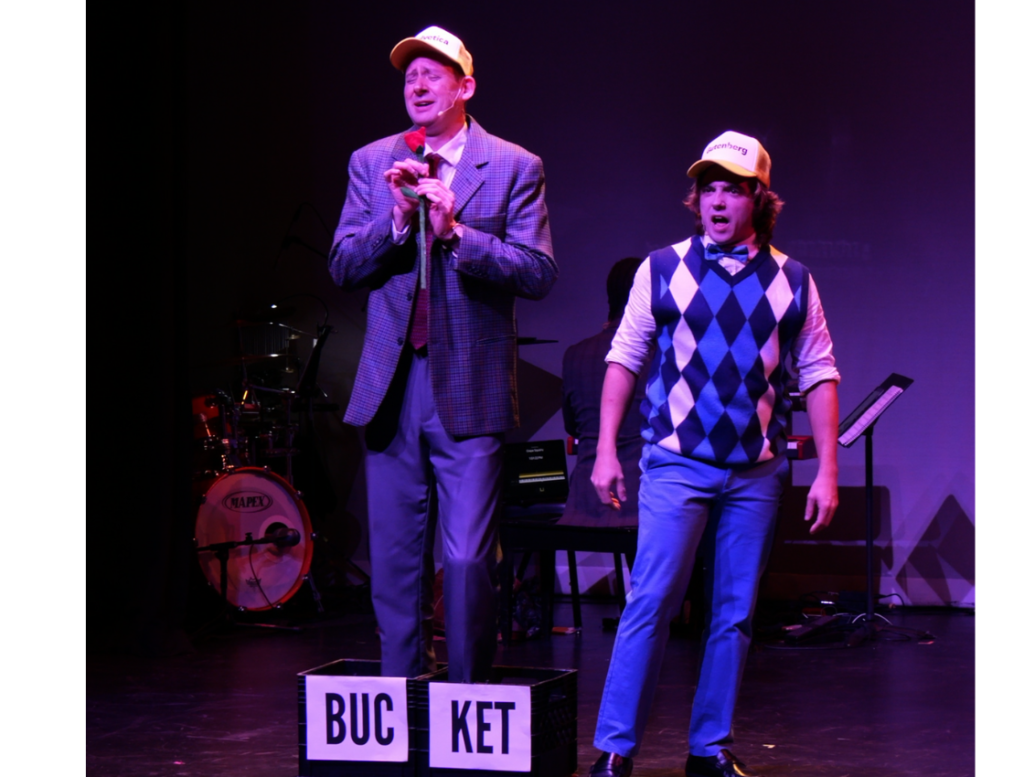
It’s time we met our evening (or matinee) hosts, who have no qualms about introducing themselves both as their in-character names, and later as themselves – actors and vulnerable human beings. Two extremely versatile, talented, and much-in-demand local thespians totally rock the roles of Bud Davenport, starring Michael Scott Ross, and Doug Simon, starring Brian Piedra. Doug introduces himself as the musical’s “book” script writer, Bud composed the music or “score,” and they both wrote the lyrics.
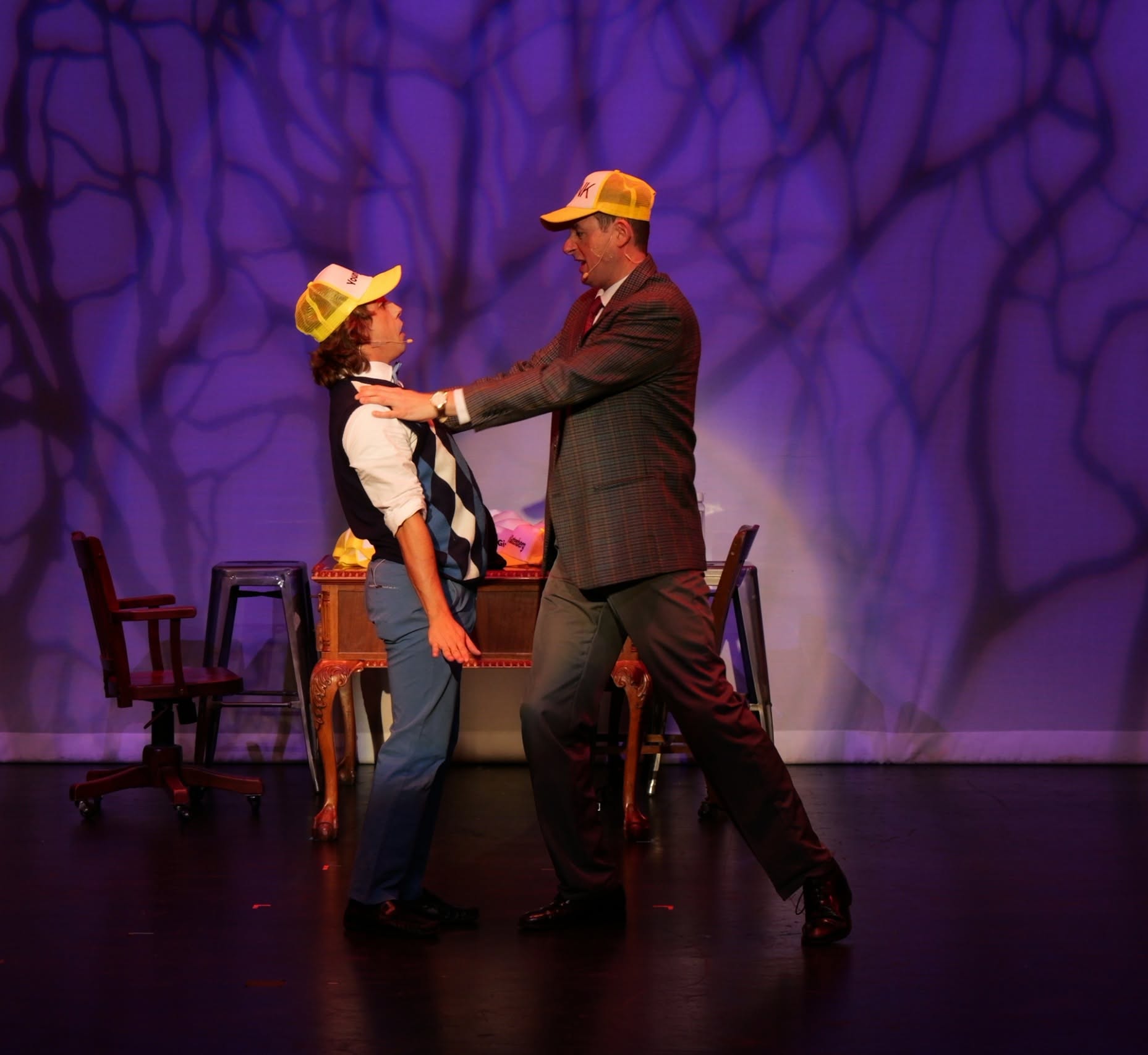
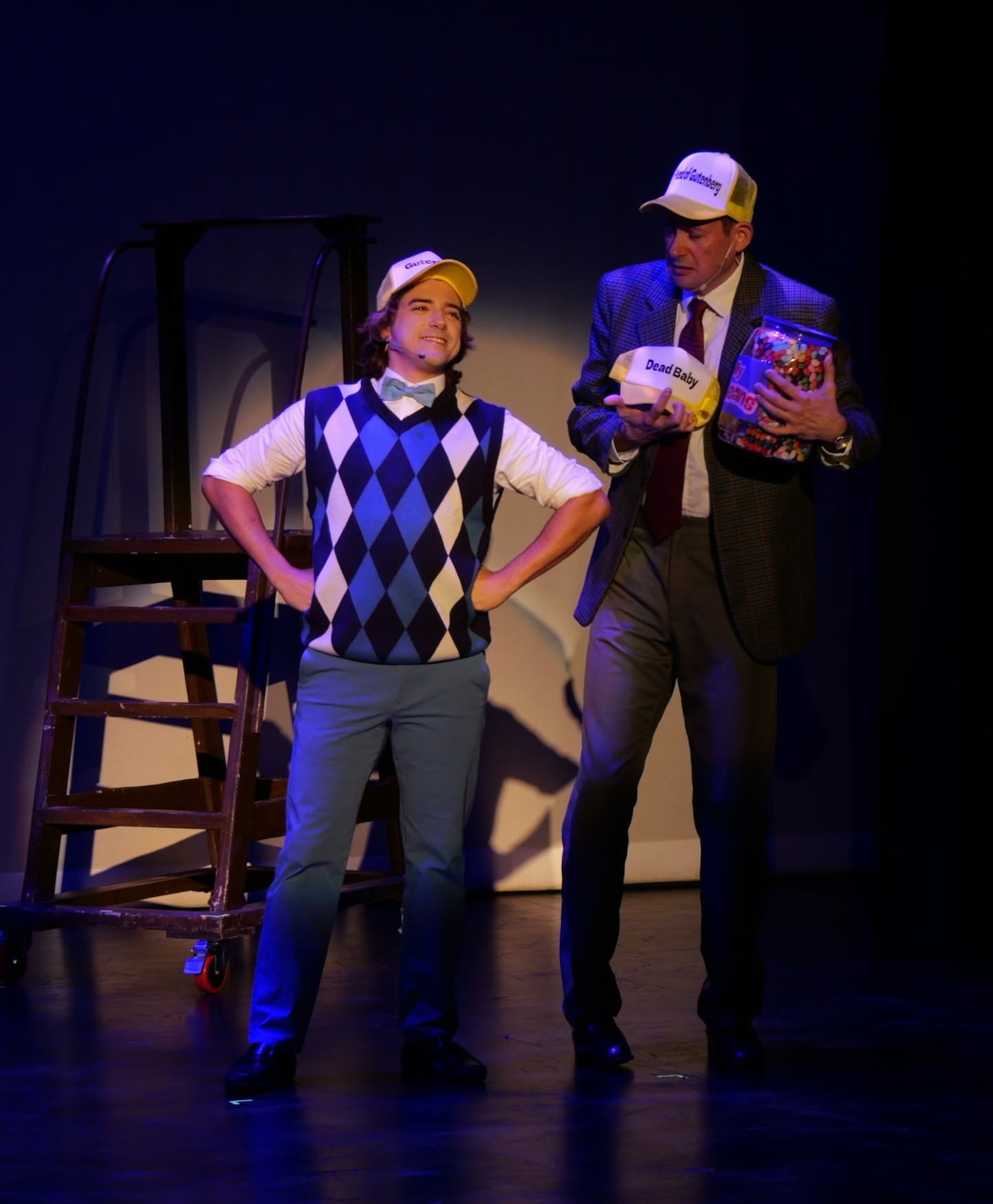
But as you’ll soon discover when they proceed with their vividly enacted script reading, the musical is packed with multitudes of secondary characters – both ongoing and short-lived – which these two actors portray as well. How do they do it? Simple. All it takes for a sudden, frenzied change of personality, even sex, is to plop a yellow trucker’s hat on their head with the character’s name printed on the front. A center stage table holds dozens of these hats, and our actors manage to get just the right one – though this often means piling them up on their head like a leaning Hat Tower of Pisa. Happily, they also tell us who they’re suddenly playing because unless you’re seated at premium stage-adjacent tables, it can be hard to make out the hat’s lettering – even from those excellent sightline, stadium-seat rows.
Be ready for traditional musical song-and-dance that’s loaded with spoof lyrics and exaggerated moves. Brian Piedra (Doug) most often (but not always) plays Johannes Gutenberg; while tall Michael Scott Ross (Bud) has an ongoing role as Helvetica, the story’s female love interest which also serves as an example of the “I want” song (and yes, at least here, the source of the popular font’s name). Both actors perform many impressive vocal numbers, but it’s obvious Ross was chosen as the alternate “female” lead for his striking, soprano-like singing ability.
Dialects change with characters as well, though none are particularly historically accurate. For general 15th century, we hear stuffy British accents. A horrid devil of a Monk, who’s bent on keeping the populace illiterate so he can have the Bible say what he wants it to, sports the southern-American accent and demeanor of a discredited televangelist. Monk tries, but fails, to get Gutenberg – who ask for a copy of his bible to share with the populace (we know the Gutenberg Bible was one of his earliest print jobs) – to abandon his goal of widespread literacy and, as in repeated song “Monk With Me,” join his self-serving cause.
Monk and his black cat, Satan, also provide plenty of opportunities for what our script writers cite as “character development.” An elaborate story number called “Haunted German Wood” features an Elvis-sound opening to describe Monk’s first interaction with the Devil. But we’re also introduced to a musical’s song for no reason, called a “Charm Song,” in “Biscuits.”
Claiming Google had no information about Gutenberg’s early life (which is true, though we can learn how the printing press idea came about and the growing pains of getting it off the ground), our musical’s presenters decided to create simple, if often horrific short scenes where the ability to read was a matter of life or death. Like when a sick infant dies after being treated with jellybeans in place of prescribed medicine because his father can’t read the jar labels. Still, there’s likely some underlying truth in how Johannes explains why he’d switched from wine making to printing: “What’s the difference between a wine press and a printing press? One makes you drink; the other makes you think.”