They say that all the world’s a stage…. But actually…. What if all the world’s a zoo?
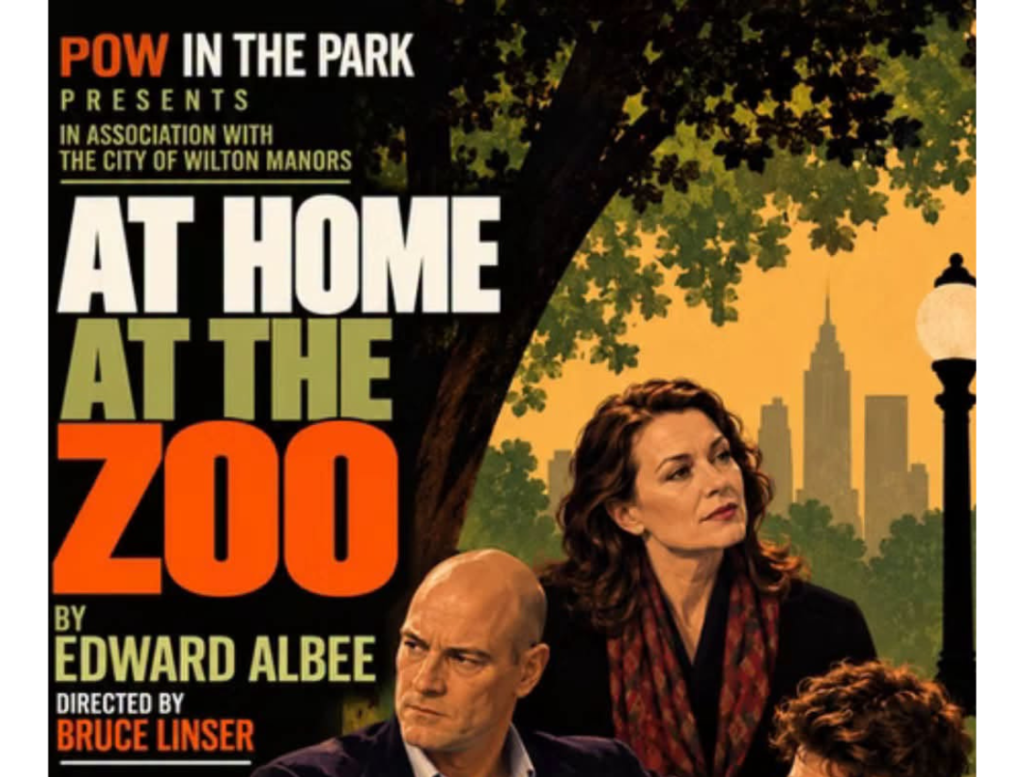
I wouldn’t say that’s exactly the question asked by Edward Albee’s At Home at The Zoo or by Plays Of Wilton’s production of it, but it is one of many, many questions one could say that I left the theater thinking about….. Except for the fact that, technically speaking, there was no “theater” at all. Rather, this set of one-acts was the latest to be staged in Richardson Park as part of the company’s wildly successful free outdoor theatre series— a choice that elevated the already phenomenal production into something truly thought-provoking.
You see, by staging At Home at The Zoo’s second act “on location” in the park, producer Ronnie Larsen and director Bruce Linser found a unique way of bringing the spark back to the oft-staged one-act, which made a huge splash when it first premiered on its own as Zoo Story in 1959. It was only decades later, in 2004, that Albee gave the story a formal prequel in Home/Life, a more understated piece that gives Zoo Story’s anonymous everyman of a protagonist Peter a specific domestic backstory.
Hearing this as someone only familiar with Zoo Story thus far, you might reasonably expect Home/Life to reveal something about Peter that helps “explain” the shocking actions he takes afterwards. Interestingly, it doesn’t— at least in any straightforward psychological sense.
Dramatically, though, the additional context does serve to emphasize the near-impossibility of achieving human connection as a defining lens through which one might interpret A Zoo Story, which is where I think the immersive staging of the piece becomes more than purely ornamental. In their own ways, both halves of At Home at The Zoo seem to be asking: is there intimacy here, or only artifice?
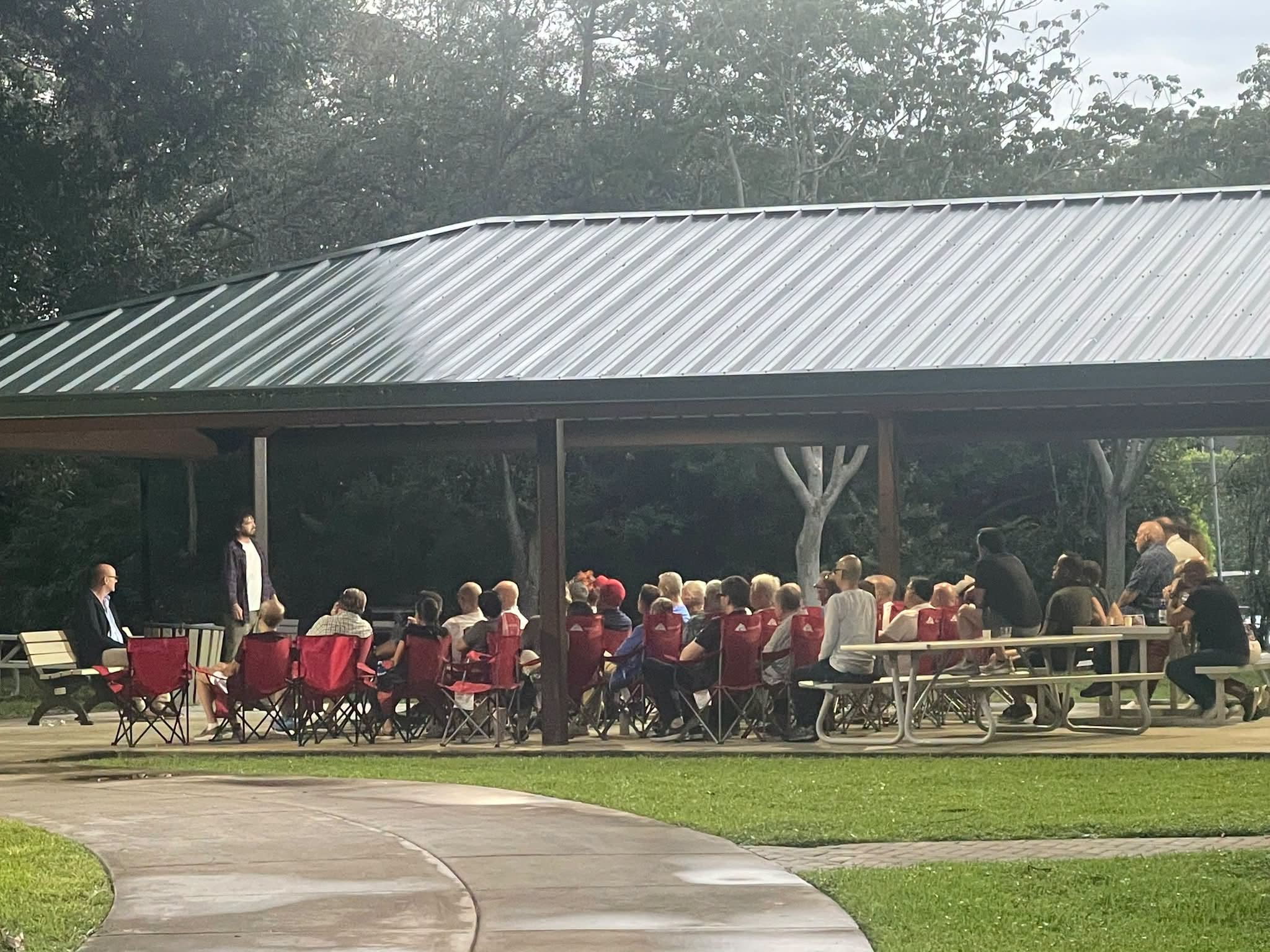
By obscuring the usual boundaries of the fourth wall, Linser seems to be using the play’s scenic architecture to echo that question, or maybe to suggest an answer. But from my perspective as an audience member, there was no clear point separating Peter and Jerry’s imaginary “onstage” park from the actual park around it— and if I tried asking the shrubbery, I expect it would have only shrugged.
Because of a signature twist that I won’t spoil, Zoo Story is by far the “flashier” piece of the two, but I was almost more compelled by Home/Life’s more down to earth version of failed intimacy, which, to most of us, is also the more familiar one. In other words, while most of us (probably) haven’t been drawn into a life altering encounter by a stranger in the park, many of us probably have struggled to feel fully “known” and adequately loved by the people closest to us, a scenario that Home/Life examines with quiet profundity. Plot wise, the segment covers a seemingly ordinary conversation between Peter, a textbook manufacturer, and his wife, Ann, which aptly dovetails back and forth between ordinary domestic dissatisfaction to something stranger and considerably more Albeeish.
For instance, in between expressing the expected grievances of someone who’s shared a long marriage with a partner whose biggest “flaw” seems to be his boring dependability, Ann fantasizes about cutting off her breasts, having an affair with no one in particular, and eating her entire family during an apocalypse. When she imagines the last scenario, Peter eventually joins in the fun, wondering, “And what will we do then… eat the girls?” referring to the couple’s two teenage daughters.
It’s one of the places that another major theme of At Home at the Zoo reveals itself in the animal nature and base instincts thinly concealed beneath our civilized human exteriors. This was also apparent in Ann’s description of the “orderly, predictable…. love-making” she shares with Peter as opposed to the impassioned “fucking” she desires from him,
The play eventually gives his restraint an almost too-tidy origin story that’s nevertheless fascinating in its visceral brutality, and which illustrates the risks of letting our animal sides fully off-leash.
Here, too, the staging gives the work a unique character- before we have the great outdoors to contend with in Act 2, Act 1 is staged inside Richardson Park’s Manor House, giving us the feeling of being “flies on the wall” observing Peter and Ann in their natural habitat, or maybe more like zoogoers peering into a cage.
The central tension of the piece is that only Ann seems to see that cage as a trap, while Peter seems largely content within his given enclosure— but her encouragement for him to embrace his bestial side is something that informs the much wilder Act 2 in a way that should be completely unexpected to first time viewers. Though the piece starts off a little slow and remains rather cerebral throughout, I was progressively drawn into the play as the ordinary domestic facade gave way to progressively stranger meanderings.
Perfectly suited to their respective roles, actors Elizabeth Price and Tom Wahl share a lovely, jovial chemistry and comfort with one another in their dialogue even as that dialogue exposes the emotional distance between them. Director Linser makes great use of the unusual space and compensates for some of the lack of conventional “action” with dynamic blocking throughout.
Playing the more impassioned Ann, Price was the first to win me over with her layered performance, her bold quirkiness and profound dissatisfaction gradually piercing through her thin “happy housewife” veneer. As one of relatively few women in the audience, I also noticed a few points in which my mother and I were more responsive to Ann’s jokes and asides than most
of the men in the audience, which ironically suggests that Albee— a gay man— managed to get at something surprisingly true to the female experience in his crafting of the character.
But the part of Home/Life that hit closest to home for me was one of the less gender-specific experiences Ann articulates— the experience of loving someone without feeling loved enough by them, and wondering if the problem lies with you, with them, or perhaps with all of the above. Wahl excels in making the unremarkable Peter dramatically interesting and implying a more complex interiority than his repressed surface indicates. Though Peter is a little less immediately fun or flashy of a part than his co-stars’ roles, his skill in handling the deceptively difficult demands of the character is essential to the play’s powerful payoff.
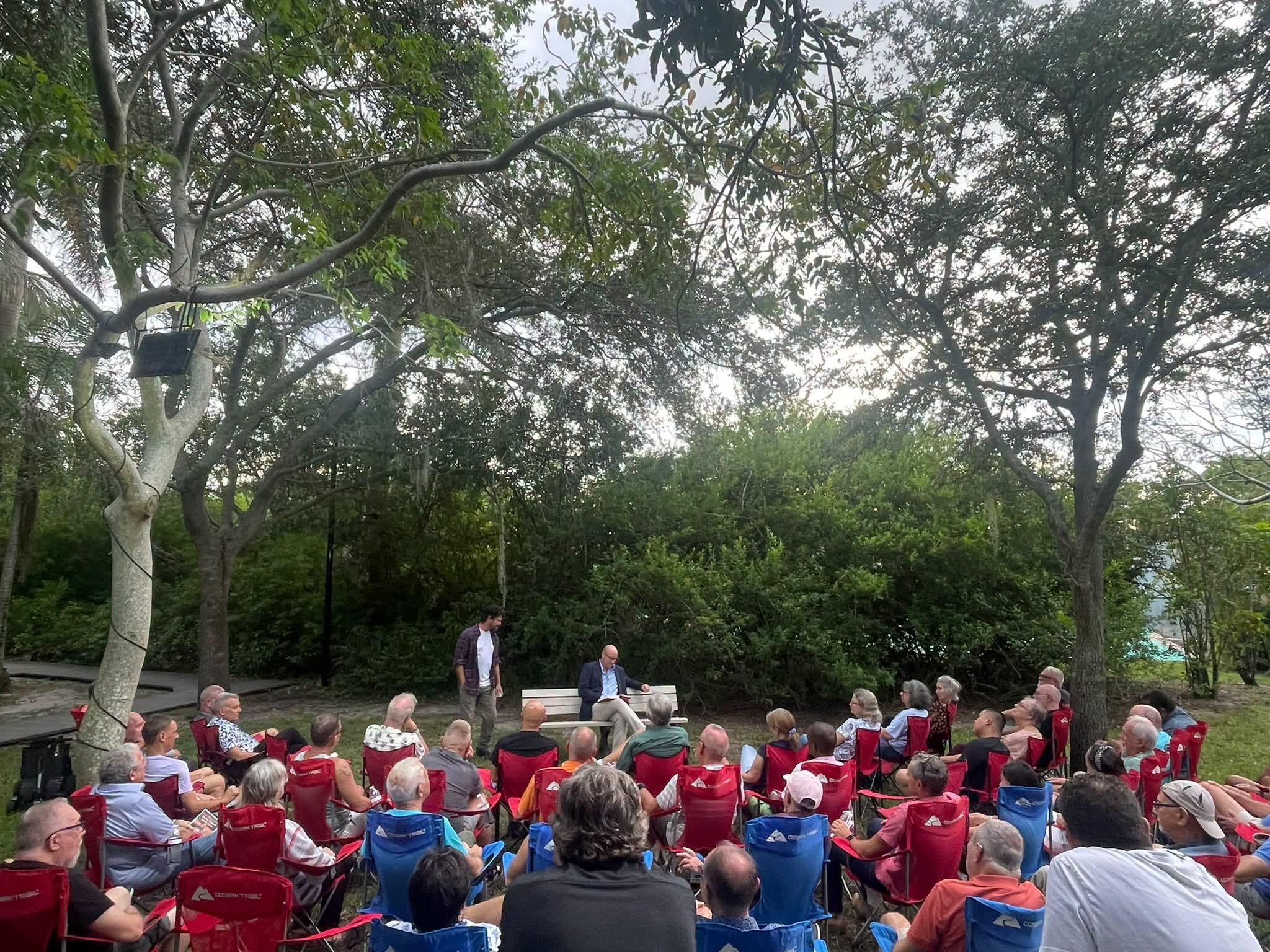
During intermission, audience members are guided out of the house and into the wild, towards a few rows of seats set up in front of the park bench that provokes the nominal “conflict” of Zoo Story. And speaking of flashier co-stars— as Jerry, Jordan Armstrong basically knocks his role out of the park from nearly the moment he appears in the park, emerging from behind a thicket of trees. When he appeared, after Wahl had already taken a seat on said bench, my mother wondered aloud if he was another actor or merely a lost audience member or random park-goer— I probably would have wondered too if I hadn’t recognized Armstrong from some other local plays, and I expect that the brief metaphysical confusion evoked by the moment is indeed part of the point.
For the rest of the act, more or less: Jerry tells Peter increasingly bizarre stories about his profound loneliness and failed attempts to connect with other beings— and I say “beings” rather than people because one of his sadder stories involves a strange emotional stalemate reached with a dog. And the interaction initially seems to itself be another failed attempt at connection, because all Peter wants is for Jerry to leave him alone. Compared to Act 1, Act 2 was intuitively more engaging by virtue of this immediately apparent conflict, and because it immediately poses a question that I’m still not entirely sure I could give a straight answer to: namely, what the F is Jerry’s deal?
Armstrong’s unhinged, electric energy is a theatrical delight, as is Wahl’s increasingly incensed responses to him. The staging of a climactic violent incident that I’m still trying to avoid spoiling any more specifically perhaps suffers somewhat in physical verisimilitude purely because it must be done in broad daylight— but for me, the trade-off became worth it in allowing us a kind of proximity to the action that made the play feel more dangerous and alive.
This sense was only enhanced with the arrival of a fourth actor dressed as a cop, discouraging any applause as he ushered us out of our seats and away from the “scene of the crime.” As much as I regret not being able to give Armstrong, Price, and Wahl the accolades they deserved in the moment, hopefully I’ve now atoned for that particular sin in recording a few of them for
posterity here, and it definitely was a much more effective theatrical choice for the moment than allowing a conventional ovation.
At Home at the Zoo’s startling ending already leaves much unanswered, which is par for the course once you’re in Albee territory, but this production’s staging almost poses a different question: between an “end of the show” that felt more like a rupture and an “edge of the stage” that was basically nonexistent, how do audience members know for sure when they’ve left the theatre?
Considering that I’m still contemplating the show and its questions now that I’ve been home from the zoo for a good while, I could almost make a case for the idea that I, personally, never did leave the theatre—which, along with being entirely on brand, is something I would call a very Albee-esque twist indeed.
Remaining performances are scheduled on Friday the 13th, Wednesday the 18th, Friday the 20th, and on two successive Sundays on November 22nd and 29th. Free tickets for the first two are already sold out, but you’re free to try your luck on the waiting list by signing up here, and tickets for performances Nov. 20th – Nov. 29th will be released Monday Nov. 16th at 10:00am.
Meanwhile, happy theatre- or should I say ZOO- going!