If you know only two things about Hamlet, they’re probably the famous line “To be or not to be” and the fact that, by the play’s end, most of its characters have landed firmly in the latter category. Even if you missed every prior performance of what many consider the greatest play ever written, it’s not exactly much of a spoiler to allude to the fact that a high body count is pretty much par for the course for Shakespearean tragedies— but in Hamlet, the focus on death is more than just incidental.
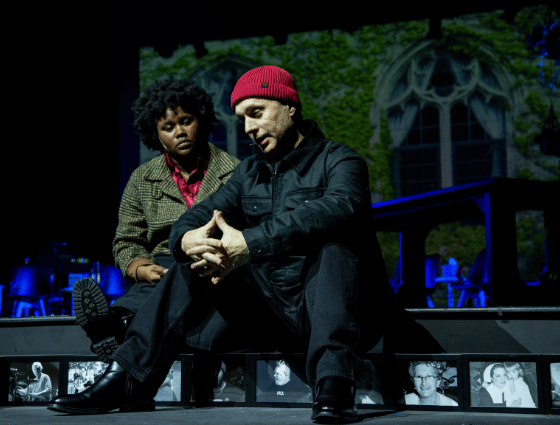
In this production’s program, director Nicole Stodard movingly describes how a devastating personal loss informed her interpretation of the play, which she ultimately chose to approach “as someone in mourning might.” Before we even enter the theatre, she sets the scene for her unique interpretation with posters advertising a “To Be or Not to Be” grief group, and then uses that famous soliloquy, traditionally placed much later in the play, as her starting point, one of several that she subtly changes the context of by reframing them as confessions Hamlet makes to his fellow mourners in grief group as opposed to himself or the audience as traditionally staged.
It’s a bold interpretive choice that starts the play off on an unusually intense foot and pays off throughout, leaving its core drama basically untouched but emphasizing the connection between Hamlet’s profound grief, his compulsive philosophizing, and the existential paralysis that makes it almost impossible for him to act on his desire to avenge his father’s death vs merely agonize over it.
Historically, the narrative stagnancy that results from this paralysis is something that has frustrated me about the play and character Hamlet in my prior exposures to the script, which I’ve read and studied in an academic context as well as seen at least two other full stagings of. Though I could intellectually appreciate the work and its place in Shakespeare’s canon, it isn’t a play that I intuitively “got” or found at all easy to connect to emotionally, finding that the tedious mechanisms of the plot and my exasperation with Hamlet as a central character made it hard for me to stay engaged in the story.
When I last reviewed an Orlando area production of the show in 2025, I found myself having to manufacture enthusiasm for what I could recognize as an artistically solid take on the piece despite how exhausting I’d found the play to actually sit through. So, especially since standard cuttings of the script seldom run less than around three hours, I can’t say I was particularly enthused about the prospect of encountering Hamlet again so soon going into this one.
But after missing the entirety of Thinking Cap Theatre’s 2025-2026 season while splitting time between cities, I was excited to check back in with the company, which I admire for dependably producing ambitious work thought-provoking to live up to its cheeky name. In this regard, their current production of Hamlet is no exception— and engaging enough that I’m ultimately quite glad I chose “to be” at this one instead of ghosting this sometimes-exasperating tragedy ahead of a spectacular second date.
In other words, Stodard’s take didn’t resolve every issue I have with Hamlet, but it was easily the most engaging version I’ve seen of the play so far- and by far the most affecting. To realize her vision, Stodard wisely entrusts the show’s leading roles to accomplished local veterans while assembling an equally talented ensemble of more up-and-coming performers to take on the less pivotal roles.
Though, come to think of it, thanks to pragmatic double, triple, and even quadruple casting for the actors assigned to multi-role tracks, even the performers playing “smaller” parts are clearly making essential contributions here. For example, Manda Gonzalez blends seamlessly into the ensemble when stepping into a few minor roles— in addition to being credited with stage managing the entire production!
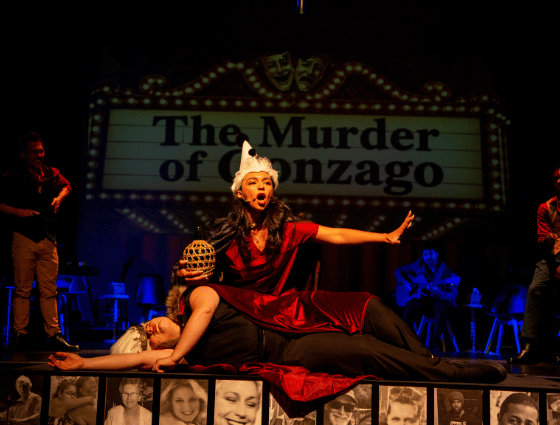
But onstage, Gonzalez perhaps makes her biggest impact as soldier Bernardo, joining Ana Marie Calise as Marcellus for a spirited, energetic scene in which the two seem to share a natural chemistry with one another as well as with Breanna Michel’s Horatio. Along with their hilariously vivid reactions, the use of projections and creative sound effects makes this scene, in which the spooked guards inform Horatio that the ghost of Hamlet’s father has been prowling the castle grounds, feel like a theatrically distinctive creation that really sets this show apart.
The appearance of the actual Ghost lives up to the high expectations set in this scene between Jonathan L. Palmer’s booming voice and authoritative presence in the role and ingenious costuming that makes him look positively otherworldly. The multi-talented Palmer also gets to showcase his singing skills as Gravedigger 2, joining Peter Wayne Galman (who plays Gravedigger 1 in addition to Polonius) in a haunting hymn that his lovely, deep voice gives a particular gravity.
That same voice and distinctive physicality becomes a source of comedy when he takes on the role of “player queen” in Hamlet’s play within a play, opposite Calise who hams it up wonderfully as the “player king.” Whether or not this was intended as some kind of meta-commentary on the cross-gender casting present in Hamlet proper or just some throwaway silliness, it definitely succeeds in being good fun.
Here, after all, the fact that the female Michel plays the male Horatio seems almost unremarkable when taking inventory of the production’s oddities, and her grounded, only-sane-man vibes in the role and brotherly energy towards Hamlet made the performer’s gender a non-issue.

Working our way backwards through the cast list, we’ll next find Christopher Ross-Dybash and Logan Green as Rosencrantz and Guildenstern, offering more comic relief as the goofy set of Hamlet’s old “friends” who, in this production, came off more like a gay couple between their attached-at-the-hip-blocking and the actors’ recognizably queer-coded mannerisms.
Aside from demonstrating his range as the rougher-hewn gravedigger, the aforementioned Galman proves a brilliant physical comedian as the doddering Polonius, and Sergio Tamayo is fiery and combative as his on-stage son Laertes. Joined by Green, the two actors also get some great moments as part of a three man team credited with providing “live foley sound” during the production to playfully enhance the show’s sonic landscape.
Meanwhile, though Ophelia— daughter to Polonius and sister to Laertes—is typically conceived of as a teenager and generally played by actresses in their teens or twenties, she becomes a much different character as played by Autumn Kioti Horne, an actress who reads as being (and presumably, is) in more like her late thirties or forties.

One possible rationale for her casting is that in this production, the actor playing Hamlet (Seth Trucks) is also more mature than the character is traditionally interpreted and reads as being in a similar age range, and the idea of making the two contemporaries seemed more palatable than introducing a potentially skeevy age difference into a play that’s already a psychological minefield.
Given that both gave excellent performances, maybe they were simply the two best actors to present themselves as contenders for their respective roles— but between youthful styling and affectations that helped obscure Trucks’ age and the fact that there’s already canonical evidence for the character being as old as thirty vs potentially prepubescent, the divergence from convention was somewhat less noticeable in his case than in Horne’s. Even then, I wasn’t really bothered by the discrepancy so much as psychologically intrigued by it and what it meant for her relationships with Polonius, Laertes, and even Hamlet.
After all, behavior that might have seemed earnestly protective if exhibited by a father or brother towards a naive teen becomes much more oppressive and controlling when used against a woman who should have every right to sexual and romantic agency. Do Hamlet’s attentions now become a kind of last hope for Ophelia to escape her social and emotional dependency on her family? Or, even more intriguingly— might whatever psychological conditions led to her initial “failure to launch” be some of the same that manifest in her later descent into total madness?
I’m not confident enough in this last interpretation to suggest that it was necessarily the takeaway Stodard intended— but when this Ophelia starts losing her marbles, the “flowers” she references in her strange childish songs are actually bottles of prescription pills. Horne does a superb job at conveying this descent in a way that makes her feel like a more unhinged version of the former Ophelia rather than a different character altogether, and allowing the unfilteredness that at first seems almost playful to ultimately become truly unsettling.
Carey Brianna Hart is poised and expressive as Queen Gertrude, giving her scenes with Hamlet a grounded maternal energy. Her Claudius is Daniel Llaca, an actor who apparently stepped into the part as a replacement only ten days before the show’s first preview— something I never would have guessed from his confident performance alone!
In a reversal of the situation I described earlier with Horne and Trucks, he’s actually much younger than most actors conventionally cast in the part, and so much so that he reads as younger than Trucks. Llaca’s handsome Claudius is more “smooth social climber” than ruthless usurper or cartoon villain, and the vibe works perfectly for the character. Narratively, their respective ages also make Hamlet’s visceral disgust at the prospect of Claudius’s marriage to his mother and resentment of his stepfather’s sudden authority somewhat more understandable.