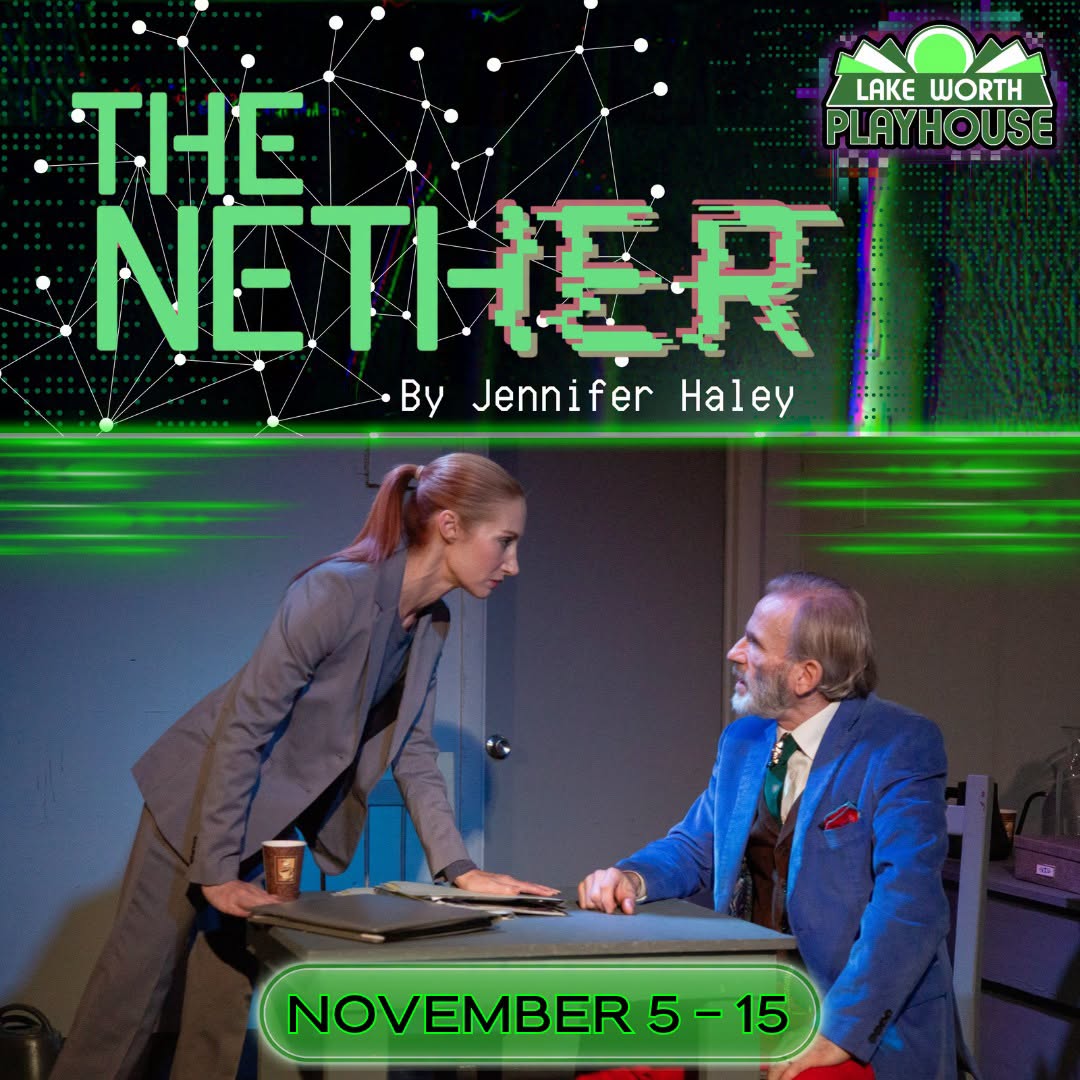
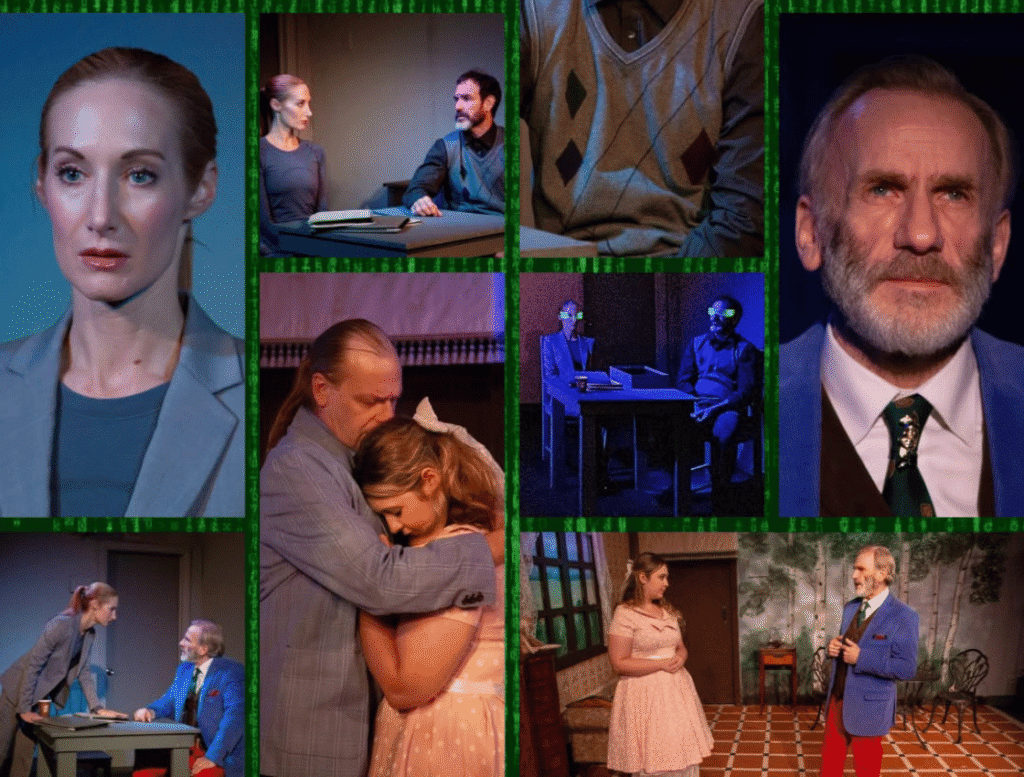
When I first read about Jennifer Haley’s play The Nether a few years back, I was immediately intrigued by the bold premise and made a note that I’d like to see it whenever I got the chance, so I was particularly excited to see the play show up as part of the Lake Worth Playhouse’s Black Box series this season. A 2013 play that explores what virtual reality means for morality, it’s a piece I think I responded to much differently today than I would have even a few years ago. In other words, back then, maybe I would’ve taken some of the questions it poses as merely speculative ones. But given how much artificial intelligence has evolved and infiltrated our daily lives in the meantime? The chilling piece and the unsettling questions it raises felt much more urgent to me, like a prescient cautionary tale that’s all too appropriate for the AI age.
Having caught the opening night of the play last Thursday, I was hoping to have this review done earlier this week rather than just under the wire ahead of its second and last weekend. Briefly, I even considered pulling an all-nighter to get it done ahead of the rest of the first weekend, only to find in The Nether a piece that clearly deserved more than a single night’s contemplation. Then, when I continued my theatrical weekend by attending a production of Hamlet I also had plans to cover, I decided to tackle the latter play first because The Nether gave me so much moral and intellectual complexity to unpack that the notoriously opaque Shakespeare play actually seemed comparatively straightforward!
In retrospect, though, the degree of thematic overlap between the two plays revealed a surprising amount of thematic coherence in my bizarre little double feature. You see: in Hamlet, a metatheatrical play within a play asks how much illusion has the power to reveal about reality. And, centering on the idea of a three-dimensional virtual world that its characters can physically inhabit, The Nether seems to be asking the same thing along with several even more unsettling questions.
For instance: if something would clearly be wrong if done to a real person in the real world, is it still wrong if done to a lifelike avatar in the virtual world? Fundamentally, that’s the issue that central characters Morris and Sims have almost opposite perspectives on. And as Morris, a government agent responsible for overseeing that virtual world— called “the nether”, hence the play’s title— investigates Sims for crimes committed in a secret online realm called The Hideaway, the play allows them to explore their respective positions in considerable depth.